

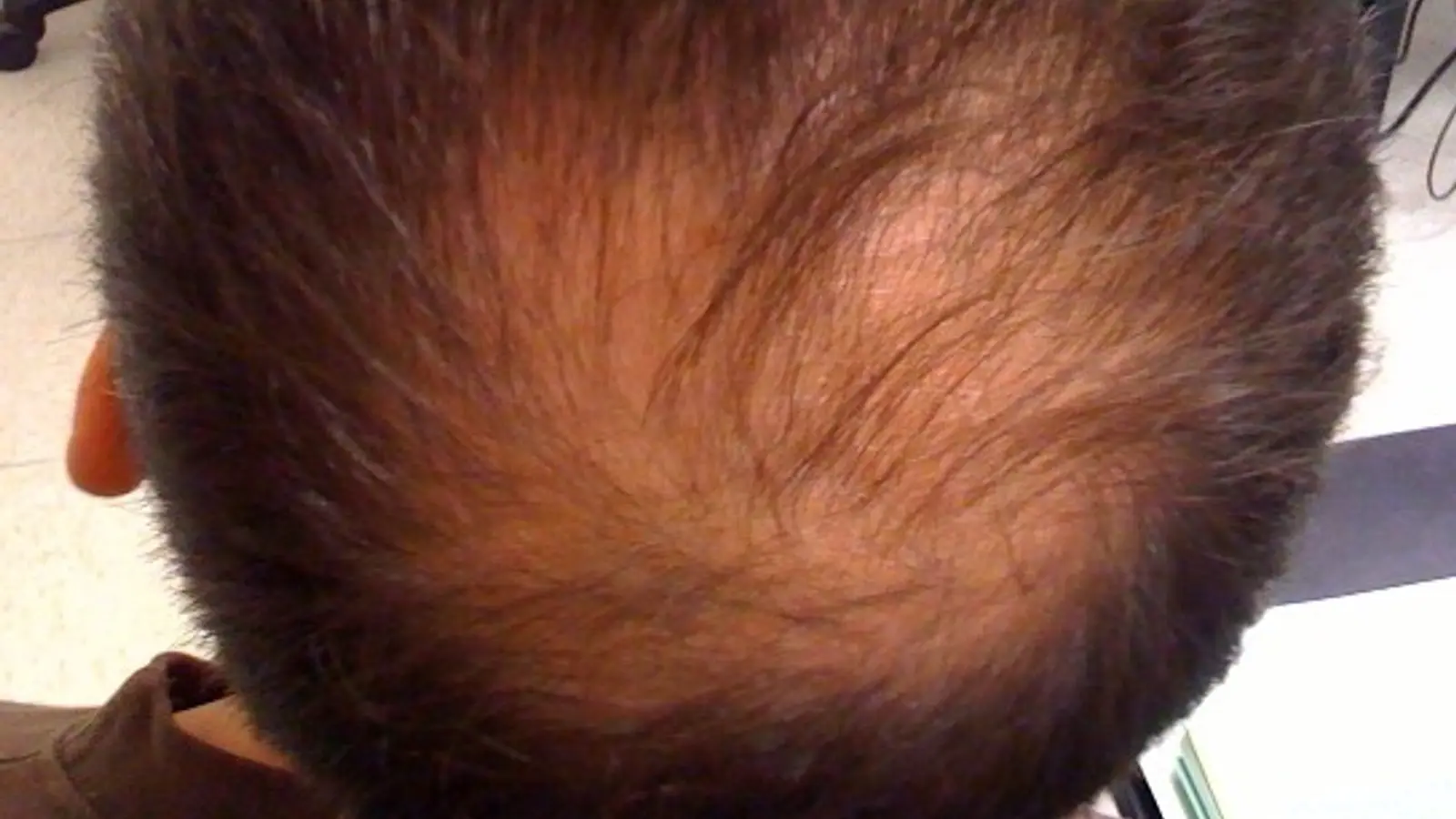
In brief
- Shedding 50–100 hairs a day is normal12, and it usually goes unnoticed because new hair grows at the same time.
- Hair loss has several main types — diffuse (usually temporary), patterned (hereditary hair loss), focal and scarring — and each has a different treatment3.
- Minoxidil is a treatment with strong evidence, and for men so are 5-alpha reductase inhibitors; PRP, light therapy and microneedling are added on as a boost to the core treatment456.
- Results are assessed after 6–12 months, and maintenance treatment preserves them over time74.
- An accurate diagnosis is the foundation: trichoscopy and sometimes blood tests, before choosing a treatment38.
- Earlier is better: every follicle that is still alive is a follicle that can be strengthened.
Running your hand through your hair and feeling that something has changed? Maybe more hairs on the pillow, maybe your scalp showing under the elevator lights, maybe a ponytail that has become thinner. You are in good company: in a population study in Australia, 73.5% of men and 57% of women aged 80 and over showed hereditary-pattern thinning9. The good news is that today there is a lot that can be done, especially when you start early.
Hair loss is not one disease, so there is no single treatment. The diagnosis determines the path. A treatment that works very well for hereditary hair loss will not help iron deficiency, and iron treatment will not stop hereditary hair loss. When you feel that "nothing works," the treatment often did not match the diagnosis. That is why every plan starts with one question: what exactly is causing your hair loss? This guide helps you understand the types, the signs and the options, and points you to a detailed page on each of them.
Not sure which type of hair loss you have? You can start with a short hair loss questionnaire: 12 questions in about 2 minutes, ending with an initial impression and the next step, before an examination.
Normal Shedding or Hair Loss: How Do You Tell the Difference?
Shedding 50 to 100 hairs a day is considered normal, and it usually goes unnoticed because new hair grows at the same time1. Hair goes through a life cycle of growth, rest and shedding, and each hair is at a different stage at any given moment2. (A short explanation of the hair cycle and the other terms on this page is in the glossary of hair medicine terms.) The problem begins when shedding rises well beyond that, when it persists over time, or when you see the result: a widening part, more scalp visible through the hair, or bald patches. A detailed explanation, including shedding on hair-washing days and seasonal shedding, is on the page how many hairs fall out a day.
Hair has seasons too. In a Swiss study that followed 823 healthy women over six years, the proportion of hairs in the resting phase was highest in summer and lowest at the end of winter10. This explains why many people notice more hair in their brush at the end of summer and in the fall. Seasonal shedding passes on its own; if it lasts more than three months, or if visible thinning appears, that is a sign to get checked.
It is hard to measure at home how many hairs are really falling out, so doctors use tests such as the pull test to assess it objectively (see hair loss diagnosis). A subjective sense of "more hair in the brush" does not always reflect abnormal shedding, and sometimes real hair loss goes unnoticed until it is already significant.
In one sentence: shedding is hair that falls out and is replaced; balding is a follicle that has stopped producing. The difference between them determines the treatment. The 50-to-100-hair rule is a starting point, not a diagnosis: what really matters is the change in you. Sometimes hair loss is also the first sign of iron deficiency, a thyroid problem or another condition in the body, one more reason not to guess on your own.
There is also a difference between "shedding" and "thinning." Shedding is the number of hairs leaving the head; thinning is the cumulative result you can see — more visible scalp, a smaller ponytail diameter, or a wider part. You can experience gradual thinning without noticing much more hair on the pillow or in the brush, because the process is slow and spread over months and years. This is why self-assessment of "how much is falling out" is less accurate than a structured examination.
What Types of Hair Loss Are There?
There are four main patterns of hair loss, and each has a completely different cause and treatment3. Non-scarring hair loss is divided into three types: diffuse (general shedding across the whole scalp, usually temporary), patterned (hereditary hair loss, progressing gradually) and focal (well-defined bald patches). Scarring hair loss destroys the follicle permanently. Alongside these there is also hair loss from external causes, such as traction, heat and chemical treatments.

- Diffuse hair loss — telogen effluvium. General shedding that usually appears 2 to 4 months after a major stress on the body, such as an illness with fever, childbirth, sharp weight loss or stress, and in most cases resolves on its own2. Full details on the telogen effluvium page, and hair loss that begins a few months after giving birth has its own page on postpartum hair loss. How to tell it apart from hereditary hair loss: telogen or hereditary hair loss.
- Patterned hair loss — hereditary hair loss (androgenetic alopecia). The most common cause of hair loss overall, in both men and women411. In men it appears as a receding hairline at the temples and a thinning crown (see male pattern hair loss), and in women mainly as a widening part and a thinner ponytail, without complete baldness (see female pattern hair loss).
- Focal hair loss — alopecia areata. An autoimmune disease that causes round, smooth bald patches, usually with no other change in the skin. It has a dedicated page: alopecia areata.
- Scarring hair loss — for example lichen planopilaris and FFA. Inflammatory diseases that destroy the follicle permanently, so early diagnosis and treatment are especially important. Details on the lichen planopilaris page.
- External causes. Tight ponytails and braids (traction alopecia), hair straightening treatments and high heat, which mainly cause hair breakage, and hair pulling. When the cause is identified in time and stopped, the hair comes back in most cases12.
Sometimes several types occur at the same time in the same person, for example hereditary hair loss with telogen effluvium on top of it — another reason why diagnosis matters before deciding on treatment. If you feel your hair has simply become thin, without a clear bald patch, you will find the possible causes on the thinning hair page. Irregular bald patches with broken hairs of different lengths may be caused by hair pulling.
Another important difference to keep in mind: the non-scarring types (diffuse, patterned, focal) keep the follicle itself in place, even if it is temporarily "silenced," so they have potential for recovery or response to treatment. The scarring types destroy the follicle permanently, so hair lost in a scarred area does not come back — which makes their early diagnosis especially critical. This difference, more than anything else, determines how urgent the evaluation is.
Why is the difference so important? It all depends on which part of the follicle is damaged. In the upper part of the follicle, in an area called the "bulge," are the stem cells from which the follicle regenerates in each cycle. In non-scarring hair loss the damage is mainly at the base of the follicle, and the bulge remains intact, so the follicle can wake up and produce a new hair. In scarring hair loss the inflammation damages the bulge and the stem cells, and scar tissue forms in their place13. You can read more about the structure of the follicle on the hair follicle page.

How do you recognize signs of scarring hair loss?
- Non-scarring hair loss, usually: a smooth, clean scalp, no pain, gradual thinning or round bald patches with a clear border.
- Suspected scarring hair loss: itching, burning or tenderness; redness and scaling around the base of the hairs; smooth, shiny skin without follicle openings; an area that keeps expanding with irregular edges; loss of eyebrows or a receding front hairline14.
With any of the signs in the second list, it is worth getting checked early: here every month counts, and early diagnosis preserves hair.
How Do You Know Whether Hair Loss Is Temporary or Permanent?
Several signs help tell them apart, but the final diagnosis is made by examination. Temporary hair loss tends to be diffuse across the whole scalp, to start after an identifiable event and to settle within months. Permanent hair loss, such as hereditary hair loss, progresses slowly in a typical pattern (temples and crown in men, a widening part in women), and does not "start" on a particular day but accumulates gradually.
| Temporary shedding (telogen) | Hereditary hair loss | |
|---|---|---|
| Pace | Sudden, noticeable within weeks | Gradual, over months and years |
| Where | Diffuse across the whole scalp | Temples and crown, or a widening part |
| Cause | An identifiable event about two to four months earlier: illness, childbirth, dieting, stress2 | Family tendency, with no particular event11 |
| The hairs | Whole hairs fall out, with a small white bulb at the end2 | The hairs become thinner and shorter even before they fall out11 |
| What to do | Treat the cause, and the hair comes back | Start treatment early and preserve the follicles |
A useful rule of thumb: today's shedding tells you what happened about three months ago. In temporary hair loss there is a gap of two to four months between the event and the shedding2, so it is worth looking back at the calendar: an illness with fever, surgery, COVID-19, a crash diet, a new medication or a particularly stressful period. If there was such an event, there is a good chance the hair will come back. If not, and especially if the thinning is progressing slowly, it is worth checking for a hereditary tendency.
Hereditary or thyroid? Hereditary hair loss follows a pattern: temples and crown in men, a widening part in women. Thyroid-related hair loss is more diffuse, and sometimes comes with fatigue, dry skin, weight change or sensitivity to cold (see hair loss and the thyroid).
Four questions that help point toward the diagnosis:
| Question | What it may suggest |
|---|---|
| Pace: gradual over years, or sudden within weeks? | Gradual fits hereditary hair loss better; sudden fits telogen effluvium or alopecia areata |
| Pattern: diffuse across the whole head, or in a defined area? | Diffuse fits telogen effluvium or female thinning; a defined bald patch fits alopecia areata, traction or scarring hair loss |
| Scalp: smooth and clean, or red and scaly? | A normal scalp fits most non-scarring types; redness and scaling around the hairs call for a prompt examination14 |
| Sensation: quiet, or itching, burning and pain? | Quiet shedding allows an orderly evaluation; hair loss with itching, burning or pain means you should not wait14 |
For example: a 35-year-old man with gradual thinning at the crown, no pain and a smooth scalp fits the picture of male pattern hair loss very well. The table helps you understand the direction, but the diagnosis itself is made by examination.
The main tool for telling them apart is trichoscopy — a magnified examination of the scalp and hair that shows differences invisible to the naked eye: uneven hair thickness, many vellus hairs and yellow dots are typical of hereditary hair loss, whereas in telogen effluvium the picture is relatively normal, because it is mainly a diagnosis of exclusion15. Sometimes this is combined with a pull test and targeted blood tests162.
What Is the Body Missing When There Is Hair Loss?
Iron deficiency, vitamin D deficiency and abnormal thyroid function are linked to hair loss, but the link is mainly statistical and not always causal. A meta-analysis of more than 10,000 women found lower ferritin levels in women with non-scarring hair loss compared with women without hair loss17. Similarly, vitamin D deficiency is more common in people with hair loss, across all the types studied18.
It is important to beware of over-interpretation: finding a link between a low level and hair loss does not prove that the deficiency is the cause, and in people without a documented deficiency there is insufficient evidence that iron, biotin, amino acid or caffeine supplements improve hereditary hair loss4. So the medical logic is to first check whether there is a real deficiency, and correct it if needed, rather than starting supplements "just in case."
Hair Loss in the Eyebrows, Beard or Other Areas — What Does It Mean?
Hair loss outside the scalp can be a sign of the same conditions that cause hair loss on the head, and sometimes it is the first sign to appear. Eyebrow loss, for example, can precede hairline changes in a certain type of scarring hair loss (see lichen planopilaris), and bald patches in the beard can be a manifestation of alopecia areata (see alopecia areata). General body hair loss, alongside scalp hair loss, fits the picture of diffuse hair loss of the telogen effluvium type better.
The practical conclusion: if you notice hair loss in areas other than the scalp as well, mention it during the evaluation, because this information helps narrow down the possible diagnoses.
How Is the Cause of Hair Loss Diagnosed?
An accurate diagnosis is the foundation for choosing treatment, because each type of hair loss has a different treatment. The evaluation includes a conversation about the timing of the hair loss, underlying conditions and medications, a clinical examination and in most cases trichoscopy — a magnified examination of the scalp that is now considered a basic part of every hair loss evaluation819. Blood tests and sometimes a biopsy are added when there is a specific suspicion.
The full details, including what trichoscopy shows in each type of hair loss and when a biopsy is needed, are on the hair loss diagnosis page.
Every evaluation also checks the health of the scalp itself (full guide: all scalp topics). Dandruff, seborrheic dermatitis, fungal infection or inflammation around the follicles can accompany hair loss and make growth harder. When they are identified, they are treated right at the first stage, so that the scalp is ready for hair treatment.
We don't guess, we measure. Photographing the scalp at the same angle and in the same lighting, and repeat trichoscopy at follow-up visits, let you see the change with your own eyes and not just feel it.
It is good to know in advance that diagnosis does not always end in one visit. In simple cases, a conversation and a clinical examination with trichoscopy are enough. In more complex cases — for example when a combination of several types of hair loss is suspected, or when the hormonal picture is unclear — the evaluation may extend over several visits, with blood test results coming in meanwhile and the pattern followed over time.
Which Treatments Have Been Proven Effective?
Topical minoxidil is a treatment with broad, consistent evidence, for both men and women. In men, 5-alpha reductase inhibitors (finasteride, dutasteride), which require a prescription, are added to it. Other methods — PRP, low-level light, microneedling and hair transplant — are considered complementary, with varying levels of evidence. The table summarizes in plain language:
| Treatment | Who it suits | Level of evidence in brief |
|---|---|---|
| Topical minoxidil | Men and women, hereditary hair loss | Strong evidence, first line in guidelines420 |
| 5-alpha reductase inhibitors (finasteride, dutasteride) | Mainly men; for women — off-label and debated | Good evidence in men; there are safety warnings you should know about212223 |
| Low-dose oral minoxidil | Men and women, off-label use | Growing body of evidence, international consensus on judicious use2425 |
| PRP (platelet-rich plasma) | A possible add-on, not a replacement | Low-quality evidence, no standard protocol626 → PRP for hair |
| Low-level light | A possible add-on | Supporting evidence in hereditary hair loss, less known in other conditions2728 → scalp phototherapy |
| Microneedling | Usually combined with minoxidil | Improves results together with minoxidil, evidence with high heterogeneity29 |
| Hair transplant | Advanced hereditary hair loss | A proven, effective surgical treatment11 → hair transplant |
Keep in mind: every drug treatment also has possible side effects, which are detailed on the dedicated pages (male pattern hair loss, female pattern hair loss), and choosing a treatment is always a balance of effectiveness, safety and personal preference. Other methods, such as scalp mesotherapy, are mentioned in guidelines but with more limited evidence → scalp mesotherapy.
Our approach: first of all, save and strengthen your natural hair. A transplant only moves hair from an area that has plenty to an area that lacks it, and the supply of donor hair is limited. So every hair preserved through medical treatment is an asset, and a transplant is considered when medical treatment alone is not enough for the coverage you want.
Step by Step: Stop, Regrow and Maintain
In hereditary hair loss, the plan has two stages: first stop the shedding, then encourage the growth of new, stronger hair. It helps to think of it as three pillars that together carry the result: blocking the hormone that shrinks the follicle, stimulating the growth phase, and regenerative strengthening of the follicle from within. Each pillar contributes something different, so a suitable combination usually works better than a single treatment4.

Don't wait for "the miracle drug five years from now." Today's treatments already stop shedding and restore thickness, and those who start now preserve more hair for the future. And the advantages of non-surgical treatments are clear: you return to your routine the same day, no surgery and no scars, with a plan stepped up as needed.
The regenerative treatments at the clinic, in brief:
- PRP for hair — a platelet concentrate from your own blood, injected into the scalp, where it releases growth factors.
- iPRF and CGF — concentrates from your own blood, without anticoagulant, whose fibrin network holds the growth factors at the injection site.
- Stem cells - Regenera Activa — micrografts from tiny scalp biopsies, broken down into a suspension rich in progenitor cells and injected into the thinning area.
- Nanofat for hair — processed fat from your own body, injected to support the follicles.
- Scalp mesotherapy, including polynucleotides (PDRN, salmon DNA) and exosomes.
- Tricopat — a device-based treatment that combines superficial micro-incisions, a growth-factor serum and delivery with a weak electrical current.
Four things determine your plan: the diagnosis (each type is treated differently), the stage and rate of progression (rapid progression requires stabilization first), how many active follicles are still left, and your expectations and lifestyle.
The right treatment depends on the stage. The earlier you start, the more active follicles there are to work with, and the path is shorter and simpler:

How to choose between the paths, and when a transplant is considered, is explained on the page hair restoration or hair transplant.
A few principles help you choose between the options. First, the treatment must match the diagnosed type of hair loss — minoxidil and finasteride are intended for hereditary hair loss, not for temporary or scarring hair loss. Second, in most cases the effective approach is a combination of treatments rather than a single one: minoxidil with finasteride in men, or minoxidil with an anti-androgen in women for whom it is suitable. Third, complementary treatments such as PRP, light or microneedling are mainly suited as an add-on on top of the core treatment, and less as a replacement for it — their evidence is still considered weak to moderate compared with minoxidil and finasteride.
Do Vitamins and Supplements Help?
When there is no documented deficiency, there is insufficient evidence that supplements improve hereditary hair loss. The German-European guideline explicitly states that there is insufficient evidence that amino acids, biotin, iron (without deficiency), caffeine or mesotherapy improve hereditary hair loss4. This does not mean nutrition is unimportant — only that an extra capsule without a diagnosed deficiency is not expected to stop hereditary hair loss.
The recommended approach: first check whether there really is a deficiency (in iron, vitamin D, or thyroid function), and only then correct it in a targeted way, alongside the specific treatment that suits the type of hair loss.
It is also important to beware of the opposite direction: taking high-dose supplements without a real need is mainly a waste of money, not a proven way to speed recovery. The simple rule that emerges from the guidelines: supplements yes, but after a test shows they are really needed, not "just in case"4.
How Long Until You See Results, and What Happens When You Stop?
Most drug treatments for hair loss require at least six to twelve months of continuous use before you can judge whether they are working. The European guideline states that response is assessed after six months, and sometimes only after twelve4. This is one of the main reasons people stop treatment too early and mistakenly conclude that it "didn't work."
Hair grows about one centimeter (under half an inch) a month30, like watching grass grow: the change comes, but gradually, so success is measured in months, not weeks. And it is worth remembering the right definition of success: if the same number of hairs is counted at the start and the end of the year, that is already a win over a process that would have continued without treatment, and every additional hair is a bonus. Details on what to expect at each stage on the page when you see results from hair loss treatment.
Treating hair loss is like caring for your teeth. For some people brushing once a day is enough, and others also need floss and mouthwash. Follicle sensitivity also varies from person to person, so a personal combination is tailored and maintained over time.
Just as important: when you stop a treatment that worked, the effect gradually disappears. According to the American Academy of Dermatology, hair loss gradually returns within three to four months of stopping treatment7. In other words, today's effective treatments are maintenance treatments, not a one-time cure.
Do Weight-Loss Medications Cause Hair Loss?
There is a reported link between GLP-1 receptor agonist medications (for example semaglutide) and hair loss, but the mechanism is not yet clear. A meta-analysis of nine studies found about a threefold higher risk of hair loss among users of these medications compared with placebo, and the reported rate of hair loss was almost 4%31. It is unclear whether the effect stems from the drug itself or from the rapid weight loss, which is in itself a known trigger for diffuse hair loss.
In practical terms, this is a form of telogen effluvium — hair loss that usually passes. More details on the telogen effluvium page.
The key point if you are taking such a medication: there is no need to "panic" and stop an important treatment for weight loss or diabetes control because of hair loss; instead, report it to your treating doctor and weigh the overall benefits and risks together. Since this is usually telogen effluvium, there is a reasonable chance the shedding will settle even without stopping the medication, especially as the rate of weight loss stabilizes.
How Does Hair Loss Affect Mood, and Why Does It Matter?
Moderate to severe hair loss is associated with higher levels of anxiety and depression, and with reduced quality of life. A review published in a family medicine journal notes that people with significant hair loss experience more psychological distress, lower body image and sometimes impaired functioning at work3. The German-European guideline also treats impaired quality of life as an integral part of assessing the patient4.
Hair loss affects confidence on a date, at a job interview and in photos, and that is exactly the reason to treat it seriously and early. It is not "just" a cosmetic problem. A clear explanation of what to expect, the treatment options and realistic results helps patients feel that their problem is being taken seriously, not just their hair.
It is also important to remember that the relationship between the severity of hair loss and psychological distress is not always direct: some people cope well even with significant hair loss, while others experience great distress even from relatively mild hair loss. Both patterns are legitimate, and appropriate medical care takes into account each patient's subjective experience, not just objective measures such as the extent of hair loss.
Doctor or Trichologist: Whom Should You See?
A doctor, especially a dermatologist, is the one who can diagnose the cause, rule out scarring or hormonal hair loss, and prescribe medication if needed. The British National Health Service (NHS) recommends having the cause of hair loss evaluated by a doctor before turning to hair institutes or commercial clinics1. This does not rule out hair care and trichological advice as part of the picture (the differences are detailed on the page trichologist or doctor) — it recommends starting with a medical diagnosis, so as not to miss a condition that requires drug treatment or follow-up, such as scarring hair loss or a hormonal problem.
The practical reason: only a doctor can prescribe prescription drugs such as finasteride or dutasteride, perform a biopsy when needed, and identify an internal disease that shows up as hair loss — such as a thyroid problem or an autoimmune disease. Hair care advice, on the other hand, can be a suitable add-on once the medical diagnosis is clear, for example in choosing a hair care routine that supports the existing hair.

When Should You Book an Appointment, and When Should You Not Wait at All?
Hair loss lasting more than three months, thinning in a defined area, or a family history of balding — this is the time for a diagnosis. The earlier you start, the more hair there is to preserve and the more follicles can be reactivated. It is worth booking an appointment this week if you have any of the following:
- New bald patches that appeared within weeks, on the scalp or in the beard (see alopecia areata).
- Itching, burning, pain or redness of the scalp alongside the hair loss, or scaling around the hairs14.
- A receding front hairline in a woman, or sudden loss of the eyebrows (lichen planopilaris and FFA).
- Thinning under age 25 with a family history, because this is exactly the stage at which treatment preserves more hair.
- Broken hairs of different lengths without a clear explanation.
- Postpartum hair loss that has not settled after a year (postpartum hair loss).
The simple rule: hair loss with redness, itching or pain — come in quickly. Quiet hair loss — there is time for an orderly evaluation, but it is best not to put it off.
What Can You Do Even Before the Examination?
You don't need to wait for the examination to start approaching the issue correctly — but there is also no point in starting random treatments without a diagnosis. While you wait for your appointment, it is worth paying attention and keeping notes: roughly when the hair loss began, whether it was preceded by an identifiable event (illness, childbirth, weight loss, a new medication), and whether there is similar hair loss in the family. Information like this significantly shortens the evaluation with the doctor.
First steps you can start today: give up tight ponytails and tight braids, comb with a wide-tooth comb, pat dry gently with a towel without rubbing, treat dandruff or itching if present, and make sure your diet includes enough protein. And if you have old photos on your phone from a year or two ago, compare them with a current photo taken at the same angle; this helps a great deal at the examination.
The internet is full of "miracle solutions." Quite a few products are presented as an instant fix, and most of them have not been tested in research. And because hair loss sometimes tends to settle and recur on its own, it is easy to get confused and think a product worked. The smart way is the reverse: first an accurate diagnosis, then treatment backed by evidence. And one more small tip: clean hair looks fuller, because oily hair clings to the scalp and makes thinning more visible.
What is worth avoiding: buying a line of "anti-hair-loss" products without a diagnosis, especially expensive products marketed as a quick fix — as we have seen, even proven treatments take months before results can be assessed, and a treatment that does not suit the type of hair loss will not help, however expensive it is. Until the examination, gentle hair care (without traction or excessive heat) and a balanced diet are reasonable steps that do no harm in any case.
Do Frequent Washing, Hair Dye or Hairstyles Cause Hair Loss?
Washing, even daily, does not cause balding: the hairs washed out during shampooing were already in the shedding phase. A hair in the resting phase detaches anyway, and the water and shampoo only collect it, which is why you see more hair in the drain on washing days (see how many hairs fall out a day). In a study comparing washing frequencies, daily washing caused no measurable damage to the hair or scalp compared with washing once a week. The study was funded by a hair products manufacturer and conducted only in an Asian population, so it should be interpreted with caution32.
What does cause damage are habits that weaken the hair shaft itself: frequent high heat, frequent coloring and straightening, rubbing with a towel and vigorous combing of wet hair33. These cause hair breakage, which looks like thinning but is not hair loss from the root. Masks, oils and conditioners act on the shaft, not on the follicle, and there is no evidence that they stop hereditary hair loss (see natural treatment for hair loss). In one sentence: a mask treats the hair strand, and hair medicine treats the follicle, where it is determined whether a new hair will grow.
Shedding or breakage? A hair shed from the root is whole, with a small white bulb at its end2. A broken hair is short, has no root, and usually breaks at uneven lengths. The difference matters, because breakage is treated by changing hair care habits, while shedding from the root requires an evaluation of the follicle.
A few more common myths: a hat does not cause balding, because the follicle gets oxygen from the blood, not from the air (see does wearing a hat or helmet cause balding). Trimming the ends does not speed up growth, because hair grows from the root. And "my father has hair, so I'm protected" is not true either: the tendency is inherited from both sides of the family11 (see genetic hair loss).
Can Hair Loss Be Prevented?
Hereditary hair loss cannot be prevented, but some types of hair loss can be prevented or stopped early.
- Tight hairstyles. Tight ponytails, braids and extensions that pull on the hair over time cause hair loss from traction (traction alopecia). Warning signs are pain or burning in the scalp and broken hairs around the hairline. If it continues, the hair loss may become permanent12.
- Smoking. In a meta-analysis of eight observational studies, the likelihood of male pattern hair loss in men who had ever smoked was about 80% higher than in men who had never smoked, and among those already balding, progression was faster. Studies like these show an association and do not prove that smoking is the cause34.
- Scalp ringworm. Scaly bald patches, mainly in children, can result from a contagious fungal infection, which is treated with oral medication and not with shampoo alone35 (see scalp ringworm).
- Don't wait for years. Treatments for hereditary hair loss mainly preserve the hair that still exists, so it is worth getting checked as soon as you notice a change.
Hair Loss Guides
Each type of hair loss and each common question has its own detailed page:
- By type of hair loss: male pattern hair loss and receding hairline and temples, hair loss in women, telogen effluvium, lichen planopilaris and FFA and hair pulling (trichotillomania).
- By life stage: hair loss in children, hair loss during pregnancy, postpartum hair loss and hair loss in menopause.
- Causes and evaluation: hair loss diagnosis, iron deficiency and hair loss, hair loss during isotretinoin treatment, how many hairs fall out a day, hair loss and the thyroid, what the body is missing when there is hair loss, hair loss and birth control pills and hair loss during chemotherapy.
- Changes in how hair looks: thinning hair, hair breakage, dry hair, hair loss after straightening, hard water and hair and premature gray hair.
- How hair is built and how it grows: the hair follicle, the hair fiber, the hair life cycle and hair follicle miniaturization.
- Common questions: hair loss myths, when you see results from treatment, helmets, hats and balding, natural treatment for hair loss and trichologist or doctor.
What's New in Research (Updated November 2026)
Two publications from the past two years summarize how evaluation and treatment are approached today:
- A structured approach to diagnosis (2026): a clinical review in the journal JAAPA summarizes the currently recommended way to evaluate hair loss: identifying the pattern (diffuse, focal or patterned), looking for the triggering cause, and targeted blood tests such as TSH, a blood count and iron stores. Trichoscopy is used to refine the diagnosis, and biopsy is reserved for suspected scarring hair loss. Treatment is chosen according to the cause, not one treatment for everyone36.
- Recommendations for the safe use of minoxidil (2025): a group of dermatologists who work with hair disorders published in the Journal of the American Academy of Dermatology (JAAD) a summary and recommendations for the use of topical minoxidil and low-dose oral minoxidil. The document focuses on what is important to know before starting: dosage, monitoring, expected side effects and situations in which it is not used37.
These summaries describe the design of the studies and the researchers' conclusions, and are not a personal recommendation. A decision on treatment is made only after an examination.
What Does a Hair Loss Consultation with Dr. Dana Buchbut Look Like?
For every type of hair loss the first step is the same: one evaluation that gives a clear diagnosis, instead of more months of guesswork. With Dr. Dana Buchbut, a hair physician with 16 years of experience treating hair, the evaluation includes a computerized trichoscopic examination, which shows the scalp and hair thickness under magnification, and a structured conversation about your history, medications and underlying conditions. Targeted blood tests are added as needed. Based on the diagnosis, a personal plan with a defined treatment goal is built, and at follow-up visits measurements are repeated, so the change can be seen in numbers and not only in appearance. Most patients are young men, and those who come early, while the follicles are still active, preserve more hair.
Not sure which regenerative treatment is right for you? A comparison of regenerative hair treatments: PRP, iPRF, CGF, Regenera, exosomes and nanofat.
Frequently Asked Questions
How many hairs falling out a day is normal?
Between 50 and 100 hairs a day is considered normal and usually goes unnoticed, because new hair grows at the same time. Shedding that is much greater, lasts a long time or is accompanied by visible thinning is a good reason for an evaluation.
What is the body missing when there is hair loss?
The deficiencies linked to hair loss in studies are iron (ferritin), vitamin D and abnormal thyroid function. The link is mainly statistical, and it is not always clear that correcting the deficiency alone resolves the hair loss — the evaluation is tailored to each person.
How do you know whether hair loss is temporary or permanent?
Temporary hair loss (such as telogen effluvium) is usually diffuse across the whole scalp, starts after an identifiable event and settles on its own. Permanent hair loss, such as hereditary hair loss, progresses gradually in a typical pattern. An accurate diagnosis is the reliable way to tell them apart.
Do vitamins help with hair loss?
Only when there is a documented deficiency. In people with normal levels, there is insufficient evidence that iron, biotin or amino acid supplements improve hereditary or diffuse hair loss. Before buying a supplement, it is better to check with a blood test whether something is really lacking.
Does stress cause hair loss?
Significant physical or emotional stress can be one of the triggers for diffuse hair loss (telogen effluvium), which usually appears 2 to 4 months after the event. Stress alone does not cause hereditary hair loss, but it can unmask a tendency that already exists.
Does washing your hair every day cause hair loss?
No. The hairs that come out during washing were already in the shedding phase and would have fallen out anyway, which is why you see more hair in the drain on washing days. Traction hair loss is caused by tight hairstyles over time, and breakage by heat and chemical treatments, not by how often you wash.
Which blood tests are done for hair loss?
The tests are chosen according to the clinical suspicion, and are not always necessary. The most common are ferritin and iron, vitamin D, thyroid function and B12. In women with signs of androgen excess, a hormonal assessment is sometimes added. The exact list is determined at the examination.
How long until you see results from treatment, and what happens when you stop?
For most drug treatments it takes six to twelve months of continuous use to assess the result. When you stop a treatment that worked, the effect gradually disappears, and within a few months the shedding returns to its pre-treatment rate.
Can hereditary hair loss be stopped?
In a large share of patients, existing treatments slow or stop progression, and in some there is also a degree of thickening of the existing hair. Hair that has already disappeared completely (a follicle that has miniaturized away) usually does not come back without a transplant.
Doctor or trichologist — whom should you see first?
A doctor, especially a dermatologist, is the one who diagnoses diseases, rules out scarring or hormonal hair loss and prescribes medication. The British National Health Service (NHS) recommends having the cause of hair loss evaluated by a doctor before turning to commercial hair institutes, so as not to miss a cause that requires medical treatment.
Why do I shed more hair at the end of summer and in the fall?
Hair has a seasonal rhythm. In a study of more than 800 healthy women, the proportion of hairs in the resting phase was highest in summer, which is why many people notice increased shedding in the months that follow. Seasonal shedding passes on its own; if it lasts more than three months or you see thinning, it is worth getting checked.
Is hair loss reversible?
It depends on the type, and the answer is usually encouraging. Temporary hair loss (telogen) almost always passes once the cause is treated. In alopecia areata the follicle is intact and the hair can come back. Hereditary hair loss can be stopped and the existing hair thickened, and in scarring hair loss the goal is to stop the inflammation and preserve what is there. In all types, those who start early preserve more follicles.
What can you do to make your hair look fuller while the treatment works?
The right haircut, hair fibers (a colored powder that clings to the hairs) and volumizing shampoo help hair look fuller from day one. They do not harm the follicle and can carry you through the period until the medical treatment shows results.
Are hair loss treatments covered by the national health basket?
Coverage of hair loss treatments varies from drug to drug and from health fund (kupat holim) to health fund, and sometimes also by the severity of the condition. The reliable way to know what is covered is to check directly with your health fund or your treating doctor.
Which hair loss treatment is right for me?
It depends on the type of hair loss, so you start with a diagnosis. In hereditary hair loss the foundation is usually drug treatment such as minoxidil, and in men also finasteride or dutasteride, with regenerative treatments added as needed, such as PRP treatment for hair, iPRF or Regenera Activa. In temporary hair loss the cause is sought first, for example iron deficiency or a thyroid problem, and in alopecia areata the treatment is completely different. In most cases several methods are combined.
Comparing Hair Restoration Treatments
PRP, iPRF, CGF, Regenera, exosomes and nanofat: the differences in brief.
Read moreThinning Hair
Fine hair or fewer hairs: the causes in women and men, and what to do.
Read moreHair Pulling (Trichotillomania)
An urge to pull out hair: how to recognize it, what helps and when the hair comes back.
Read moreHair Loss in Children
Ringworm, alopecia areata, hair pulling and hair loss after illness.
Read morePremature Gray Hair
What causes early graying and what is worth checking.
Read moreHair Breakage
Shedding or breakage? Heat, dye, straightening and tight hairstyles.
Read moreDry Hair
What dries out hair, what happens in menopause and what really helps.
Read moreHow Many Hairs Fall Out a Day?
What counts as normal shedding and when to get checked.
Read moreHair Loss and the Thyroid
Hypothyroidism, hyperthyroidism, and whether hair comes back once levels are balanced.
Read moreMale Pattern Hair Loss
Receding temples and a thinning crown: causes, minoxidil, finasteride and dutasteride.
Read moreHair Loss in Women
A widening part and a thinner ponytail: diagnosis and treatment of female pattern hair loss.
Read moreTelogen Effluvium
Sudden shedding after illness, childbirth or stress — and when it passes.
Read morePostpartum Hair Loss
How long it lasts, what helps and when to get checked.
Read moreHair Loss During Pregnancy
Why hair falls out during pregnancy, what is checked and what is allowed.
Read moreHair Loss and Birth Control Pills
Hair loss after stopping the pill and while using contraception.
Read moreHair Loss During Chemotherapy
When it starts, scalp cooling and when the hair comes back.
Read moreHair Loss: What Is the Body Missing?
Iron, vitamin D, B12 and supplements: what helps and what doesn't.
Read moreHair Loss Diagnosis
Trichoscopy, the pull test and blood tests: how a diagnosis is reached.
Read moreTrichologist or Doctor?
Whom to see about hair loss, and what the difference is.
Read moreLichen Planopilaris and FFA
Scarring alopecia: why early diagnosis is critical.
Read moreAlopecia Areata
Sudden round bald patches: an autoimmune disease with new treatments.
Read moreScalp Seborrheic Dermatitis
Dandruff, itching and redness of the scalp: causes and treatment.
Read moreHair Loss in Menopause
Hormones, thinning and a receding hairline: what is common and what helps.
Read moreNatural Treatment for Hair Loss
Rosemary, shampoos and supplements: what has been tested in studies and what hasn't.
Read moreHair Gallery
Before-and-after photos from Dr. Dana Buchbut's clinic: thinning hair in men and women, after hair transplant, focal hair loss and more. Results vary from person to person.
ViewHair Loss Treatment Methods
All hair loss treatment methods in one place: PRP, iPRF and CGF, micrografts, mesotherapy, phototherapy, hair transplant and more — with the level of evidence for each method.
Read moreGenetic Testing for Hair Loss
What a genetic test can tell you about risk, and what it can't.
Read moreTypes of Alopecia
Androgenetic, areata, scarring and traction alopecia: how to tell them apart.
Read moreBald Patches and Balding
Types of balding in men and women: how to recognize them and what the next step is.
Read moreAll Scalp Topics
Itching, dandruff, sores, redness and pain: diagnosis by symptom and when it is related to hair loss.
Read moreThe information on this page is general educational information only and is not a substitute for an examination, diagnosis or personal medical advice. A decision on treatment is made only after an examination.