

In short
- Regenera Activa is an autologous micrograft treatment: tiny samples from the back of the scalp are mechanically broken down into a suspension rich in progenitor cells and growth factors, and injected into the thinning area in the same visit12.
- The suspension delivers living cells from your own scalp to the follicles, including stem cells of the hair follicle itself, which support shrunken follicles and their growth phase34.
- In a controlled half-head study, density on the treated side rose by 23.3 hairs per cm², while on the control side it barely changed5.
- In a multicenter study of 60 patients, density rose after one year by 30 hairs per cm² in men and by 28 in women4.
- Usually a single treatment, which combines well with medication and with PRP.
- At the clinic, the treatment is performed by Dr. Dana Buchbut herself, physician (M.D.).
At a glance
- What it is: autologous micrografts: tiny skin samples from the back of the scalp, broken down in a dedicated device into a suspension and injected into the weakened area.
- Duration: everything in one visit, using only your own tissue.
- Number of treatments: one treatment in most studies. A repeat treatment is considered based on follow-up.
- Results: the change builds up gradually. In controlled studies the improvement in density was clear after about six months and continued after one year.
- Comfort: the samples are taken under local anesthesia, and nitrous oxide (laughing gas) can be added for anyone who is anxious.
- Who it suits: men and women with thinning hair, when the weakened area still has active follicles.
- Combines with: medication, and sometimes PRP for hair or MCT (Hebrew).
Searched for Regenera, Rigenera or "stem cells for hair"? These all refer to the same technology, whose professional name is autologous micrografts. On this page we explain what happens during the treatment, why it works and what the studies have found. The method is different from PRP for hair, which is based on blood, and also from iPRF and CGF (Hebrew), which are blood concentrates.
What is Regenera Activa?
PRP is like fertilizer: it brings the follicle proteins that nourish it. Regenera Activa also brings seeds: living cells from your own scalp. A few tiny skin samples are taken from the back of the head, broken down in a dedicated device, and the resulting suspension is injected into the weakened area12.
Why the back of the head? Hair at the back of the scalp is usually the hair that is preserved over the years, even when the crown and temples thin out. This way, cells from your strong area are used to help the area that has weakened.
What is in the suspension?
The suspension is your own disaggregated scalp tissue, rich in progenitor cells, growth factors and tiny vesicles secreted by the cells.
- Hair follicle stem cells: a study that analyzed the suspension found thousands of cells in each sample, including stem cells from the dermal papilla, the "engine" at the base of the follicle, and from the bulge region, the follicle's stem-cell reservoir3.
- Growth factors and exosomes: a multicenter study showed tiny vesicles (exosomes) in the suspension that carry signals to the surrounding cells4.
- From your own body only: these are adult cells from your own tissue. Not embryonic cells, not donor material, and no cell culturing in a laboratory. The breakdown is purely mechanical, in the same visit3.
How does it help hair?
The suspension brings cells and substances from your own scalp directly into the environment of the follicles.
- Waking dormant follicles: in hereditary hair loss, follicles gradually shrink. Progenitor cells and growth factors encourage them to return to the growth phase and stay in it24.
- Thicker hairs: in a study of 140 patients, an increase in hair shaft thickness and in the proportion of thick hairs was measured after a single treatment6.
- A better environment for the follicle: tissue examinations after treatment showed improved scalp structure and follicle development2.
How is the treatment done, step by step?
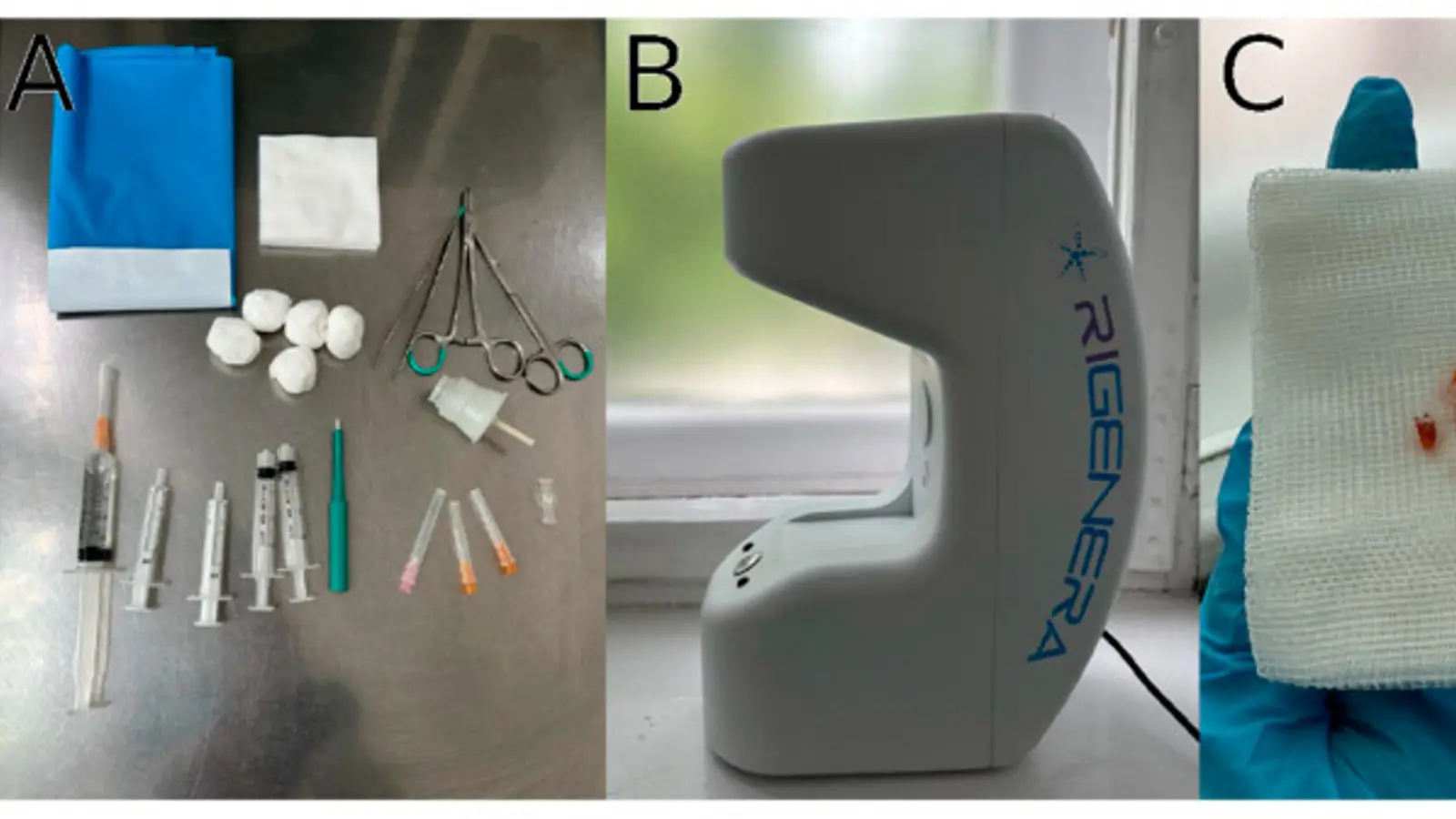
Everything happens in one visit: sampling, mechanical breakdown and injection.

- Examination and mapping: a trichoscopic examination confirms the type of hair loss and marks the areas suitable for treatment.
- Sampling: after local anesthesia, a few tiny skin samples are taken from the back of the head. In a study in women, five samples only 2.5 mm in diameter were taken1.
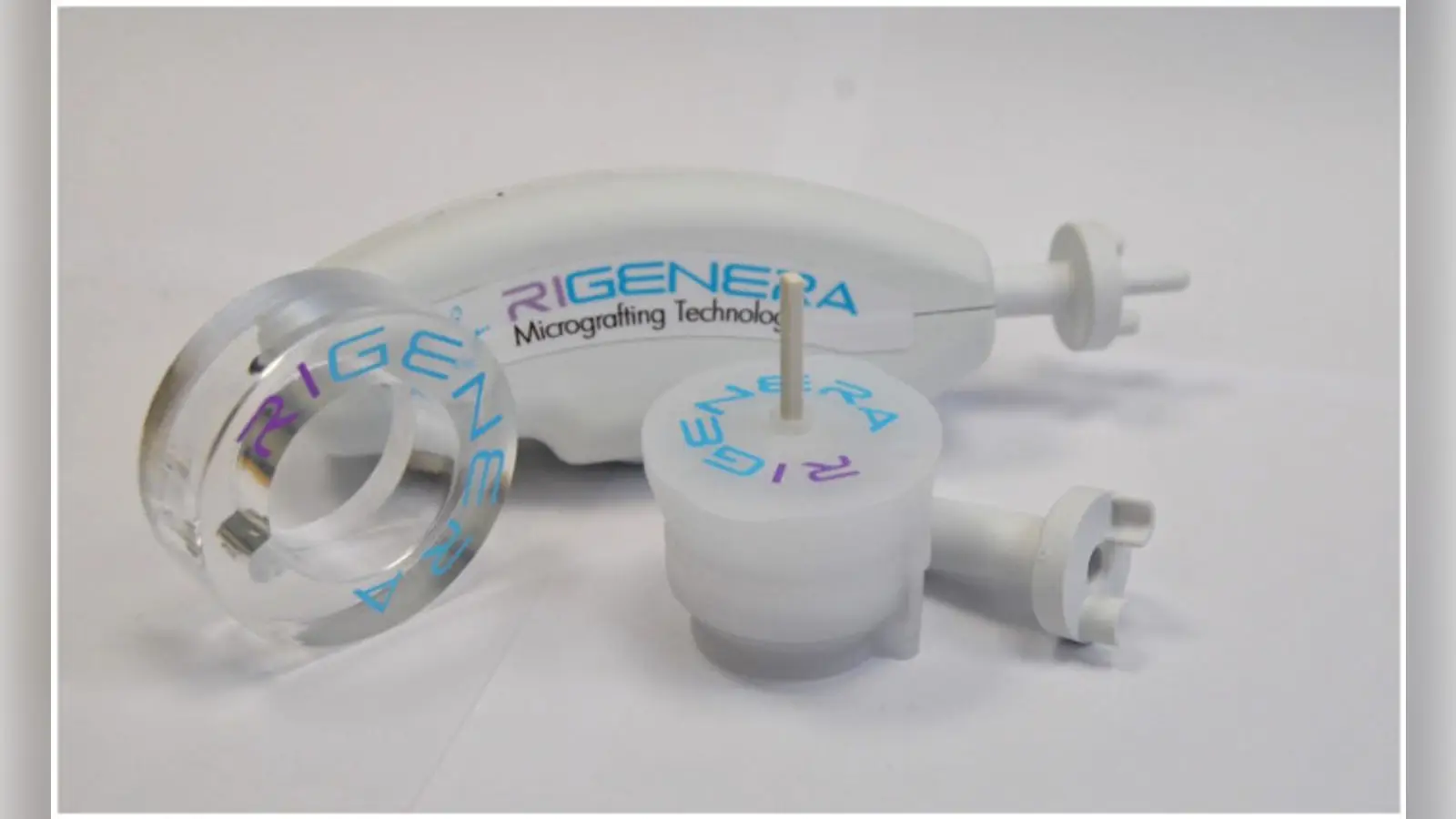
- Breakdown: the tissue is mechanically disaggregated and filtered in a dedicated device until a uniform suspension is obtained23.
- Injection: the suspension is injected into the weakened areas with small needle pricks, similar to a PRP injection12.
- Follow-up: photographs and a magnified examination after a few months, to measure the change61.
What have studies found?
Studies in men and women with hereditary hair loss show an increase in hair density and thickness after a single treatment.
| Study | Design | Main finding |
|---|---|---|
| Half-head vs. placebo, 27 patients5 | Controlled, follow-up up to 26 months | An increase of 23.3 hairs per cm² on the treated side, compared with a slight decrease on the placebo side |
| Follicle stem cells, placebo-controlled3 | Assessment 23 weeks after treatment | A 29% increase in density in the treated area, compared with less than 1% in the placebo area |
| Multicenter, 60 patients4 | Assessors blinded to treatment, one-year follow-up | An increase of 30 hairs per cm² in men and 28 in women |
| Retrospective, 140 patients6 | One treatment, follow-up 1–6 months | An increase in hair density and thickness, and fewer thin hairs in the frontal area |
| 23 women1 | Photographic assessment after 6 months | A significant improvement in the appearance of the hair after one treatment |
| Clinical and tissue assessment2 | Follow-up at 4, 6 and 12 months | Improvement in density and growth at every follow-up point |
A systematic review of micrograft technology found seven studies in hereditary hair loss7. The studies to date are relatively small, and the field continues to develop rapidly.

What's new in research (updated November 2026)
Two new publications on autologous micrograft technology (AMT), on which the Regenera treatment is based:
- Micrografts compared with finasteride (2026): a systematic review and meta-analysis used a statistical method to compare the results of studies on autologous micrografts with the results of studies on finasteride in hereditary hair loss. Both groups showed an improvement in hair counts, and the researchers conclude that micrografts may be an alternative comparable to finasteride in grades 2 to 5 of hair loss. They describe this as preliminary evidence, because it is a comparison between separate studies and not a direct head-to-head trial10.
- Quality of life in women (2024): a study from Poland followed 23 women with hereditary hair loss who had a single autologous micrograft treatment, and measured, before treatment and six months after it, both the severity of hair loss and quality of life and sexual function, using validated questionnaires. The hair loss grade on the Ludwig scale decreased, and there was an improvement in the mental domain of quality of life and in some sexual function measures. The study had no control group, so it points to a direction and does not prove a causal link11.
These summaries describe the design of the studies and the researchers' conclusions, and are not personal advice. Any decision about treatment is made only after an examination.
How long does the effect last, and is a repeat treatment needed?
In most studies only one treatment was given, and the improvement was measured over the following months, and also after one year.614 In the study with the longest follow-up, up to 26 months, most patients maintained the result, and six of 27 received a repeat treatment5. In hereditary hair loss, the decision whether and when to repeat the treatment is made together, based on follow-up. Combining it with medication and regular follow-up helps maintain the result over time. What happens at each stage after treatment is explained on the page Regenera results over time (Hebrew).
Regenera Activa, PRP or a hair transplant?
| Regenera Activa | PRP | Hair transplant | |
|---|---|---|---|
| Material | Your own scalp tissue | Your own blood | Your own whole follicles |
| What it brings to the follicle | Living progenitor cells and growth factors | Growth factors from platelets | New follicles for a bald area |
| Number of treatments | Usually one | A series, followed by maintenance | Usually one procedure |
| Recovery | Back to routine | Back to routine | Days to weeks |
| Especially suited to | Early to moderate thinning | Early to moderate thinning | Areas where follicles are already gone |
So which is better? Usually you don't need to choose. Regenera Activa and PRP complement each other, and in a study by the same research group both treatments improved the hair, each through a different mechanism8. A hair transplant is the tool for an area that is already bald, and the difference between hair restoration and a transplant (Hebrew) is explained on a separate page.
Regenera Activa before and after a transplant
- Want to postpone a transplant? At an early stage, strengthening existing follicles may delay the need for surgery.
- Before a transplant: strengthening the native hair so that the overall result is fuller.
- After a transplant: strengthening the hair around the transplanted area, which continues to be affected by hereditary hair loss. Had a transplant abroad? You can receive follow-up and strengthening treatment here, close to home.
Who is it especially suited for?
The treatment is designed to strengthen existing follicles, so it works best in the early and moderate stages.4 In the multicenter study, men in stages I to III of the Norwood scale (Hebrew) and women in stages I–II of the Ludwig scale were treated4.
- Men with early to moderate hereditary hair loss (Hebrew), including a receding hairline (Hebrew) and the crown. What men should know is on the page Regenera Activa for men (Hebrew).
- Women with diffuse thinning (Hebrew). What to check first is on the page Regenera Activa for women (Hebrew).
- Anyone who prefers to avoid medication or did not get on well with it.
- Anyone who wants a single treatment rather than a series.
- Anyone planning a transplant, or who has already had one.
Less suitable when the area no longer has follicles, such as an old smooth bald patch or scarring hair loss, and when there is an active scalp infection, a bleeding disorder, pregnancy or breastfeeding. For a completely bald area, the appropriate tool is a hair transplant.
Why combine it with other treatments?
In hereditary hair loss, the core treatment is usually medication (Hebrew), which addresses the hormonal mechanism that makes follicles shrink. Regenera Activa complements it from a different direction: it brings cells and growth factors from the scalp itself to the follicles. At the clinic, the combination is tailored to each patient after a trichoscopic diagnosis (Hebrew), sometimes adding PRP or MCT (Hebrew).
"Stem cells": the facts, without the hype
- What it is: micrografts from your own tissue, rich in progenitor cells and growth factors. Not embryonic cells and not donor material3.
- What is known: controlled and multicenter studies have shown an increase in hair density after a single treatment543.
- What about "fat-derived stem cells" and exosomes? These are different methods. Fat-derived cells are the basis of nanofat for hair (Hebrew), which requires liposuction. Exosomes are tiny vesicles, described on the page exosomes and growth factors for hair (Hebrew). Regenera Activa does not require liposuction: just a few tiny samples from the scalp.
What are the side effects?
Because the material comes from your own tissue, there is no concern about rejection or an allergic reaction to the material. Side effects are mainly local and temporary: mild tenderness at the sampling site and the injection area. The sampling site has tiny marks (2.5 mm in diameter in the study cited)1, which are easy to hide under the hair. As with any procedure that involves taking tissue from the skin, there is a rare risk of local infection. A single case of alopecia areata appearing after micrograft injection has been described9. What to expect in the days after treatment and how to prepare for it is covered on the pages after a Regenera treatment (Hebrew) and preparing for a Regenera treatment (Hebrew).
What does the cost depend on?
The cost depends on the size of the treated area, the single-use kit, any combination with treatments such as PRP, and trichoscopic follow-up. That is why the plan and its cost are put together after a personal examination that tailors the treatment precisely to your scalp. It is also worth remembering that this is usually a single visit, compared with a series of several treatments with other methods — a significant advantage in terms of time and commitment. A full breakdown of what is included and how to get a quote is on the page how much Regenera Activa costs (Hebrew).
What does Regenera Activa treatment look like with Dr. Buchbut?
The treatment is planned after a trichoscopic diagnosis, with close follow-up that measures the change in hair density and thickness in numbers. With Dr. Dana Buchbut, who has been treating hair loss for 16 years, the decision whether to choose Regenera Activa on its own or combine it with PRP, medication or a transplant is based on the condition of your follicles, not on a fixed package. What the visit at the clinic in Ramat HaHayal looks like is described on the page Regenera Activa in Tel Aviv (Hebrew).
Not sure which regenerative treatment is right for you? A comparison of regenerative hair treatments: PRP, iPRF, CGF, Regenera, exosomes and nanofat (Hebrew).
Frequently asked questions
What is Regenera Activa?
A treatment in which a few tiny skin samples are taken from the back of the scalp, mechanically broken down in a dedicated device into a suspension rich in progenitor cells (primitive cells capable of renewal) and growth factors, and injected into the weakened areas in the same visit. Its professional name is autologous micrografts.
Is it really a stem-cell treatment?
Yes, in the sense that the suspension contains progenitor cells from your own follicles. A study that analyzed the suspension found stem cells from the dermal papilla and from the bulge region of the follicle. These are adult cells from your own body, not embryonic cells and not donor material.
Does it hurt?
Not really. The samples are taken under local anesthesia, and the injections are similar to PRP injections. Nitrous oxide can be added for anyone who is anxious.
How many treatments are needed?
In most studies only one treatment was given, and the improvement was measured over the following months. Depending on follow-up, a repeat treatment can be decided on together later.
When are results visible?
Hair grows in cycles, so the change builds up gradually. In a study of 140 patients, improvement was measured as early as the first months after a single treatment, and in controlled studies the improvement in density was clear after about six months and continued after one year.
How long does it last?
In the study with the longest follow-up, up to 26 months, most patients maintained the result, and six of 27 received a repeat treatment. Combining it with medication helps maintain the result over time.
What is the difference between Regenera Activa and PRP?
PRP is based on blood and brings growth factors from platelets to the follicle, in a series of several treatments. Regenera Activa is based on scalp tissue and also brings living progenitor cells from your own follicles, usually in a single treatment. The two can also be combined.
How is it different from a hair transplant?
A hair transplant moves whole follicles to a bald area in a surgical procedure. Regenera Activa strengthens the existing follicles in the weakened area, without surgery and without recovery days. That is why it suits early stages, and also before and after a transplant.
Who is it suitable for?
Men and women with early to moderate thinning, when the weakened area still has active follicles. The earlier you start, the more follicles there are to strengthen. It is also especially suitable for anyone who prefers to avoid medication or did not get on well with it.
Who is it less suitable for?
When the area no longer has follicles, such as an old smooth bald patch or scarring hair loss, and when there is an active scalp infection, a bleeding disorder, pregnancy or breastfeeding. Suitability is assessed at a personal examination.
Side effects
Because the material comes from your own tissue, there is no concern about rejection or an allergic reaction to the material. Side effects are mainly local and temporary: mild tenderness at the sampling site and the injection area. A single case of alopecia areata appearing after such a treatment has been described.
Regenera, Regenera Activa and stem cells for hair: is it the same treatment?
Yes. Regenera Activa is the name of the method, and it is also known as Rigenera or a stem-cell treatment for hair. Its professional name is autologous micrografts: a suspension made from your own scalp tissue, rich in progenitor cells and growth factors, not embryonic cells or donor material.
When does the clinic offer Regenera?
In the clinic's treatment plans, Regenera Activa is considered when thinning is severe, as long as the area still has active follicles, as part of a combined plan with medication and sometimes PRP or MCT. When thinning is very severe, adding nanofat (Hebrew) is also considered. The decision is made after a trichoscopic diagnosis.
How much does a Regenera treatment cost?
The cost depends on the size of the treated area, the single-use kit, any combination with treatments such as PRP, and trichoscopic follow-up, so the plan and its cost are put together after a personal examination. It is usually a single visit rather than a series of several treatments.
Related reading
Hair restoration treatments compared
PRP, iPRF, CGF, Regenera, exosomes and nanofat: the differences in brief.
Read (Hebrew)PRP for hair
Growth factors from blood, which combine well with Regenera Activa.
ReadNanofat for hair
A different regenerative approach, using your own fat.
Read (Hebrew)Hair transplant
For areas where follicles are already gone.
ReadiPRF and CGF for hair
More concentrates from your own blood.
Read (Hebrew)Micrografts for scars
The same method for scars and stretch marks.
Read (Hebrew)Nitrous oxide in scalp treatments
A calm treatment, even for those who are afraid of needles.
Read (Hebrew)Regenera Activa for women
Which women with thinning hair the treatment suits, what is checked first and what the studies show.
Read (Hebrew)After a Regenera treatment
What happens in the first days, what is allowed, what to postpone, and when to contact a doctor.
Read (Hebrew)Regenera results over time
When change is visible after Regenera Activa, how long it lasts and when the treatment is repeated.
Read (Hebrew)Preparing for a Regenera treatment
What to do before Regenera Activa, which medications to mention, and when it is better to postpone.
Read (Hebrew)How much Regenera Activa costs
What makes up the cost, what one visit includes, and whether the health funds cover it.
Read (Hebrew)The information on this page is general and for education only. It does not replace an examination, diagnosis or personal medical advice. Any decision about treatment is made only after an examination.