

In short
- Topical minoxidil is the topical treatment recommended in guidelines for hereditary hair loss, in men and women over 181.
- It takes at least 4 months of regular use, and sometimes up to a year, before an effect is seen; the response is usually assessed after about 6 months23.
- In the first weeks there may be increased, temporary shedding, a known part of starting treatment4.
- Common side effects: scalp irritation and itching, and excess facial hair, mainly in women3.
- The effect lasts only as long as you use it; after stopping, the hair gradually returns to its previous state23.
Minoxidil is one of the two pillars of a home treatment plan for hair loss (Hebrew), and it is suited mainly to hereditary male pattern hair loss (Hebrew) and female pattern hair loss (Hebrew). On this page we explain how it works, how to use it correctly, what you can expect and what the risks are, without brand recommendations and without promises.
What is minoxidil, and how does it help hair?
Minoxidil is a drug that, when applied to the scalp, lengthens the growth phase (anagen) of the hair follicle. It was originally developed as a drug for high blood pressure, and during its use it was discovered to stimulate hair growth. To work, an enzyme in the hair follicle (sulfotransferase) converts it into its active form, minoxidil sulfate. This is one of the reasons the response varies from person to person3.
The European guideline on hereditary hair loss recommends topical minoxidil at the highest grade of recommendation, for both men and women1. The 2025 Canadian consensus also includes it among the recommended treatments5. In women, a Cochrane review found topical minoxidil more effective than placebo, based on moderate-quality evidence6.
What minoxidil does not do: it does not treat the hormonal-genetic cause of the hair loss, and it does not bring back hair to an area that has been completely bald for years. It is also not the right treatment for every type of hair loss. In telogen effluvium (Hebrew), for example, treatment starts with finding the cause. That is why it is worth having a hair loss diagnosis (Hebrew) before you start.
How do you use topical minoxidil?
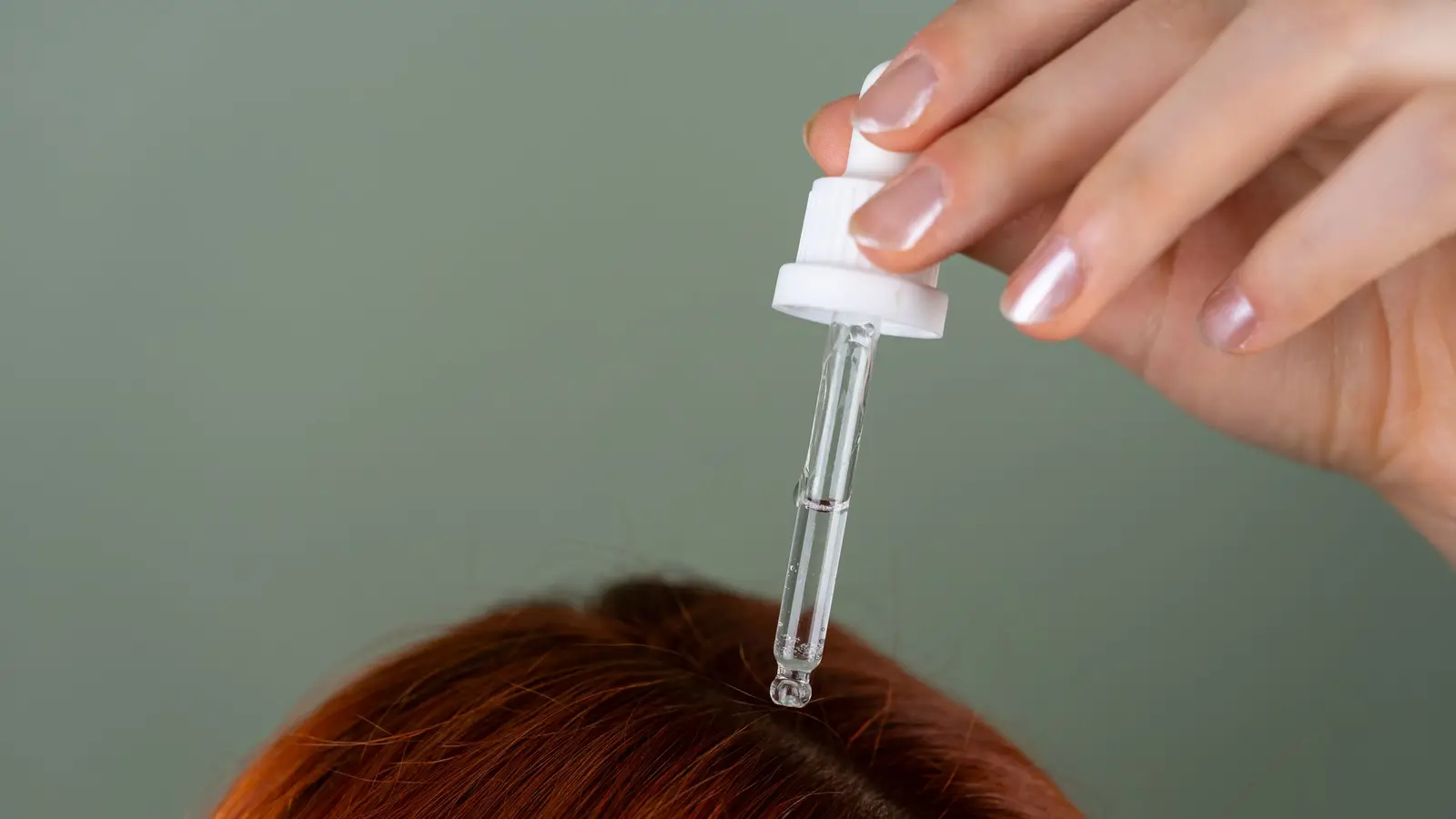
Apply the product to the dry scalp skin in the thinning area, usually twice a day, and not to the hair itself. This is how standard use is described in the patient information leaflet of the U.S. National Library of Medicine2. Some practical rules from the same source2:
- Apply to a dry scalp, and wash your hands after applying.
- Do not apply to an irritated, broken or sunburned scalp, because more of the drug is then absorbed into the body.
- Minoxidil may increase the skin’s sensitivity to the sun.
- If you miss a dose, do not double the amount next time.
The exact dose and frequency depend on the product and its concentration, so read the leaflet and consult a doctor or pharmacist. Consistency matters more than quantity: applying more product does not speed up the result, but it does increase the risk of irritation and side effects.
Can you color, wash and style your hair while using minoxidil?
Yes. According to the product leaflet, hair coloring, perms and styling products have not been found to change the effect of minoxidil, but there are a few timing rules. These are the instructions on the label of minoxidil 5% topical in the U.S. National Library of Medicine drug database7 and in the UK patient leaflet4:
- Washing and getting wet: leave the product on the scalp for about 4 hours before washing or wetting it, so that it is not washed off74.
- Styling products: hairspray, gel or mousse can be used once the product has been absorbed into the scalp7.
- Before bed: when applying in the evening, let the product dry for 2 to 4 hours before going to sleep7.
- Coloring, perms or chemical straightening: wash all the product out of the hair and scalp before the chemical treatment, do not apply it on the same day, and wait 24 hours after the treatment before applying again7.
- Change in hair shade: the UK leaflet reports isolated cases of a slight change in hair shade in people with very light hair, when hair products were used at the same time or after swimming in heavily chlorinated water4.
Exact instructions vary slightly between products, so check the leaflet of the product you are using.
Solution or foam? 2% or 5%?
The active ingredient is the same in the solution and the foam; the main difference is in the other ingredients. The liquid solution usually contains propylene glycol, the common cause of irritation and contact dermatitis. The foam has no propylene glycol, so it tends to be less irritating, and it also dries faster3.
As for concentration: in men, 5% led to a larger increase in hair density than 2%, but also to more side effects3. In women, a Cochrane review found no meaningful difference in effectiveness6. The decision is best made with a doctor. For details on concentrations: minoxidil 2% or 5% (Hebrew); and for a full comparison of the forms: minoxidil foam or solution (Hebrew).
How long does minoxidil take to work?
It takes at least 4 months of regular use, and sometimes up to a year, before an effect can be seen. This is what the patient information leaflet states2, and the review on minoxidil describes a peak response at around 12 months of continuous treatment3. Guidelines suggest assessing the response after about 6 months, and continuing if there is improvement1.

According to the leaflet, the response is better in people younger than 40 and in those whose hair loss is relatively recent2. Studies focused mainly on the crown and the middle of the scalp; at the front hairline (receding temples (Hebrew)) the response is less predictable2.
To know whether there is a change, photograph your scalp before starting treatment, in the same lighting and from the same angle, and compare after a few months. A day-to-day impression of “more hair in the brush” is not a reliable measure.
Why is there increased shedding at the start of treatment?
Increased shedding in the first weeks is a known, temporary effect, and it is usually not a sign that the treatment is failing. Minoxidil speeds up the transition of follicles from the resting phase to a new growth phase, so “old” hairs fall out earlier than usual and make room for new ones. According to the patient leaflet, this was seen in some patients two to six weeks after starting treatment, and it passes within a few weeks4.
This shedding frightens many people and leads them to stop at exactly the wrong moment. If it is very heavy, lasts more than a few weeks, or comes with itching and pain in the scalp, see a doctor to make sure there is no other cause for the hair loss.
What are the side effects of minoxidil, and when should you see a doctor?
Full details are on the page minoxidil side effects (Hebrew).
The common side effects are local: itching, dryness, flaking, redness and burning of the scalp2. The usual cause of irritation is the added ingredient, propylene glycol, rather than minoxidil itself3. Another common effect is hypertrichosis: unwanted hair growth on the forehead, cheeks or face. It depends on the concentration, is more common in women, and usually resolves within a few months after stopping treatment3.
See a doctor immediately if general symptoms appear: sudden weight gain, swelling of the face, hands or feet, shortness of breath, a fast heartbeat, chest pain or dizziness2. These are rare with topical use, but they are a sign that the drug is being absorbed into the body.
Two safety points worth knowing:
- Pregnancy and breastfeeding: there is not enough safety information, so minoxidil is generally avoided during these periods3. If you become pregnant during treatment, tell your doctor2.
- Pets, especially cats: severe poisoning has been reported in cats exposed to topical minoxidil, for example after it was spilled on them8. Keep the product closed and out of their reach, and do not let a cat lick your scalp or pillow after application.
Stopping minoxidil: what to expect, in brief
The effect of minoxidil lasts only as long as you use it. After stopping, the hair that was strengthened by the treatment gradually falls out within a few months (in the review: about 3 to 4 months), and the situation returns to what would have been expected without treatment23. Minoxidil is therefore an ongoing treatment, not a “course”. If you are thinking of stopping because of side effects or inconvenience, first check with a doctor whether the form, concentration or frequency can be changed. For details: what happens when you stop minoxidil (Hebrew).
Oral minoxidil: how is it different?
Low-dose oral minoxidil is an off-label use of the drug, so it is considered only by a doctor, on an individual basis and with follow-up. In a multicenter study of 1,404 patients, the most common side effect was excess body hair, and effects such as dizziness and fluid retention were relatively rare. The study was retrospective and had no control group9. In a small controlled trial in men, oral minoxidil was not found to be superior to topical minoxidil after 24 weeks10. Details on combining it with finasteride and on the other options are on the page how to stop hair loss at home (Hebrew).
Can minoxidil be combined with other treatments?
Yes. Minoxidil is usually the base, and other treatments are added as needed. In men it is often combined with finasteride. In-clinic treatments such as PRP for hair are considered complementary, not a substitute. An anti-hair-loss shampoo (Hebrew) or a biotin supplement (Hebrew) is not a substitute for minoxidil either: a shampoo can help mainly when there is a scalp problem, and a supplement helps mainly when there is a diagnosed deficiency. A detailed comparison of the two is on the page PRP or minoxidil (Hebrew).

What’s new in research (updated November 2026)
In the past two years, consensus statements and recommendations have been published that set out how minoxidil should be used, mainly in tablet form:
- International consensus on oral minoxidil (2025): 43 dermatologists who work with hair loss, from 12 countries, reached a consensus through a Delphi process on prescribing low-dose oral minoxidil, an off-label use. They agreed on 76 statements, including the conditions in which the treatment may help, doses for adults and adolescents, contraindications, tests before starting and follow-up. The consensus was published in JAMA Dermatology and is intended to guide doctors until large trials are available11.
- Oral minoxidil and blood pressure (2025): a meta-analysis in JAAD pooled studies that examined blood pressure in patients taking oral minoxidil at doses of up to 5 mg a day. No significant change in blood pressure was found, but heart rate rose slightly and some patients reported dizziness, and the most common side effect was excess hair growth on the body and face. The studies had no control groups, so evaluation before starting and follow-up remain important12.
- Recommendations for safe use (2025): a group of dermatologists who work with hair disorders published in JAAD a summary and recommendations for the use of topical minoxidil and low-dose oral minoxidil. The document focuses on what is important to know before starting: dose, follow-up, expected side effects and situations in which it is not used13.
These summaries describe the design of the studies and the researchers’ conclusions, and are not a personal recommendation. Any decision about treatment is made only after an examination.
How is minoxidil treatment planned with Dr. Buchbut?
With Dr. Dana Buchbut, who has been treating hair loss for 16 years, the form, the concentration and the combination with other treatments are chosen after a precise trichoscopic diagnosis, with close follow-up of your response.
Frequently asked questions
What is Minoxi, and how is it different from minoxidil?
Minoxi is a common name in Israel for minoxidil: the same active ingredient, and the number (2 or 5) indicates the concentration in percent. Choosing between concentrations and forms is described further down this page and on the page minoxidil 2% or 5%.
What is minoxidil and how does it help hair?
Minoxidil is a drug that, when applied to the scalp, lengthens the growth phase of the hair follicles. It works after an enzyme in the follicle converts it into its active form. It is the topical treatment recommended in guidelines for hereditary hair loss in men and women.
How long does minoxidil take to work?
According to the patient information leaflet, it takes at least 4 months of regular use, and sometimes up to a year, before an effect is seen. Guidelines suggest assessing the response after about 6 months. The peak response is described at around 12 months. Assessing after a few weeks is too early.
Why is there increased shedding at the start of minoxidil treatment?
In the first weeks, some of the hairs in the resting phase fall out earlier, to make room for hairs in the growth phase. This is a known, temporary effect. If the shedding is very heavy or lasts more than a few weeks, consult a doctor.
Minoxidil solution or foam: which is better?
Both forms contain the same active ingredient. The solution usually contains propylene glycol, a common cause of irritation and itching, while the foam does not, so the foam tends to be less irritating. The choice depends on convenience and skin sensitivity.
Minoxidil 2% or 5%?
In men, 5% showed a larger increase in hair density than 2%, with more side effects. In women, a Cochrane review found no meaningful difference in effectiveness between the concentrations, and because of the risk of excess facial hair a lower concentration is sometimes preferred. The concentration is chosen with a doctor.
What are the side effects of topical minoxidil?
The common ones are itching, dryness, flaking, redness and a burning scalp (Hebrew), and unwanted facial hair growth, mainly in women. Rarely there are general symptoms such as a fast heartbeat, dizziness, swelling or sudden weight gain, and then you should stop and see a doctor.
What happens if you stop minoxidil?
The effect lasts only as long as you use it. After stopping, the hair that was strengthened by the treatment gradually falls out within a few months, and the situation returns to what would have been expected without treatment.
Can minoxidil be used during pregnancy or breastfeeding?
It is not recommended. There is not enough safety information for pregnancy and breastfeeding, so it is generally avoided during these periods. If you become pregnant during treatment, tell your doctor.
Can you color your hair while using minoxidil?
According to the product leaflet, hair coloring, perms and chemical straightening have not been found to change the effect of minoxidil. The instruction is to wash the product out before the chemical treatment, not to apply it on the same day, and to resume applying 24 hours afterwards. After each application, wait about 4 hours before washing your hair.
Does minoxidil help receding temples?
Studies on minoxidil focused mainly on the crown and the middle of the scalp, and at the front hairline the response is less predictable. That does not mean there is no benefit, but it is important to come with realistic expectations and to assess after a few months.
What is the difference between topical and oral minoxidil?
Topical minoxidil is the topical treatment that guidelines recommend. Low-dose oral minoxidil is an off-label use, with a different side-effect profile, and it is considered only with a doctor and with follow-up.
Related reading
How to stop hair loss at home
A home treatment plan: minoxidil, finasteride, shampoo and supplements.
Read (Hebrew)Minoxidil injected into the scalp
What studies show, how it differs from topical use and what to know about safety.
Read (Hebrew)Topical, oral or compounded minoxidil
The differences, the evidence and the points of caution.
Read (Hebrew)Anti-hair-loss shampoo
What shampoo can do for your hair, and what it cannot.
Read (Hebrew)Biotin for hair
When a biotin supplement helps, and why it can interfere with blood tests.
Read (Hebrew)Male pattern hair loss
Causes, stages and treatment options.
Read (Hebrew)Hair loss in women
A widening part and a thin ponytail: diagnosis and treatment.
Read (Hebrew)PRP for hair
A complementary treatment, and how it fits with minoxidil.
ReadHair loss diagnosis
Why diagnosis comes before choosing a treatment.
Read (Hebrew)Spironolactone as a complementary treatment in women
When combining it with minoxidil is considered.
Read (Hebrew)Increased shedding at the start of treatment: why it happens and what to do
Has shedding increased since you started minoxidil?
Read (Hebrew)Minoxidil or finasteride
Minoxidil or finasteride: the difference and how to choose
Read (Hebrew)Mistakes when applying minoxidil
How to apply minoxidil correctly: common mistakes according to the leaflets
Read (Hebrew)Minoxidil side effects
What is common, what is rare and when to see a doctor.
Read (Hebrew)Minoxidil for women
Concentration, form, excess hair and pregnancy.
Read (Hebrew)The information on this page is general and for education only. It does not replace an examination, diagnosis or personal medical advice. Any decision about treatment is made only after an examination.