

In short
- An autoimmune disease, not contagious, that causes round, smooth bald patches12.
- The follicle is not destroyed, so hair can grow back, often even without treatment, especially after a first, small episode32.
- Treatment depends on the extent of hair loss and on age: watchful waiting, a steroid cream, injections into the patch, contact immunotherapy, and for extensive disease, tablets from the JAK inhibitor family45.
- Two new drugs are included in Israel's health basket for severe alopecia areata: one for adults and one from age 1267.
- The emotional impact is real, and psychological support is part of treatment85.
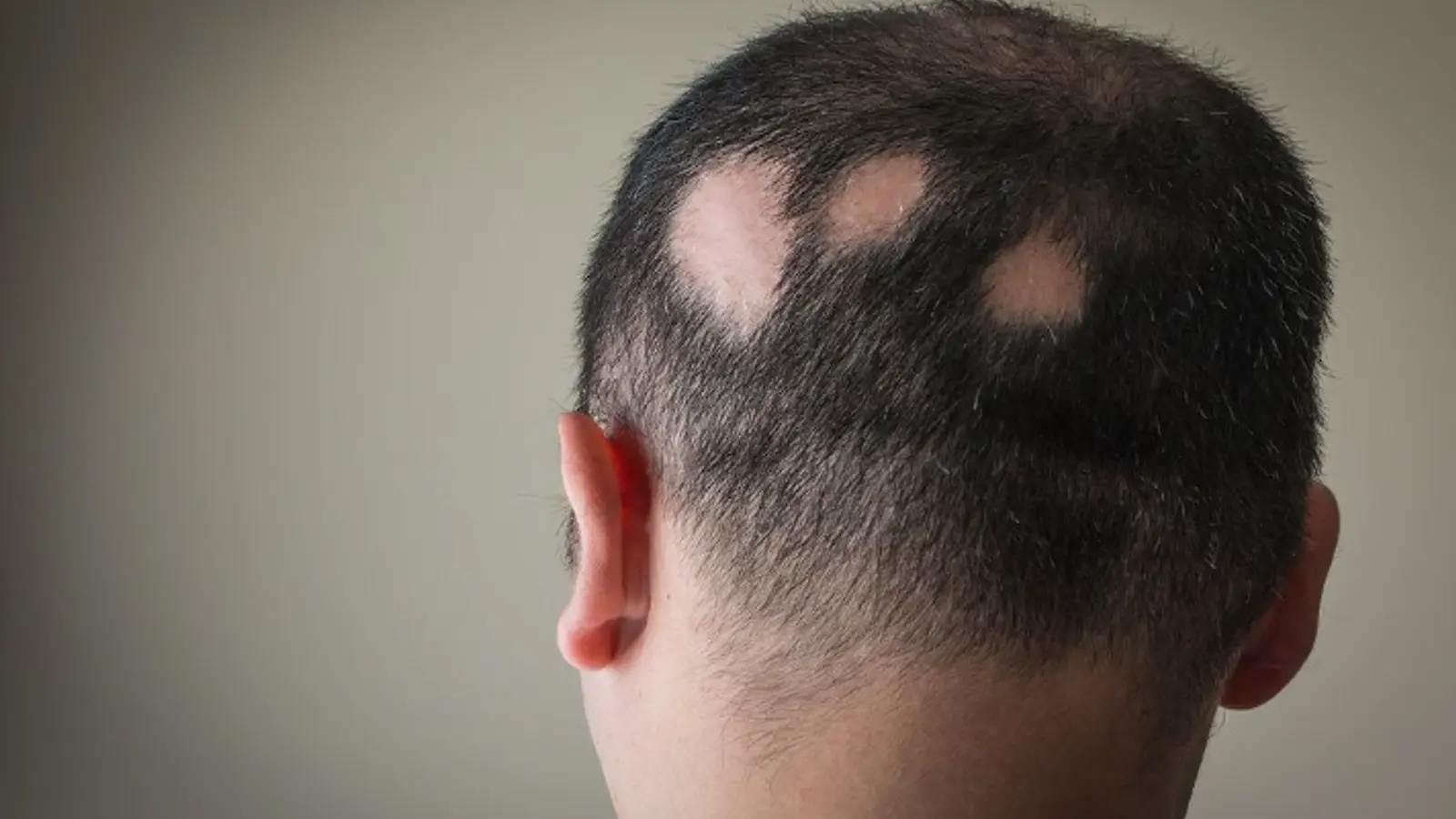
Did your barber tell you there is a round bald spot on the back of your head? Or did you find a small gap in your beard? This is common, especially in young men, and there is effective treatment for it. The most important message on this page: in alopecia areata the follicles are not destroyed, they are only “dormant”. That is why the hair can grow back, and early treatment shortens the way.
What is alopecia, and what types are there?
“Alopecia” is the medical word for hair loss or baldness. It is not a single disease. There are several main types, each with a different cause and treatment:
- Androgenetic alopecia (hereditary hair loss): the most common type, in men (Hebrew) and in women (Hebrew).
- Alopecia areata: an autoimmune disease that causes round bald patches. This is the subject of this page.
- Scarring alopecia: conditions in which the follicle is destroyed and replaced by scar tissue, such as lichen planopilaris (Hebrew).
- Traction alopecia: hair loss from tight hairstyles (Hebrew) worn over a long time.
So the first step is a diagnosis of the type of hair loss (Hebrew), and only then is a treatment chosen.
What is alopecia areata?
Alopecia areata is an autoimmune disease in which immune cells attack the hair follicles. Normally the follicle is “protected” from the immune system. In alopecia areata this protection breaks down, the follicle goes into a resting state and the hair falls out. The follicle itself is not destroyed, so the hair can regrow3. Put simply: the follicle is attacked, not wiped out. When the inflammation settles, the hair can come back, even after a long time.

The disease is also known as patchy alopecia or spot baldness; whatever the name or spelling, it is the same condition.
What does alopecia areata look like?
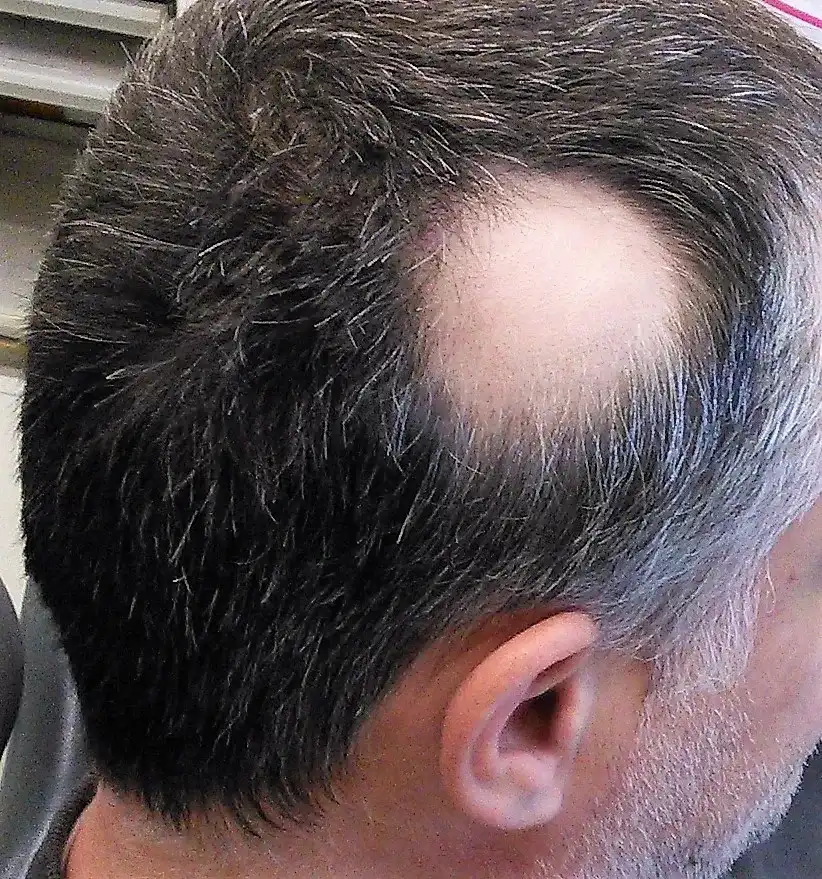
The typical sign is a round or oval bald patch that is smooth, with clean skin: no scaling, no redness and no signs of scarring19. Sometimes short hairs can be seen at the edge of the patch, thicker at the tip and thinner at the base. These are called “exclamation mark hairs”1.
The disease can appear:
- On the scalp: the most common site.
- In the beard, eyebrows, eyelashes and on the body: alone or together with the scalp19. There is a separate page on bald patches in the beard: alopecia areata in the beard (Hebrew).
- In the nails: 10–40% of patients have nail changes, mainly small pits110.
Quick recognition checklist: a round, smooth bald patch that appeared suddenly; clean skin without redness, scaling or scarring; short, broken hairs at the edge of the patch; and sometimes also a bald patch in the beard or eyebrows. Another interesting sign: white hairs are sometimes spared inside the affected area, because the immune attack is aimed mainly at follicles that produce pigment11.
Why does it happen? Is it caused by stress?
The cause is a combination of genetic predisposition and an immune response. About 20% of patients have a relative with the disease212, and in identical twins the chance that both are affected is much higher than in non-identical twins13.
Nor is it a curse or “the evil eye”. A round bald patch that appears overnight seems mysterious, but it is a well-known immune response, and it can be treated. And because the follicles are alive, there is good reason for optimism: the way forward is medical treatment that calms the inflammation, not a transplant.
About stress: many people report a stressful period before an episode, but stress has not been proven to cause the disease1415. It is fair to say that stress may be a possible trigger in people who are predisposed: not the cause, and certainly not the fault of the person who has it. Details on all the factors that have been studied, including associated diseases, vitamin D, smoking and diet, are on the page causes of alopecia areata (Hebrew).
How common is it, and who gets it?
About 2% of people will develop alopecia areata during their lifetime1617. The disease can start at any age, and it is more common in children than in adults17.
In Israel, a study of data from Maccabi (one of the Israeli health funds) between 2005 and 2019 identified more than 30,000 patients. The study found a rising incidence among men aged 18–3014. In the UK too, in a study of more than 4 million primary care patients, the most common age of onset was 25 to 29, in both men and women18. In other words, if you are in your twenties and have found a round bald patch, you are definitely not alone.
Will the hair grow back?
In many people, yes, especially after a first episode with only a few patches. According to Clalit (Israel's largest health fund), the disease resolves within a year in about half of patients2. Children under 10 often regrow hair even without treatment19.
The most important factor for the outlook is the extent of hair loss at the start. In a study that followed 191 patients for 15 to 22 years, 68% of those with the mildest disease were disease-free at the end of follow-up, compared with only 7–9% of those with severe disease20.
Factors that predict a good response: a first episode, few patches, disease lasting less than a year, onset at an older age, normal nails, and no atopy or other autoimmune disease. Factors linked to a longer course: onset at a young age, extensive hair loss, disease lasting more than a year, nail changes, the ophiasis pattern, and atopy or another autoimmune disease12021. Even in these cases there are effective treatments today, including the new drugs described below.
Even after the hair grows back, further episodes can occur22. Regrowing hair may be white at first and gradually regain its color1. Fine, light hairs inside the patch are usually a good sign: they are the beginning of regrowth. By contrast, “exclamation mark” hairs at the edge of the patch show that the disease is still active, and examination under magnification can tell them apart. Under magnification, new growth can be seen even before it is visible to the eye, so it is possible to know early that the treatment is working.

What types of alopecia areata are there?
There are five main forms of alopecia areata: patchy, ophiasis, diffuse, totalis and universalis. The patchy form is the most common.
| Type | What it is |
|---|---|
| Patchy | One or several round bald patches. The most common type1 |
| Ophiasis | A band of hair loss along the back and sides of the head, above the ears1 |
| Diffuse | General thinning without clear patches. Easy to confuse with other types of hair loss1 |
| Totalis | Loss of all scalp hair91 |
| Universalis | Loss of all body hair91 |
Totalis and universalis are rare: about 5% and about 1% of patients, respectively22. What is known about them and the options at each stage is on the page alopecia totalis and universalis (Hebrew).
How is the extent of hair loss measured? The SALT score
To choose a treatment and track progress, doctors measure the extent of hair loss with the SALT score, which runs from 0 (no hair loss) to 100 (loss of all scalp hair). The scalp is divided into four areas, each weighted by its size: the top 40%, the back 24%, and each side 18%. The doctor estimates what percentage of each area is bald, multiplies it by the weight and adds the results together23.

| SALT score | What it means |
|---|---|
| 0 | No hair loss on the scalp |
| 1–24 | Limited hair loss, for example one or a few patches. Topical treatment is particularly suitable here |
| 25–49 | Moderate hair loss |
| 50–99 | Extensive hair loss. This is where the Israeli health basket's definition of “severe” begins7 |
| 100 | Loss of all scalp hair (totalis) |
The treatment goal is usually a SALT score of 20 or less, meaning hair on at least 80% of the scalp. In a study in which doctors and patients with extensive hair loss described what they considered success, this was exactly the threshold both groups agreed on24. That is also why trials of the new drugs measure success as a SALT score of 20 or less.
How is alopecia areata diagnosed?
In most cases the diagnosis is made with an ordinary examination of the scalp91. Examining the scalp under magnification (trichoscopy (Hebrew)) helps identify typical signs, such as “exclamation mark” hairs, broken hairs and yellow or black dots in the follicle openings1.
Part of the examination is ruling out conditions that look similar1:
- Scalp ringworm (tinea capitis): common mainly in children, and usually accompanied by scaling.
- Hair pulling (trichotillomania).
- Sudden, diffuse hair loss from other causes.
- Scarring hair loss: in which the follicles are destroyed.
A biopsy is needed only when there is doubt1. Details on the other types of hair loss, which are not related to this autoimmune disease, are in the guide hair loss.
Is it linked to other diseases?
Yes, there is a link to other autoimmune and allergic diseases. Thyroid diseases are more common in people with alopecia areata25. There is also a link to asthma and eczema (atopy), vitiligo and other autoimmune diseases13.
How is alopecia areata treated?
Treatment is chosen according to the extent of hair loss, age and how long the disease has lasted. The current guidelines, a British “living” guideline that is updated every year and a German guideline from 2026, propose a stepwise approach45:
| Situation | Accepted options | What to know |
|---|---|---|
| A small, new patch | Watchful waiting, or a steroid cream / solution | Waiting is reasonable, because the hair often grows back on its own219 |
| A few patches, in adults | Steroid injections into the patch | First line in adults4. In children a cream is preferred526 |
| Moderate to extensive hair loss | Contact immunotherapy (DPCP) | Some regrowth in about two thirds, but relapses are common21 |
| Extensive hair loss (50% or more) | Tablets from the JAK inhibitor family | In Israel's health basket for adults and from age 1267 |

Steroid cream or solution
The British guideline recommends a potent topical steroid once a day for 3 to 6 months. This is a strong recommendation, but it is based mainly on professional consensus rather than strong evidence4. If there is no response after 3 months, the German guideline recommends stopping5.
Steroid injections into the patch
This is the accepted first-line treatment in adults with limited hair loss4. In a study of 127 patients, more than 80% regrew at least half of the hair in the treated area within 12 weeks19. The injections are usually repeated every 4–6 weeks. The common side effect is a small dent in the skin at the injection site, which usually resolves, and sometimes lightening of the skin26. In children the German guideline does not recommend injections, and in adolescents they can be considered5.
Contact immunotherapy (DPCP)
A substance that causes a mild, controlled allergic reaction in the skin is applied to the patch, in a series of treatments. In a meta-analysis of 45 studies and about 2,200 patients, about two thirds showed some regrowth and about one third complete regrowth. The response is weaker in extensive hair loss, and the relapse rate is high21.
Tablets from the JAK inhibitor family
This is a new group of drugs that block the immune signal that attacks the follicle3. In the large trials, about a third of adults with extensive hair loss who received baricitinib reached hair on at least 80% of the scalp after 36 weeks, compared with 3–6% on placebo27. With ritlecitinib the success rate was 23% after 24 weeks, compared with 2% on placebo28. A third drug in the family, deuruxolitinib, was tested in a phase 3 trial in adults with 50% or more hair loss: after 24 weeks, 29.6% of patients on the low dose and 41.5% on the high dose reached hair on at least 80% of the scalp, compared with 0.8% on placebo29. The improvement is usually gradual and continues over the months of treatment. With baricitinib, for example, the success rate kept rising up to week 52, and at the 4 mg dose reached 37%–41% of patients in the two trials30. And the really good news: of those who had hair on 80% of the scalp after a year and continued treatment, 89% kept the result even after three years31.
Getting the hair back is the first stage; keeping it is the second. That is why a good plan also includes a maintenance phase and follow-up, not just the initial treatment.
These drugs carry important warnings: a risk of serious infections, blood clots and cardiac events. Their long-term safety in alopecia areata is not yet known, and the hair may fall out again if treatment is stopped426.
What about PRP?
PRP has been studied in alopecia areata in several small trials. A small first trial from 2013 found good results32. A meta-analysis of four trials found no significant difference between PRP and steroid injections33, and in another controlled trial the steroid produced more regrowth34. The British and German guidelines do not recommend PRP as a routine treatment for alopecia areata, and it is not used in children45. It may be an option for adults who do not respond to steroids or cannot receive them, after a discussion of what is and is not known.
Which drugs are covered by Israel's health basket?
Two drugs from the JAK inhibitor family are included in the health basket for severe alopecia areata:
- Baricitinib: for adults, since the 2024 basket6.
- Ritlecitinib: from age 12, since the 2024 basket. In the 2025 basket the indication was extended to adults as well67.
In the basket, “severe” is defined as loss of 50% or more of scalp hair, or 21–49% with clear involvement of the eyebrows or eyelashes7. Treatment is started on a prescription from a board-certified dermatologist35.
What happens to alopecia areata in pregnancy and after childbirth?
There are no large studies on the course of alopecia areata in pregnancy, so it is not possible to predict whether the disease will improve, worsen or stay stable. The available information is based mainly on case reports and small series, and the researchers themselves note that more research is needed36.
The most important practical question concerns treatment. JAK inhibitors are generally not given during pregnancy, and women treated with them need to plan a pregnancy in advance with their doctor, including contraception during treatment and for a period afterwards37. In a series of 9 women (14 pregnancies) who stopped JAK inhibitors because of pregnancy, all lost hair after stopping. Eight of them resumed treatment, on average about four months after giving birth, and all regrew hair after resuming36. Details on planning a pregnancy during treatment are on the page JAK inhibitors (Hebrew).
After childbirth it is important to distinguish between two situations: diffuse shedding over the whole scalp that starts a few months after delivery is usually postpartum hair loss (Hebrew), not alopecia areata. Round, well-defined bald patches are more consistent with alopecia areata and warrant an examination.
Can COVID-19 or vaccination trigger alopecia areata?
An increased risk of alopecia areata has been found after COVID-19, but the absolute risk remains low. In a nationwide study from South Korea that compared about 259,000 people with COVID-19 with the same number of people who had not been infected, the rate of new alopecia areata was 43 per 10,000 person-years of follow-up, compared with 24 in the control group. That is a 1.8-fold higher risk, but it amounts to less than half a percent per year38.
As for COVID-19 vaccines, a systematic review found only 51 documented cases of alopecia areata after vaccination, mostly in the month after the first dose. About half of them were people who had had the disease before, and the vaccine coincided with a flare. The researchers conclude that this is a rare occurrence39. Case reports like these do not make it possible to establish that the vaccine is the cause.
How does alopecia areata affect mood?
Alopecia areata affects quality of life, and this effect deserves treatment in its own right. Even one small bald patch can occupy your thoughts all day, and that is completely natural. An Israeli study that included more than 41,000 patients at Clalit found an increased risk of anxiety and depression, especially in women and at ages 30–498. The German guideline recommends telling every patient about psychological support and support groups, and offering psychotherapy when there is depression or anxiety5.
In Israel, the non-profit organization Heads Up (BeRosh Moram) provides information, support and materials for children, parents and schools40.
What rights do people with alopecia areata have in Israel?
In Israel, people with alopecia areata are entitled to reimbursement for a wig in cases of complete hair loss, to psychological treatment included in the health basket, and to further rights depending on the circumstances.
- Wig: people who have lost all scalp hair (totalis) or all body hair (universalis) are entitled to reimbursement for a natural-hair wig once every two years through their Israeli health fund (kupat holim). The reimbursement amount and conditions are set by each fund and are updated, so it is worth checking them with your fund. Details on the page rights in alopecia areata (Hebrew)41. How to choose a wig or hairpiece: medical wig (Hebrew).
- Psychological treatment is included in the health basket41.
- Further rights, including from the National Insurance Institute (Bituach Leumi), depend on the circumstances. It is worth checking with the patient organization or your health fund41. Details on the page rights in alopecia areata: National Insurance, wigs and the health basket (Hebrew).
What can you do at home?
At home you can protect the scalp from the sun, treat regrowing hair gently, eat a balanced diet and use camouflage in the meantime.
- Sun protection: on exposed bald patches on the scalp, sunscreen or a hat all year round.
- Be gentle with regrowing hair: no coloring or straightening of areas where hair is starting to grow, and a mild shampoo.
- A balanced diet with enough protein, and testing of iron and vitamin D when there is a reason. Supplements such as biotin have not been shown to help when there is no deficiency.
- When eyelashes or eyebrows fall out: larger sunglasses protect the eyes from dust and light, and an eyebrow pencil or brow filler can help you feel comfortable.
- Camouflage in the meantime: a suitable haircut, hair fibers or an eyebrow pencil can help you feel comfortable until the hair grows back.
When should you see a doctor?
It is worth having an examination when a new bald patch appears, when there is scaling, redness or itching, when hair loss spreads quickly, when eyelashes or eyebrows fall out, and in children.
In detail, the situations that warrant an examination:
- A new bald patch appears, to confirm the diagnosis and rule out a fungal infection or another cause.
- The patch is accompanied by scaling, redness or itching.
- The hair loss spreads quickly or new patches appear.
- There is hair loss in the eyebrows or eyelashes.
- The patient is a child.
Guides on alopecia areata
Each of these topics is covered on a separate page:
- Understanding the disease: causes and risk factors of alopecia areata (Hebrew) and a round bald patch on the head: what it could be (Hebrew).
- By area and by age: alopecia areata in the beard (Hebrew), alopecia areata in the eyebrows, eyelashes and nails (Hebrew), alopecia totalis and universalis (Hebrew) and alopecia areata in children (Hebrew).
- Treatment: alopecia areata treatment by extent of hair loss (Hebrew), steroid injections for alopecia areata (Hebrew) and JAK inhibitors for alopecia areata (Hebrew).
- Rights: National Insurance, wig reimbursement and other rights (Hebrew).
What's new in research (updated November 2026)
Over the past year, results were published from large trials of drugs from the JAK inhibitor family for severe alopecia areata:
- Upadacitinib, the UP-AA trials (2026): two parallel phase 3 trials published in JAMA Dermatology included 1,399 patients aged 12 to 64 who had lost at least half of their scalp hair. Patients who received upadacitinib at 15 or 30 mg a day reached meaningful scalp coverage at week 24 at a much higher rate than the placebo group. No new safety findings emerged, and the common side effects were upper respiratory tract infections and acne43.
- Deuruxolitinib, the THRIVE-AA2 trial (2026): a second randomized, double-blind phase 3 trial included 517 adults with severe alopecia areata lasting at least six months. At both doses tested, more patients than in the placebo group were left at week 24 with hair missing from no more than a fifth of the scalp, and most side effects were mild to moderate. The trial did not examine how durable the response is over the long term44.
- Ritlecitinib over three years (2026): a follow-up analysis of 191 patients aged 12 and over who received ritlecitinib 50 mg continuously in the ALLEGRO trial program showed that most of those who responded after one year kept the response after three years as well. A better response was linked to less extensive and shorter-lasting hair loss at the start of treatment, and no new safety signals were found. This is an open-label follow-up study without a control group45.
These drugs are intended for severe cases, are given by prescription under medical follow-up, and their approval and availability vary between countries. These summaries are not personal recommendations.
What does an examination with Dr. Dana Buchbut look like?
The examination starts with a trichoscopic assessment: the scalp and hairs are examined under magnification to confirm that this is alopecia areata, assess the extent of hair loss and rule out a fungal infection or other causes. Dr. Dana Buchbut has been treating hair loss for 16 years, and with close follow-up it is possible to see how the disease is progressing and how it responds to treatment, and to adjust the plan to you.
Frequently asked questions
Is alopecia areata contagious?
No. Alopecia areata is an autoimmune disease, meaning the body's own immune system damages the hair follicles. It is not passed on by touch, by sharing a comb or a hat, or from person to person.
Does alopecia areata go away on its own?
Often, yes, especially after a first episode with one or a few small patches. According to Clalit, the disease resolves within a year in about half of patients. In extensive disease the chance is lower, and even after the hair grows back, further episodes can occur.
Is alopecia areata genetic?
It has a genetic component: about 20% of patients have a relative with the disease. However, most children of a person with alopecia areata will not develop it. The disease results from a combination of genetic predisposition and other factors.
Does emotional stress cause alopecia areata?
Many people describe a stressful period before an episode, but stress has not been proven to cause the disease. Stress may be a possible trigger in people who are predisposed. It is not your fault, and it could not have been prevented.
Does alopecia areata change during pregnancy?
There are no large studies on the subject, and the course during pregnancy cannot be predicted. Women treated with JAK inhibitors should plan a pregnancy in advance with their doctor, because these drugs are generally not given during pregnancy. Diffuse shedding a few months after childbirth is usually postpartum hair loss, not alopecia areata.
Do COVID-19 or COVID-19 vaccines cause alopecia areata?
A large study found a 1.8-fold higher risk of alopecia areata after COVID-19 infection, but the absolute risk remained below half a percent per year. After vaccination only isolated cases have been reported, and case reports cannot establish a causal link.
Why did my hair grow back white?
White hair after alopecia areata is common. The hair that first grows back in the patch is often white or light, and it gradually regains its normal color.
How can you tell alopecia areata from a fungal infection?
In alopecia areata the skin in the patch is smooth and clean, without scaling or redness. Scalp ringworm (tinea capitis), which is especially common in children, is usually accompanied by scaling, itching or broken hairs. The distinction is made at an examination, sometimes with microscopic examination of scalp samples or a culture.
Do I need blood tests?
Not always. The diagnosis is usually clinical. Because thyroid diseases are more common in people with alopecia areata, the doctor may recommend tests depending on the overall picture.
Is there a drug for alopecia areata in Israel's health basket?
Yes. Since 2024 two drugs from the JAK inhibitor family have been included in Israel's national health basket for severe alopecia areata: baricitinib for adults, and ritlecitinib from age 12, which was extended to adults in 2025. Eligibility is defined by the extent of hair loss, and treatment is started on a prescription from a board-certified dermatologist.
What is the SALT score?
SALT is a score from 0 to 100 that describes what percentage of scalp hair has been lost. The scalp is divided into four areas according to their size, and the score helps choose a treatment and track progress. The treatment goal is usually a score of 20 or less, meaning hair on at least 80% of the scalp.
Is it for life?
In many people the episode passes and the hair grows back, sometimes for many years. Others have repeated episodes, and then the disease is managed like any other long-term autoimmune disease, with a range of effective treatments, including the new drugs.
Is there a natural treatment that works?
No natural treatment has been shown to be effective in controlled studies. It is important to remember that in alopecia areata the hair often grows back on its own, so any treatment, even one that does nothing, can look as if it worked.
What does National Insurance provide, and what about wig reimbursement?
In Israel, people who have lost all scalp hair (totalis) or all body hair (universalis) are entitled to reimbursement for a natural-hair wig once every two years through their health fund, and psychological treatment is included in the national health basket. The National Insurance Institute (Bituach Leumi) may sometimes grant further recognition, for example under the work injury track, under varying conditions. Because the details depend on personal circumstances, it is worth checking with the organizations "Heads Up (BeRosh Moram)" or "Kol Zchut", and not relying on general information as legal advice.
Does PRP help in alopecia areata?
This cannot be determined today. In a systematic review of patchy hair loss, the comparison between PRP and steroid injections was rated as having very low-quality evidence42. The choice of treatment depends on the extent of hair loss, age and preferences, and not every treatment suits every person.
Related reading
Causes of alopecia areata
Genetics, associated diseases, vitamin D, diet and stress: what is known.
Read (Hebrew)Rights in alopecia areata
National Insurance, wig reimbursement and the Israeli health basket.
Read (Hebrew)Hair loss: the complete guide
All types of hair loss, how to tell them apart and which treatments exist.
ReadDiagnosing hair loss
Trichoscopy and tests that help tell the types of hair loss apart.
Read (Hebrew)Treating alopecia areata
All the treatment options, by extent of hair loss and level of evidence.
Read (Hebrew)JAK inhibitors for alopecia areata
How the drugs work, who is eligible in the health basket and what the risks are.
Read (Hebrew)Steroid injections into the patch
First-line treatment in adults: how it is done and what the side effects are.
Read (Hebrew)Alopecia areata in children
A guide for parents: what is different in children and from what age the new drugs can be used.
Read (Hebrew)Alopecia areata in the beard
A round gap in the beard that appeared suddenly: what it is and which treatments exist.
Read (Hebrew)A round bald patch on the head
What it could be, how to tell it from a fungal infection or hair pulling, and when to see a doctor.
Read (Hebrew)Alopecia areata in the eyebrows, eyelashes and nails
What it looks like, which treatments have been studied and what can be done cosmetically.
Read (Hebrew)Alopecia totalis and universalis
When all the hair falls out: outlook, treatments and rights.
Read (Hebrew)Does alopecia areata go away?
Does alopecia areata go away? What is known about recovery and the course of the disease
Read (Hebrew)Types of alopecia
Androgenetic, areata, scarring and traction alopecia: how to tell them apart.
Read (Hebrew)The information on this page is general and for education only. It does not replace an examination, diagnosis or personal medical advice. Any decision about treatment is made only after an examination.