


In brief
- Thinning hair can come from fewer hairs, finer hairs, or both, and age itself also reduces the amount of hair and the thickness of each hair12.
- The most common cause is hereditary hair loss: in women, a widening part; in men, a receding hairline at the temples and thinning at the crown3.
- Temporary shedding after childbirth, illness or stress causes diffuse thinning, and the hair usually grows back within 6 to 9 months3.
- Iron deficiency, thyroid problems and hormonal changes are causes that are checked with blood tests43.
- The solution depends on the cause, so the first step is a diagnosis, including a magnified examination of the hairs5.
What is the difference between fine hair and thinning hair?
Fine hair means each individual hair is narrower; thinning hair means there are fewer hairs on each square centimeter of scalp. Both make the hair look less full, and they often appear together. In a study that measured the hair of healthy women, average hair density fell from about 293 hairs per cm² at age 35 to about 211 at age 701. Another study found that hair thickness increases between ages 20 and 40 and declines afterwards, and that women begin to notice a decrease in the amount of their hair mainly from their mid-40s2.
Some people have always had naturally fine hair, and that is not a disease. What warrants a workup is a change: a ponytail that has become thinner, a widening part, scalp showing through the hair in bright light, or hair that no longer grows to the length it once did. A general guide to all types of hair loss is on the hair loss page.
Why does hair become thin?
The most common cause of thinning hair, in women and in men, is hereditary hair loss, followed by temporary shedding after a triggering event, nutritional deficiencies, thyroid problems and hormonal changes. The American Academy of Dermatology (AAD) lists hereditary hair loss as the most common cause of hair loss worldwide, alongside many other causes3:
| Cause | What it usually looks like | Does it grow back? |
|---|---|---|
| Hereditary hair loss | Women: a widening part. Men: receding temples and thinning crown3 | Treatment can stop or slow it, and sometimes improve it3 |
| Temporary shedding (telogen effluvium) | Diffuse shedding a few months after childbirth, illness or stress3 | Usually regains its fullness within 6–9 months3 |
| Age | Gradual decrease in amount and thickness12 | Partly; early treatment helps some people3 |
| Deficiencies (iron, protein, zinc) | Diffuse shedding3 | Yes, once the deficiency is corrected3 |
| Thyroid | Diffuse shedding across the whole scalp6 | Usually yes, after treatment, sometimes only partly6 |
| Hormonal changes (e.g. polycystic ovaries, stopping birth control pills) | Thinning on the scalp3 | Treatment can help3 |
| Tight hairstyles and damage from hair products | Thinning at the hairline and breakage78 | Depends on the damage. Prolonged pulling may be permanent7 |
| Scarring alopecia | Areas where the follicles have been destroyed3 | No, a destroyed follicle will not grow hair3 |
There is often more than one cause. For example, temporary shedding after childbirth can unmask another hair loss condition, such as hereditary hair loss, that had already begun earlier9. So it is worth not settling for the first explanation, especially when the thinning does not improve.
Thinning hair in women: what is important to know?
In women, thinning in the middle of the head and a widening part are the typical sign of female pattern hair loss, which is the most common cause of thinning hair in women. According to the AAD, in women hereditary hair loss shows up as overall thinning or a widening part, not as complete baldness3. It becomes more common with age: in the study mentioned earlier, it was found in 6% of women under 50 and in 38% of women over 701. For a full overview: thinning hair in women.
In women it is also important to check for causes that can be corrected: iron deficiency has been linked to non-scarring hair loss in women10, and hormonal changes such as polycystic ovaries or stopping birth control pills can cause thinning3. Thinning that appears around menopause is described on the hair loss during menopause page, and the diagnosis and treatment of female pattern hair loss are detailed on the hereditary hair loss in women page.
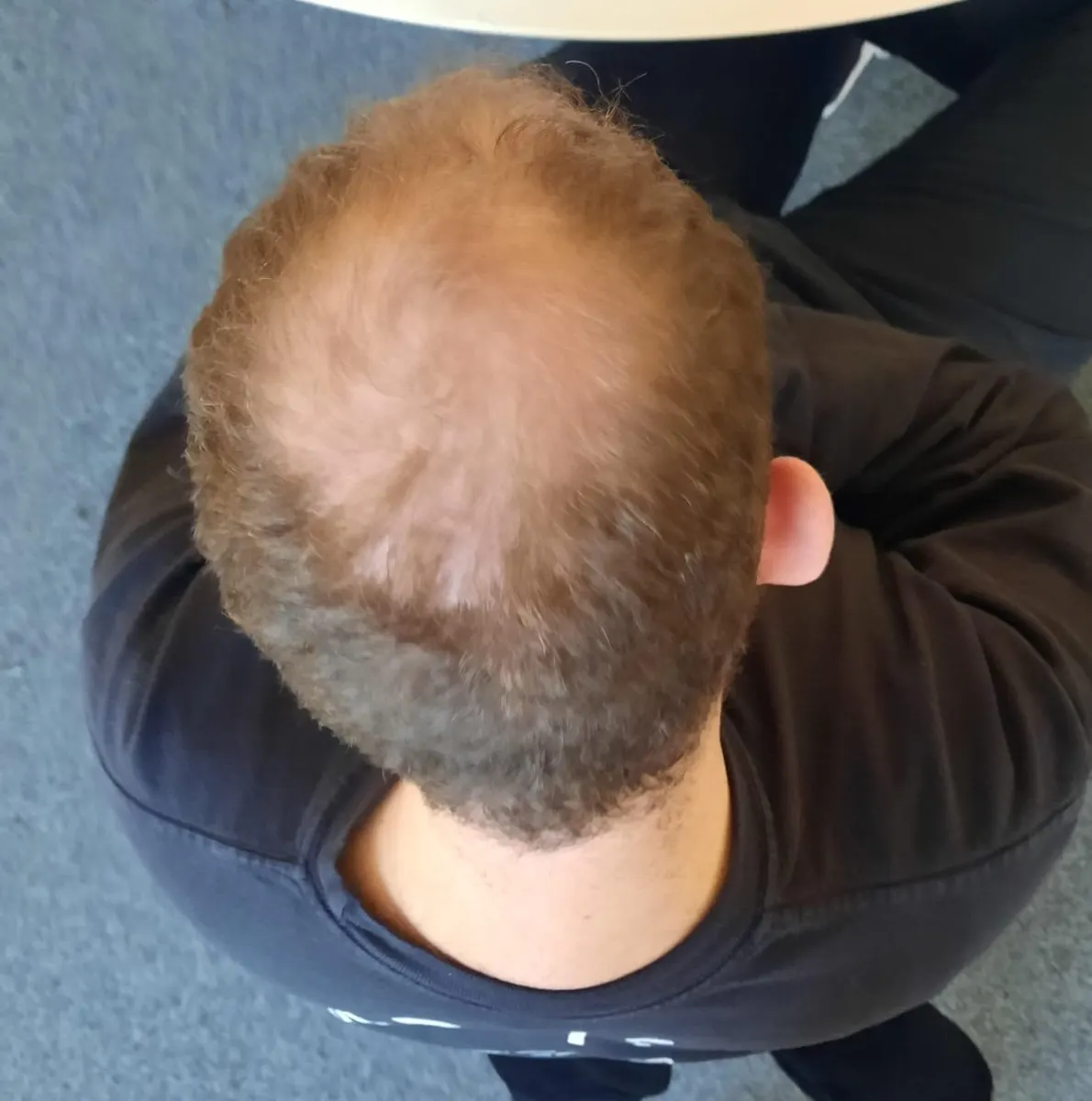
Thinning hair in men and at the crown
In men, thinning at the crown and a receding hairline are usually the first signs of male pattern hair loss. According to the AAD, male pattern hair loss sometimes begins as early as the late teens or early 20s, and by age 50 more than half of white men show some sign of it. The best results are achieved when treatment starts soon after the change is noticed11.
In this type of hair loss, the hairs do not fall out all at once. They undergo miniaturization: the hairs gradually become finer and shorter12. That is why thinning at the crown often starts with a feeling that the hair is “thinner,” even before a bald spot is visible. Details are on the male pattern hair loss and receding hairline pages.
Thinning hair at the front: what could it be?
In men, thinning hair at the front of the head is usually the beginning of male pattern hair loss, but in women it is worth also considering traction alopecia and an inflammatory disease that affects the hairline. In men, a hairline receding at the temples is a well-known sign of hereditary hair loss, and treatment is more effective when started early11. Details on the receding hairline page. For a full overview: thinning hair in men.
In women, there are two important causes of thinning at the front hairline:
- Traction alopecia. Ponytails, braids or extensions that pull on the hair over time cause broken hairs and a receding hairline around the forehead and temples. At an early stage it is reversible, but prolonged pulling may leave permanent hair loss7. Details in the traction alopecia entry.
- Frontal fibrosing alopecia (FFA). According to DermNet, this is a uniform band of hair loss along the front and side hairline, sometimes together with thinning or loss of the eyebrows. The skin in the area looks pale and shiny, with no follicle openings. It is typical of women after menopause, but also appears at a younger age and in men. Itching and pain are common at an early stage, sometimes even before thinning is visible. It is a scarring alopecia, so the hair does not grow back unless treatment starts early13. Details on the lichen planopilaris page.
So new thinning at the front hairline in a woman, especially with eyebrow loss, itching or pain, calls for an examination rather than waiting.
Fine, brittle hair: shedding or breakage?
Hair that looks thin is not always falling out from the root. Sometimes it breaks along its length, because of heat, coloring, straightening or rough handling. According to the AAD, ongoing damage to the hair can eventually lead to thinning and even bald patches, and if changing your habits does not help, it is worth seeing a dermatologist8. Fine, brittle hair can also result from grooming habits: rubbing with a towel, aggressively combing wet hair, excessive heat, and frequent coloring and straightening treatments14.
How can you tell the difference? With breakage you usually see short hairs of different lengths and broken ends, without a white bulb at the tip. With shedding, whole hairs fall out from the root. The distinction is not always simple, and sometimes there is both. Details about the causes and what helps, including hair that has become thin after straightening, are on the hair breakage page.
How is thinning hair examined?
The examination starts with a conversation and an examination of the scalp, including a magnified examination, and blood tests as needed. In a magnified examination (trichoscopy) it is possible to see whether there is variation in hair shaft thickness, which is a key sign of hereditary hair loss in women5. This kind of examination also helps distinguish hereditary hair loss from temporary shedding or other conditions that look similar.
In diffuse shedding, the standard blood tests are ferritin (iron stores) and thyroid function4. Additional tests are added as needed. Details about all the tools are on the hair loss diagnosis page.

What can be done about thinning hair?
Treatment depends on the cause: for hereditary hair loss there are treatments that can stop or slow its progression, and for other causes the underlying factor itself is treated. In female pattern hair loss, a Cochrane review found that topical minoxidil is more effective than placebo15. In male pattern hair loss there are several standard treatments, and their results usually become visible only after months11. Every treatment has possible side effects, and the benefit stops when the treatment is stopped11. Details are on the minoxidil for hair page, and a full home plan is on the how to stop hair loss page.
When the cause is a deficiency, it is corrected. Vitamins and minerals help mainly when there is a proven deficiency16. When there is no deficiency, the evidence for the benefit of hair supplements is limited and of variable quality17, and some supplements, such as biotin, can interfere with blood test results18. More on this on the hair loss: what the body is missing page.
Alongside medical treatment, and sometimes instead of it, there are cosmetic solutions such as wigs and scalp micropigmentation12. More on these further down the page. It is also important to protect the hair you have: reduce heat, avoid pulling it back tightly, and leave time between coloring and straightening treatments147.
How long does it take to see a change in thinning hair?
Usually months, not weeks: according to Cleveland Clinic, on average, results of hair loss treatment start to show after three to six months of consistent treatment.19 Hair grows slowly, so judging after just a few weeks may lead to stopping a treatment too early, before it has had time to work. With minoxidil, for example, the response is assessed only after several months, as explained on the minoxidil page.
According to the same source, during treatment it is best to avoid products that may damage the hair, such as dyes, chemical curl relaxers and chemical straighteners19. When the cause is a deficiency or temporary shedding, the pace of recovery depends on the trigger, so it is important to identify it first.
How can you make thinning hair look fuller?
You can improve the look of thinning hair with gentle care and camouflage methods, as long as you remember that they do not treat the cause. For people with hair loss, the American Academy of Dermatology recommends a gentle shampoo and a moisturizing conditioner after every wash, a microfiber towel, a hair dryer on the lowest heat, flat irons and curling irons only for special occasions, gentle brushing, and avoiding tight hairstyles and at-home coloring, perms and straightening. It also recommends quitting smoking and not eating too few calories20.
The common camouflage methods, according to a review on the subject:
- Hair fibers, powders and tinted sprays. The fibers are made of keratin or other materials and cling to the existing hairs, while powders and sprays reduce the contrast between hair color and scalp color. They wash out with shampooing, so they are applied every day21. On what they do and do not do: hair fibers and volumizing powder.
- Hair extensions. They add volume, but their pull on the natural hair can make hair loss worse. Bald patches at the attachment points have been reported21.
- Partial or full wig. Suited mainly to extensive thinning. Adhesives used to attach wigs can cause an allergic skin reaction21.
- Scalp micropigmentation. Tattooing of small dots that mimic hair follicles. The risks are infection and allergy to the pigment, and the natural hair may turn gray over time and no longer match the color21.
Camouflage can greatly improve how you feel day to day, and it is legitimate alongside medical treatment too. If you choose it, it is worth first finding out the cause of the thinning, so as not to miss a condition that responds to treatment.
Thinning hair in children
In children, hair that suddenly becomes thin, bald patches or hair that breaks warrant an examination. According to the American Academy of Pediatrics, most types of hair loss in children resolve when the cause is treated. The common causes are scalp ringworm (tinea capitis), alopecia areata, hair pulling, shedding after an illness, and tight hairstyles22. Details on the hair loss in children page.
When should you get checked?
It is worth getting checked when the hair gradually becomes thinner, when there are bald patches, or when the hair is falling out in large amounts. These are the signs for which it is recommended to get examined rather than wait23. It is worth coming in sooner when there is also itching, pain or redness on the scalp, because in conditions where the follicles are destroyed, the hair does not grow back3. In hereditary hair loss, as mentioned, results are better when treatment starts early11.
What is new in research (updated November 2026)
Two new studies bear directly on the question of why hair becomes fine, and what helps:
- Measuring the thickness of individual hairs (2025): In a randomized, double-blind, placebo-controlled trial, researchers measured the diameter of individual hairs, the same hair before and after, in men with hereditary hair loss who received sublingual minoxidil (a form of administration still under study) at different doses for 24 weeks. In the placebo group the hairs continued to narrow, while at the higher doses the diameter increased, mainly in medium-thickness hairs. The researchers see this as a sign of partial reversal of follicle miniaturization, the process underlying hair that becomes fine24.
- Nutritional supplements: what is the evidence? (2025): A network meta-analysis of 19 randomized trials with 1,658 patients compared 16 different nutritional supplements in hereditary hair loss. Some of the supplements, mainly plant extracts and multi-ingredient formulations, improved hair density compared with placebo, and all were well tolerated. The trials were small and varied, and the researchers note that large, high-quality trials are needed to confirm the findings25.
These summaries describe the design of the studies and the researchers' conclusions, and are not a personal recommendation. A decision about treatment is made only after an examination.
What does a thinning hair workup with Dr. Dana Buchbut look like?
Whether your hair is naturally fine or it is the beginning of hair loss, a short examination gives a clear answer. And when it is hair loss, the earlier you start, the more density there is to preserve.
Terms on this page: androgenetic alopecia · hair density · telogen effluvium · scarring hair loss · male pattern hair loss · frontal fibrosing alopecia · Full glossary
Frequently asked questions
What is the difference between fine hair and thinning hair?
Fine hair means each individual hair is narrower; thinning hair means there are fewer hairs on each square centimeter of scalp. Both make the hair look less full, and they often appear together. Some people have naturally fine hair, without any disease.
Why does hair become thin?
The most common cause is hereditary hair loss, in which the hairs gradually become finer and shorter. Other causes are temporary shedding after childbirth, illness or stress, iron deficiency, thyroid problems, hormonal changes, medications, tight hairstyles and damage from hair products. Age itself also causes some decrease in the amount of hair.
Thinning hair in women: what are the solutions?
The solution depends on the cause. In hereditary female pattern hair loss, topical minoxidil is a standard treatment whose effectiveness has been shown in studies, and there are additional treatments depending on the situation. When the cause is iron deficiency, a thyroid problem or temporary shedding, the underlying cause is treated. At the same time, cosmetic solutions such as a wig or scalp micropigmentation can help.
Why is hair thin at the crown?
In men, thinning at the crown is one of the first signs of male pattern hair loss, along with a receding hairline. In women, thinning in the middle of the head and a widening part are the typical sign of female pattern hair loss. Here too, it is worth confirming the diagnosis with an examination.
Can thinning hair become full again?
It depends on the cause. In temporary shedding after childbirth, illness or stress, the hair usually regains its fullness within 6 to 9 months. In hereditary hair loss it is possible to stop the progression and improve hair thickness and density, especially when treatment starts early. After diagnosis, Dr. Dana builds a personal plan and sets a treatment goal with you. In scarring alopecia, a destroyed follicle will not grow hair.
How long does it take to see improvement when treating thinning hair?
Usually months rather than weeks. According to Cleveland Clinic, on average, results start to show after three to six months of consistent treatment. Judging too early may lead to stopping a treatment before it has had time to work.
What tests are done for thinning hair?
The examination starts with a conversation and an examination of the scalp, including a magnified examination that shows whether the hairs have become finer. Sometimes a pull test is done. Common blood tests are ferritin (iron stores) and thyroid function, with additional tests as needed.
Do vitamins help thinning hair?
Vitamins and minerals help mainly when there is a proven deficiency, such as iron deficiency. When there is no deficiency, there is no good evidence that supplements thicken the hair, and some supplements may even be harmful or interfere with blood test results.
Is thinning hair in children a cause for concern?
When a child's hair suddenly becomes thin, when there are bald patches, or when the hair breaks, it is worth getting checked. Most types of hair loss in children resolve when the cause is treated.
Why is hair thin at the front?
In men, thinning at the front of the head and at the temples is usually the beginning of male pattern hair loss. In women, it is worth considering traction alopecia from tight hairstyles, and frontal fibrosing alopecia, in which the hairline recedes in a uniform band and sometimes the eyebrows fall out too. New thinning at the front hairline, especially with itching or pain, calls for an examination.
How can you hide thinning hair?
You can use hair fibers, powders and tinted sprays that reduce the contrast between the hair and the scalp, a partial or full wig, or scalp micropigmentation. Hair extensions add volume, but their pull can make hair loss worse. Camouflage does not treat the cause, so it is worth finding out the cause at the same time.
Hair loss in women
A widening part and thinning in the middle of the head: diagnosis and treatments.
Read moreMale pattern hair loss
Receding temples and crown: how the hair loss progresses and what stops it.
Read moreTelogen effluvium
Diffuse shedding after childbirth, illness or stress, which usually passes.
Read moreHair loss: what the body is missing
Iron, vitamin D and more: when a deficiency causes hair loss.
Read moreHair loss diagnosis
Trichoscopy, pull test and blood tests: how a diagnosis is reached.
Read moreHair loss: the complete guide
All types of hair loss, how to tell them apart, and what treatments exist.
Read moreThinning hair in men
Thinning hair in men: when it is the start of hair loss, and what to check first
Read moreThe information on this page is general educational information only and is not a substitute for an examination, diagnosis or personal medical advice. A decision about treatment is made only after an examination.