

In short
- PRP for hair in Tel Aviv starts with a trichoscopic diagnosis. The exact type of hair loss determines whether PRP is suitable and how the plan is built around it.
- Hereditary hair loss is where most of the evidence lies: a 2025 meta-analysis of 43 randomized trials found moderate evidence for improved density and reduced shedding1.
- A typical course: three treatments one month apart, a progress check around the third month, and then maintenance every three to six months2.
- Usually not on its own: PRP is combined with minoxidil, finasteride and other treatments, and does not replace them without a shared decision.
- No promises: results vary between people, so progress is measured with before and after images.
- At the clinic, the treatment is performed by Dr. Dana Buchbut herself, physician (M.D.).
If you search for PRP for hair in Tel Aviv, you will find many pages explaining what PRP is. A general explanation of the mechanism, the preparation and the trials is already on the page PRP for hair: how it works, and there is no point repeating it here. This page answers a different question: what actually happens at our clinic, from your first visit to the summary consultation, and which type of hair loss the treatment suits.
What is PRP for hair, and what is it not?
PRP is a concentrate of platelets from your own blood, injected into the scalp to support follicles that are still active. It does not grow hair where there are no longer any follicles, so it is not a substitute for a hair transplant on a bald scalp. Nor is it one treatment for every type of hair loss. For that, you first need to understand what is causing your hair loss.
PRP has been used in medicine for many years, and for hair it has been studied in dozens of trials. However, the studies differ in preparation method, platelet concentration and number of treatments, which is one reason why the results in the literature are not uniform1.
How is hair loss diagnosed before PRP, and why is this the first step?
The first visit is a diagnostic visit: a conversation, a scalp examination and computerized trichoscopic imaging. Dr. Dana Buchbut has been practicing hair medicine for 16 years, and every plan she makes is built on the diagnosis.
- Conversation: when the hair loss started, whether it is gradual or sudden, family history, medications and medical conditions, and whether there was a birth, an illness with fever, a diet or unusual stress in the past six months.
- Examination and imaging: a trichoscopic examination magnifies the scalp and shows hair thickness, density, and whether there are signs of follicle miniaturization, inflammation or scarring. The first image also serves as a baseline for later comparison.
- Further tests as needed: in some cases blood tests are appropriate, for example when iron deficiency or a thyroid problem is suspected. The doctor decides on this after the examination.
- Checking suitability for PRP: you are asked about bleeding disorders, use of anti-inflammatory drugs and steroids, and conditions in which treatment is postponed.
By the end of the visit you should have a clear answer to one question: is PRP the right step now, and in what combination. Sometimes the answer is yes, sometimes "another treatment first", and sometimes "not worthwhile". You will be told this directly.
What do studies say about PRP for hair, and where are they weak?
The overall picture is encouraging but not uniform, and it is important to know its less comfortable side as well.
- A meta-analysis of 43 randomized trials (1,877 participants, 2025): activated PRP increased hair density and reduced shedding compared with placebo, but did not significantly change hair shaft thickness. Non-activated PRP was associated with more side effects. The authors' conclusion: moderate evidence of safety and efficacy, and a call for larger standardized trials1.
- A physician group and meta-analysis from 2019: improved density compared with baseline and with placebo, and a recommendation of three monthly treatments with maintenance after three to six months2.
- A trial with a less clear-cut result: in 35 patients with hereditary hair loss, an area treated with PRP was compared with an area treated with saline, over three monthly treatments. Density rose in both areas, from 151 to 171 hairs per cm² in the PRP area and from 151 to 167 in the control area, and the difference between them was not statistically significant. The authors note the possibility that the plasma spread between the areas, and that the needling itself also stimulates the scalp3.
- The 2025 Canadian consensus: a panel of 11 physicians reviewed 45 interventions for hereditary hair loss and recommended, among others, PRP, minoxidil and finasteride4.
What does this mean in practice? There is a good basis to expect improvement in a large share of patients, and no reason to promise it. That is why every plan at our clinic includes measurement points agreed in advance.
Who is PRP suitable for, by type of hair loss?
This is where this page differs from most of what you will find: suitability is determined by the type of hair loss, not by the name of the treatment.
Hereditary (androgenetic) hair loss, in men and women. This is the hair loss most studies address. The follicles shrink and produce thinner hairs, and PRP has been studied mainly here. It is particularly suitable when there is still hair, even thin hair, because there is something to strengthen. In male pattern hair loss and female pattern hair loss it is usually planned alongside medical treatment.
Chronic diffuse shedding (telogen). In telogen effluvium the body "switches off" many hairs at once after a trigger, and the shedding usually resolves on its own once the cause is gone. First the cause is sought and treated, as detailed in telogen effluvium. For persistent chronic shedding, a small randomized trial examined PRP: 30 women with chronic telogen effluvium received four monthly treatments of PRP prepared by two methods or saline, and both PRP groups showed improvement in the pull test, satisfaction and density, but the study was small with a short three-month follow-up5. This is preliminary evidence, and the decision is individual.
Postpartum hair loss. It is usually temporary and resolves. In postpartum hair loss the first step is understanding and reassurance, not treatment. If the shedding goes on well beyond what is expected, it is time to return for a diagnosis.
Alopecia areata. This is an autoimmune disease, and its treatment differs from hereditary hair loss. A 2022 systematic review found that PRP showed promising results and was comparable to steroid injections in some studies, but the authors themselves wrote that there is not enough evidence to recommend it as a standard treatment6. A meta-analysis of four trials (201 participants) found no significant difference between PRP and triamcinolone injection, with high heterogeneity and short follow-up7. So in alopecia areata, PRP is a complementary option considered in certain cases, after the dedicated treatments.
Scarring hair loss (for example lichen planopilaris). Here the follicles are destroyed by an inflammatory process, and the first goal is to stop the process. In the review mentioned above, the evidence on PRP in scarring hair loss consisted mainly of case reports and very small series, and the measure was disease stabilization, not regrowth6. The first step is an accurate diagnosis; see lichen planopilaris.
After or before a hair transplant. In a randomized trial of 30 patients with hereditary hair loss, adding PRP to medical treatment around an FUE transplant was associated with better follicle survival, growth rate and hair strength8. It is a small single-center study, but it fits the combined approach: strengthening the existing hair alongside the transplanted hair. See hair transplant.
What does the treatment course look like, visit by visit?
According to the literature, a typical course for hereditary hair loss lasts about a year and is built in stages with measurement between them. The exact protocol at the clinic, including the number of treatments and intervals, is set after the examination, and your personal plan may look different.
- Diagnostic visit. Conversation, examination, trichoscopic imaging and setting a plan.
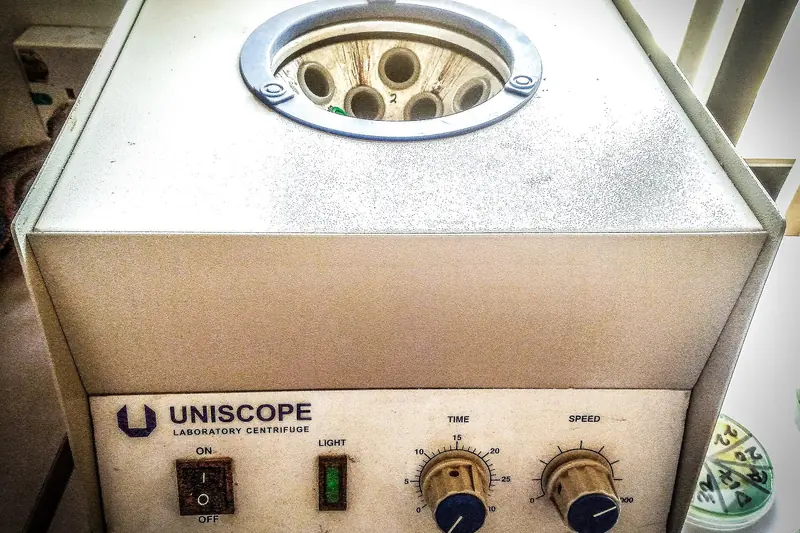
- Three treatments about a month apart. At each visit a small amount of blood is drawn, separated in a centrifuge, and the plasma is injected into the scalp in the weakened areas and around them. The length of the visit is set at the consultation. If you are anxious about needles, cooling, a numbing cream, vibration and, if needed, nitrous oxide ("laughing gas") can help.
- A check around the third month. Repeat imaging of the same areas and comparison with the first image. At this point it is decided whether to add a treatment, combine further treatments, or move on to the next stage.
- A booster treatment and six months. In a randomized trial of 40 patients, a series of three monthly treatments with a booster after three months gave an average increase of about 30% in hair count after six months, compared with about 7% for two treatments three months apart. Both protocols were considered tolerable, and the average pain score was 2.1 out of 109.
- Maintenance. Hereditary hair loss continues in the background, so after the series you move to a few treatments a year. In a two-year follow-up after a series of three treatments, four of 20 patients reported progressive hair loss after one year and were retreated10. Details are in how many PRP sessions for hair you need.
After treatment, mild tenderness and swelling are an expected reaction, and most people return to their routine the same day. Exact instructions are given in writing.
Is PRP combined with minoxidil, finasteride and other treatments?
Yes, and that is usually the way. PRP acts on the follicle through growth factors, minoxidil and finasteride act in other ways, and the studies have mostly examined combinations.
- Minoxidil: in a trial of 93 patients, the pull test was negative (meaning hair did not come out in the test) in 48% of patients on minoxidil alone, 65% with added PRP, and 87% with added PRP and microneedling11. A 2026 systematic review of four trials (226 patients) found that no single treatment was clearly superior and that the combination looks promising, but the studies are small and short12.
- Finasteride and other medications: a DHT blocker such as finasteride acts on the hormonal cause of follicle shrinkage. The Canadian consensus includes it, together with PRP and minoxidil, among the recommended interventions4. Trials that directly examined PRP alongside finasteride are few and small, so there is no exact figure for the added benefit. Using finasteride is a personal medical decision, and in women it is considered cautiously and according to the situation.
- Microneedling, phototherapy and mesotherapy: see microneedling, scalp phototherapy and mesotherapy for hair. At the clinic this is the combined approach: not a single treatment, but a plan matched to the degree of hair loss.
Existing medical treatment is not stopped because of PRP. Any change to it is made only in coordination with the doctor.
When are results seen, and what can and cannot be promised?
Hair grows slowly, so change comes gradually. The first sign is usually less shedding, and only later thickening. In a small one-year follow-up study (20 patients, no control group), shedding fell to a normal level and density peaked around the third month, and stayed above baseline even after a year, with a booster treatment in the sixth month13. In other patients the pace is slower.
What can be said with reasonable confidence: in early to moderate hereditary hair loss there is a good chance of improvement in density and shedding, especially in combination with medical treatment, and there is a way to measure it.
What cannot be promised: a specific result, a specific number of hairs, or that your hair will "come back". PRP does not cancel the hereditary tendency, so it is a treatment you keep up over time. If the examination shows that PRP is not the right tool, you will be told so.
What are the side effects of PRP for hair?
PRP is made from your own blood, so the risk of a reaction to the material itself is low, although allergic reactions have been reported in the literature, and the common effects are mild and pass: tenderness, redness, mild swelling and pain at the injection site, usually for a day or two. Rare effects include temporary shedding and lasting tenderness, and infection is very rare. No serious side effects were reported in the trials reviewed13. People with a bleeding disorder, an active infection or a condition requiring postponement will not be treated.
PRP, iPRF or CGF for hair: what is the difference and how do you choose?
All three concentrates are prepared from your own blood. The difference is in how they are prepared, and therefore in their composition and the rate at which growth factors are released.
- PRP: usually prepared with an anticoagulant, and the platelets are concentrated in it.
- iPRF: prepared without an anticoagulant, with a slower spin, and forms a fibrin network that releases growth factors gradually.
- CGF: also without an anticoagulant, with spins at varying speeds, and forms a denser fibrin network.
What is known about comparing them? A 2026 multicenter randomized trial in women with female pattern hair loss, in which 74 women completed four treatments four weeks apart, found that the increase in hair count after 24 weeks was greater with CGF (about 27%) and iPRF (about 27%) than with PRP (about 15%), and that the iPRF group had the lowest rate of side effects of the three14. Another small study, of 20 patients using a half-head design, found that PRP with CGF improved more than PRP alone15, and a single-center prospective study of 30 patients with hereditary hair loss who had not responded sufficiently to conventional treatments reported a response in 80% of them after six monthly iPRF injections16.
These are individual, relatively small studies, so no winner can be declared. iPRF and CGF are also offered at the clinic, and the choice between the three concentrates, or a combination, is made after the diagnosis and according to the response. A broader comparison is on the page hair restoration treatments. More pages in the series: PRP treatment in Tel Aviv, PRP for the face in Tel Aviv, iPRF in Tel Aviv and CGF in Tel Aviv.
Where is the clinic in Tel Aviv, and how do you get there?
Dr. Dana Buchbut's clinic is located in Beit HaRofim (medical building), 11 HaBarzel St., Ramat HaHayal, Tel Aviv-Yafo. Details about Dr. Buchbut, her training and her experience are on the About page. The clinic is in Building A, 7th floor, Unit 16A. When you exit the elevator, turn left and then right. The clinic is wheelchair accessible.
- By car: Ahuzot HaHof parking garage, 1 HaNehoshet St. The back part of the garage is behind Beit HaRofim, with direct access to the building.
- By train and bus: Tel Aviv Savidor Center station, then bus 44 toward the Atidim terminal, getting off at the Raoul Wallenberg/HaBarzel stop. Travel times from nearby cities and more details are on the page how to get to the clinic.
More details, including a map, are on the contact page.
How do you book an examination and consultation?
You can book an appointment yourself through the website, or send a WhatsApp message. Book your own appointment. You can also write on WhatsApp to +972-54-556-8871 (send a message), ask for a price list (beforehand you can read what affects the cost of PRP for hair to understand what drives the cost) and ask whether it makes sense to come for an examination. Opening hours are given when you book.
It is worth bringing a list of medications and supplements, blood test results if you have them, and old photos of your hair, which help show the pace of change.
The bottom line
PRP for hair is a relatively well-established tool in hereditary hair loss, a complementary tool in alopecia areata, and a tool that requires careful diagnosis in other types of hair loss. In Tel Aviv, as anywhere, what determines success is the match: the right diagnosis, a planned series, combination with other treatments, and before and after measurement. If you are not sure whether it suits you, the examination is the first step.
Frequently asked questions
What is PRP treatment for hair?
PRP is platelet-rich plasma prepared from your own blood: a small amount of blood is drawn, separated in a centrifuge, and the concentrate is injected with superficial needle pricks into the scalp. Platelets contain growth factors that have been studied as supporting hair follicles. The treatment is chosen according to the type of hair loss, so it starts with a diagnosis.
Does PRP for hair work?
Most reviews show signs of improvement, but not every trial does. A 2025 meta-analysis of 43 randomized trials found moderate evidence for improved hair density and reduced shedding, while in another trial comparing a treated area with an area that received saline, the improvement in both areas was similar. So we talk about a chance of improvement, not a promise, and measure it with imaging.
How many PRP sessions for hair do you need?
In hereditary hair loss the usual recommendation is three treatments one month apart, followed by maintenance every three to six months. In a randomized trial of 40 patients, a monthly series with a booster treatment gave greater and faster improvement than spaced-out treatments. The final number of treatments is set according to the measured response.
When are results seen after PRP?
Usually the first sign is less shedding, around the third month, and only later thickening and density. Hair grows slowly, so the change is assessed after about three months and again after six months, with trichoscopic imaging of the same areas.
Is PRP suitable for every type of hair loss?
No. Most of the evidence is in hereditary hair loss in men and women. In diffuse shedding (telogen) the cause is sought first, in alopecia areata there are dedicated treatments and the evidence for PRP is limited, and in scarring hair loss the emphasis is on accurate diagnosis.
Can PRP be combined with minoxidil or finasteride?
Yes, and it is the common combination. Small studies showed that adding PRP to minoxidil gave a better result, and the 2025 Canadian consensus includes PRP as well as minoxidil and finasteride among the recommended treatments. Medical treatment is not stopped without coordination with the doctor.
What is the difference between PRP, iPRF and CGF for hair?
All three are concentrates from your own blood. PRP is prepared with an anticoagulant and the platelets themselves are concentrated in it, while iPRF and CGF use no anticoagulant and the concentrate forms a fibrin network. A 2026 randomized trial in women found better results with iPRF and CGF than with PRP, but it is a single study and needs confirmation.
Does the treatment hurt?
Most patients describe small pricks and a feeling of pressure. In a randomized trial the average pain score was 2.1 out of 10. Discomfort can be reduced with cooling, a numbing cream, a vibration device and, if needed, nitrous oxide ("laughing gas").
What if no change is seen after a PRP series?
First the diagnosis and the measurements are checked again, because sometimes the first change is less shedding before it shows in the mirror. Then the plan is adjusted: an additional treatment, adding medication, activation, or a different concentrate. The decision is based on the imaging, not on a feeling.
How much does PRP for hair cost in Tel Aviv?
Prices are not published on the website. The cost depends on the number of treatments in the series, combination with other treatments and follow-up, so a quote is prepared after the examination. You can ask for a price list by WhatsApp message.
How do you choose a clinic for PRP for hair in Tel Aviv?
Check that there is a diagnosis before treatment, that a physician performs the injection, that there is before and after measurement of the same areas, and that you are also told what cannot be promised. Ask how the plasma is prepared and whether the plan includes combination with medical treatment.
Related reading
PRP for hair: how it works
The full explanation of the mechanism, the studies and the protocol.
Read moreHow many PRP sessions for hair you need
Number of treatments, intervals, maintenance and measurement.
Read moreHair loss diagnosis
Trichoscopy and what is checked at the first visit.
Read moreComparing hair restoration treatments
PRP, iPRF, CGF, stem cells and more, in one table.
Read morePRP treatment in Tel Aviv
The general overview of PRP for hair and face.
Read morePRP for the face in Tel Aviv
What the treatment includes, who it suits and what research says.
Read moreiPRF in Tel Aviv
A blood concentrate without anticoagulant: what is known and what is not.
Read moreCGF in Tel Aviv
A concentrate of growth factors from your own blood.
Read moreRegenera Activa in Tel Aviv
What actually happens at the clinic in Ramat HaHayal: diagnosis, treatment day, follow-up and how to get there.
Read moreHow to get to the clinic
Parking, public transport, travel times from nearby cities and all treatments at the clinic in Tel Aviv.
Read moreHair transplant in Tel Aviv
Examination, FUE or DHI planning, transplant day and follow-up at the clinic in Ramat HaHayal.
Read moreThe information on this page is general educational information only and is not a substitute for an examination, diagnosis or personal medical advice. A decision about treatment is made only after an examination.