

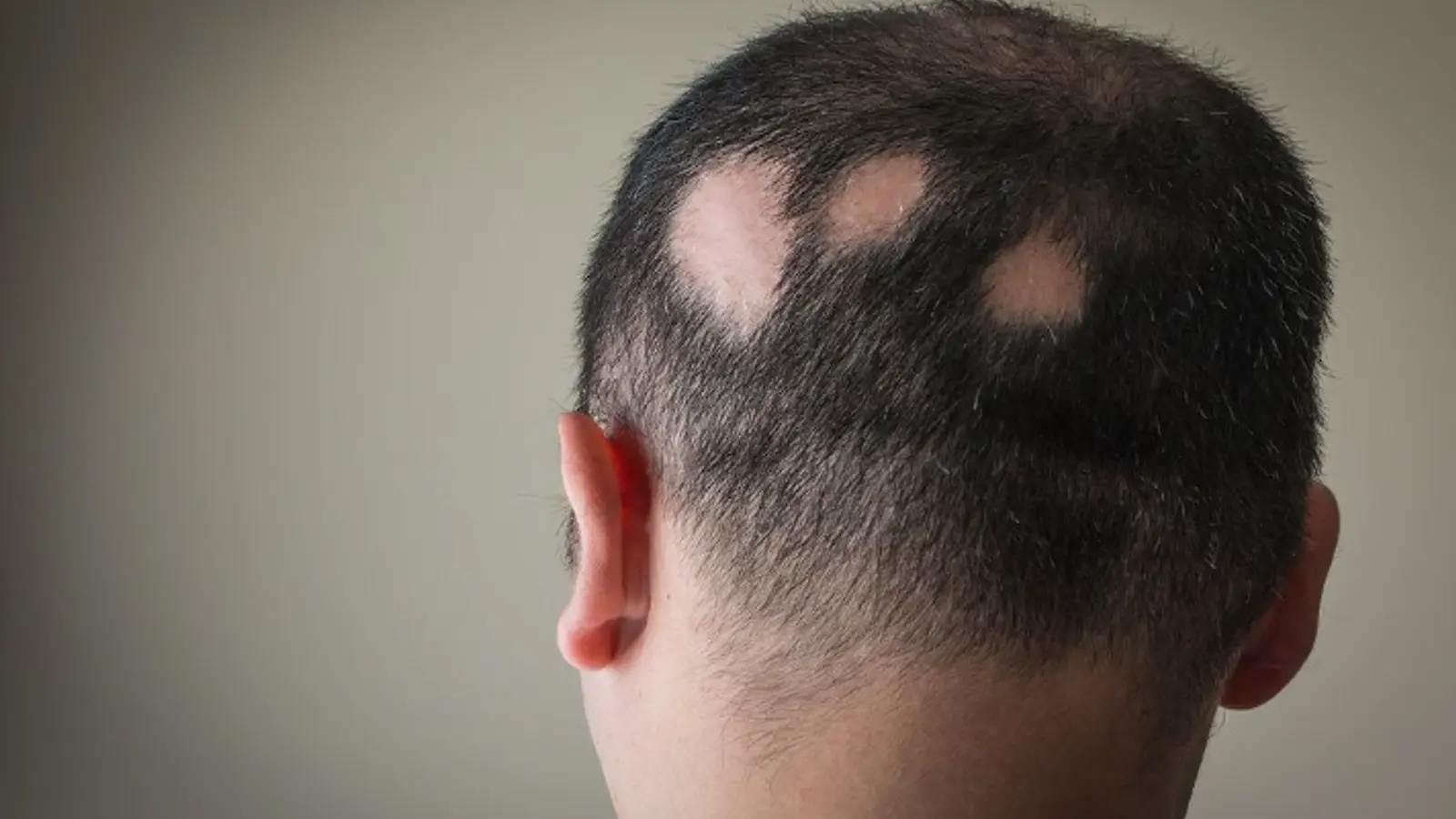
In short
- Alopecia areata treatment is chosen by the extent of hair loss, age and how long the disease has been active; there is no single treatment for everyone12.
- For a small, new patch, waiting is legitimate, because hair often grows back on its own34.
- First line in adults with limited patches: steroid injections into the patch1.
- For extensive hair loss: contact immunotherapy (DPCP) or JAK inhibitor tablets51.
- PRP and stem cells are being studied but are not recommended as routine treatment for alopecia areata12.
What is the best treatment for alopecia areata?
The answer depends on the extent of hair loss and on age. With one or two patches that have been present for less than a year, it is reasonable to wait, because in many people the hair grows back on its own, or to apply a steroid. In adults with scattered patches, steroid is injected into the patch, sometimes with minoxidil added. For extensive hair loss there is contact immunotherapy and JAK inhibitor tablets12.
The American Academy of Dermatology summarizes it this way: children up to age 10 are usually treated with a steroid applied to the skin, sometimes with minoxidil; adults with patches are treated with steroid injections, topical steroids, anthralin and minoxidil; and extensive hair loss is treated with contact immunotherapy (weekly visits) or JAK inhibitors4. Treatment is built in steps: the more extensive the hair loss, the more intensive the treatment. It is important to know up front that no treatment "cures" the disease itself, and hair can fall out again even after a good response. This page follows the British "living" guideline, updated every year, and the German S3 guideline from 202612. What triggers the disease in the first place is explained on What causes alopecia areata?
Do you have to treat alopecia areata?
Not always. With one or a few small, new patches, simply monitoring is a legitimate option. According to Clalit, Israel's largest health fund, the disease resolves within a year without treatment in about half of patients3. In an American study of 127 patients with patches, more than 80% regrew at least half of the hair in the treated area within 12 weeks of steroid injections alone4. Whether to treat, and when, is a conversation between the patient and the doctor, and also depends on how much the patch is affecting you emotionally. More on the natural course: Does alopecia areata go away?
How is a treatment chosen?
The choice is based on the extent of hair loss (measured as a SALT percentage), age, how long the disease has been active, and whether the eyebrows or eyelashes are involved. Guidelines suggest a ladder: monitoring or a cream for limited disease, injections for adults with moderate disease, and DPCP or JAK inhibitors for extensive hair loss12. How SALT is scored is explained on Types of alopecia areata.
| Situation | Accepted options | What to know |
|---|---|---|
| Small, new patch | Monitoring, or a steroid cream or solution | Waiting is legitimate; hair often grows back on its own34 |
| A few patches in adults | Steroid injections into the patch | First line in adults1; in children a cream is preferred26 |
| Moderate to extensive hair loss | Contact immunotherapy (DPCP) | Some regrowth in about two thirds; relapses are common5 |
| Extensive hair loss (50% or more) | JAK inhibitors | In Israel's basket for adults and from age 12; significant safety warnings178 |
| Add-on at any stage | Minoxidil | Encourages growth; does not act on the immune process29 |
Steroid cream or solution: for whom and for how long?
A potent topical steroid, once a day for three to six months, is a reasonable option for limited patches and for children. The British guideline gives it a strong recommendation, but one based mainly on expert consensus rather than high-quality trials1. The German guideline suggests it for children with mild to moderate disease and for adults, and advises stopping if there is no response after three months2. To be honest about the evidence: a 2008 Cochrane review found that no treatment, including topical steroids, showed a clear benefit over placebo in the studies available at the time, which shows how weak the evidence in this field is overall9.
Steroid injections into the patch: for whom?
This is the accepted first-line treatment for adults with limited to moderate patches. In a study of 127 patients, more than 80% regrew at least half of the hair in the treated area within 12 weeks4. Injections are usually repeated every 4 to 12 weeks: the American Academy of Dermatology mentions every 4 to 6 weeks4, and the 2025 British guideline suggests considering an interval of 6 to 12 weeks1. In children the German guideline does not recommend injections, and in teenagers they can be considered for moderate to severe disease2. The full process and side effects are on Steroid injections for alopecia areata.
What is DPCP (contact immunotherapy), and how well does it work?
DPCP is a chemical applied to the scalp to provoke a mild, controlled allergic reaction that draws the immune system's attention away from the hair follicle. In a meta-analysis of 45 studies and about 2,200 patients, some regrowth occurred in 65.5% overall, 74.6% in patchy disease and only 54.5% in totalis or universalis. Complete regrowth was recorded in about a third. The response was weaker with more extensive disease, atopy or nail changes, and relapse rates were high5. The British guideline recommends DPCP for moderate to severe disease, and the German guideline adds that in children it should only be considered as an individual trial12. More detail in Hebrew: Contact immunotherapy (DPCP) (Hebrew).
What about anthralin and light therapy?
Anthralin is a cream that deliberately irritates the skin and can be considered. According to the American Academy of Dermatology, it is applied to the bald areas, left on for a time set by the doctor and then washed off, and it causes some skin irritation4. DermNet notes that its use is limited in people with fair hair, because it stains the skin and hair brown10. The German-European S3 guideline states that anthralin can be offered to children and adults as an off-label treatment2.
For light therapy, the same guideline recommends against offering PUVA (a light-sensitizing drug combined with UVA) and against UVA1, in all forms of the disease and at all ages. Targeted UVB (laser or excimer lamp) can be considered off-label; reported side effects are redness, darkening of the skin, itching and mild peeling2. Low-level red light is a different treatment, described on Scalp phototherapy.
JAK inhibitors: who are they for?
JAK inhibitors are tablets that dampen the immune signal attacking the follicle, and they are intended for extensive hair loss. In the large trials, about a third of adults reached hair on at least 80% of the scalp within 24 to 36 weeks111213. In Israel, two drugs are funded in the health basket for severe alopecia areata: baricitinib for adults and ritlecitinib from age 1278. Baricitinib's own approval was extended to age 12 and up in the European Union in April 2026 and in the US in September 20262122, but the Israeli basket still funds it for adults only. They carry significant warnings about infections, blood clots and heart events, and they are prescribed by a specialist dermatologist. Eligibility, side effects and what happens when you stop are covered on JAK inhibitors for alopecia areata.
Does minoxidil help?
Minoxidil can help as an add-on, but it does not act on the immune process itself. The German guideline allows its off-label use at all ages in mild to moderate disease, with no recommendation in severe disease2. The Cochrane review did not find a clear advantage over placebo9. So it is best seen as a possible add-on to the main treatment rather than a treatment on its own. More on the drug itself: Minoxidil.
Does PRP help alopecia areata?
The honest answer: the evidence is limited and conflicting, and current guidelines do not recommend PRP as routine treatment. PRP (platelet-rich plasma) is prepared from the patient's own blood and has been injected into the scalp in several small studies. The first, small 2013 trial found relatively good results compared with steroid injection, but the authors themselves described it as a pilot study14. A 2022 meta-analysis of four trials found no significant difference between PRP and triamcinolone, with high variability between studies15. In another controlled trial from 2020, steroid injection produced more regrowth than PRP16. A larger 2025 meta-analysis found improved hair density, but it was written by researchers linked to a company that makes PRP systems and did not separate the types of hair loss well enough17.
The British guideline says there is not enough evidence to recommend PRP, and the German guideline says it cannot recommend for or against it, and that it should not be offered to children and teenagers at all12. It may be an additional option for adults who do not respond to steroid or cannot receive it, after a conversation about what is and is not known. For iPRF and CGF, newer versions of the same idea, no controlled trials in alopecia areata were found, so there is no basis to say they work in this disease. For pattern hair loss, PRP is a different story: PRP for hair loss.
Stem cells and micrografts: what is known?
The evidence is very early, and there are no controlled trials in alopecia areata. A 2026 review describes stem cell therapies as a field with potential in hair loss in general, but notes that long-term safety and efficacy have not yet been tested18. For autologous scalp micrografts, no study was found that examined them specifically in alopecia areata. A 2019 case report described multifocal alopecia areata appearing after autologous dermal micrograft injections given for a different type of hair loss, a reminder that skin interventions are not always immunologically neutral19. At the current state of knowledge, these approaches should be regarded as experimental only.
Steroid tablets, methotrexate and others: when?
These are reserved for hair loss that is progressing very fast, and only for a short time, because of their whole-body side effects. The British guideline addresses systemic steroids (tablets or infusion) in such situations1. Methotrexate and ciclosporin are mentioned in the European consensus and the German guideline as options with a limited role, mainly when JAK inhibitors are unavailable or unsuitable220.
How long until you see improvement, and what if treatment does not work?
Usually three to five months, sometimes longer. This applies to most treatments, injections, creams, DPCP and JAK inhibitors alike, and reflects the natural hair growth cycle6. New hair can be fine and light at first and thicken gradually; see Signs of regrowth.
If there is no improvement after several months, the usual approach is to consider moving to the next line of treatment rather than continuing indefinitely. The German guideline says this explicitly for topical steroids, and a similar principle applies to injections and DPCP. When nothing works, non-medical options are a legitimate part of the picture too: wigs, permanent make-up and emotional support2. Eyebrows and eyelashes can be affected on their own or with the scalp, and some treatments act on them too12; see Alopecia areata of the eyebrows, eyelashes and nails. Children are treated differently, mainly with creams: Alopecia areata in children.
Where can you get alopecia areata treatment in Tel Aviv and Israel?
In Israel there are three main routes: a dermatologist through your health fund (kupat holim), hospital hair clinics such as Ichilov (Tel Aviv Sourasky) and Sheba, which you reach with a referral and a Form 17, and private hair medicine clinics. JAK inhibitors from the health basket are prescribed on every route by a specialist dermatologist.
Dr. Dana Buchbut (M.D., license no. 115672) has practiced hair medicine since 2010, at her clinic in Beit HaRofim, HaBarzel 11, Ramat HaHayal, Tel Aviv:
- Alopecia areata is diagnosed with a trichoscopy examination using a FotoFinder device. The examination takes one to two hours, and it is recommended to wash your hair beforehand.
- For limited disease, steroid injections into the scalp are given after the examination, with the concentration and intervals set individually.
- When JAK inhibitors are being considered, they are started on a prescription from a specialist dermatologist, and regrowth follow-up continues at the clinic.
- No referral is needed. Patients under 18 are seen with a parent's consent. You receive an invoice for private insurance.
What happens at the first visit, and how the routes compare: Alopecia areata in Tel Aviv. Back to the main guide: Alopecia areata.
Frequently asked questions
What is the best treatment for alopecia areata?
It depends on the extent and on age. With one or two patches present for less than a year you can wait, because hair often regrows on its own, or apply a steroid. Adults with scattered patches usually receive steroid injections into the patch, sometimes with minoxidil. Extensive hair loss is treated with contact immunotherapy or JAK inhibitor tablets.
Is there a cure for alopecia areata?
There is currently no treatment that cures the disease itself, meaning that permanently stops the immune attack. Treatments encourage regrowth or calm the inflammation around the follicle while it is active, but in some people the disease returns even after full regrowth.
What is the first treatment to try?
It depends on the extent. For a small, new patch you can start with monitoring alone or a steroid cream. In adults with a few limited patches, steroid injection is usually first line.
Cream or injection: which is better?
It is more a matter of fit than of superiority. A cream is easier and suits children and relatively large areas; an injection delivers a higher drug concentration to a specific spot, so it is more common in adults with well-defined patches.
How long does it take to see results?
With most treatments it takes three to five months to see clear improvement, sometimes longer. New hair can be fine and light at first and then thicken and regain color.
Are JAK inhibitors covered in Israel?
Yes, for severe alopecia areata. Israel's health basket funds baricitinib for adults and ritlecitinib from age 12, under defined criteria, on a prescription from a specialist dermatologist.
Does PRP help alopecia areata?
The evidence is limited and conflicting. Current British and German guidelines do not recommend it as routine treatment, and it is not offered to children. It may be considered as an additional option for adults who did not respond to steroid, after a discussion of what is and is not known.
Does light therapy help alopecia areata?
The European S3 guideline recommends against PUVA and UVA1 for alopecia areata. Targeted UVB (laser or excimer lamp) can be considered off-label, with side effects such as redness, skin darkening, itching and mild peeling.
Is there a natural treatment that works?
No natural treatment has been proven effective in controlled studies. Because hair often regrows on its own in alopecia areata, any treatment, including one that does nothing, can look as if it worked.
Where is alopecia areata treated in Israel?
There are three main routes: a dermatologist through your health fund, hospital hair clinics such as Ichilov and Sheba (with a referral and Form 17), and private hair medicine clinics. In central Israel, one private clinic is that of Dr. Dana Buchbut in Ramat HaHayal, Tel Aviv, where diagnosis starts with a FotoFinder trichoscopy and no referral is needed.
Sources
- Harries MJ, et al. British Association of Dermatologists living guideline for managing people with alopecia areata 2025. Br J Dermatol. 2026;194(2):e56-e73. doi:10.1093/bjd/ljaf452. doi.org
- Blume-Peytavi U, et al. S3 guideline diagnostics and therapy in alopecia areata, Part 2: therapy, psychosocial and cosmetic support. J Dtsch Dermatol Ges. 2026. PMC13435026. pmc.ncbi.nlm.nih.gov
- Clalit Health Services. Alopecia areata (Hebrew). clalit.co.il. www.clalit.co.il
- American Academy of Dermatology. Alopecia areata: diagnosis and treatment. www.aad.org
- Lee S, et al. Hair regrowth outcomes of contact immunotherapy for patients with alopecia areata: a systematic review and meta-analysis. JAMA Dermatol. 2018;154(10):1145-1151. doi:10.1001/jamadermatol.2018.2312. doi.org
- Mayo Clinic Press. How is alopecia areata treated?. mcpress.mayoclinic.org
- Recommendations of the public committee for expanding the Israeli health basket for 2024 (Hebrew, PDF). a7.org
- Expansion of the Israeli health basket for 2025: Medical Technologies Division circular (Hebrew, Wikirefua). www.wikirefua.org.il
- Delamere FM, et al. Interventions for alopecia areata. Cochrane Database Syst Rev. 2008;(2):CD004413. doi:10.1002/14651858.CD004413.pub2. doi.org
- DermNet. Alopecia areata. dermnetnz.org
- King B, et al. Two phase 3 trials of baricitinib for alopecia areata. N Engl J Med. 2022;386(18):1687-1699. doi:10.1056/NEJMoa2110343. doi.org
- King B, et al. Efficacy and safety of ritlecitinib in adults and adolescents with alopecia areata (ALLEGRO-2b/3). Lancet. 2023;401(10387):1518-1529. doi:10.1016/S0140-6736(23)00222-2. doi.org
- King B, et al. Efficacy and safety of deuruxolitinib in adults with alopecia areata (THRIVE-AA1). J Am Acad Dermatol. 2024;91(5):880-888. doi:10.1016/j.jaad.2024.06.097. doi.org
- Trink A, et al. A randomized, double-blind, placebo- and active-controlled, half-head study to evaluate the effects of platelet-rich plasma on alopecia areata. Br J Dermatol. 2013;169(3):690-4. doi:10.1111/bjd.12397. doi.org
- Meznerics FA, et al. Platelet-rich plasma in alopecia areata, a steroid-free treatment modality: a systematic review and meta-analysis of randomised controlled trials. Biomedicines. 2022;10(8):1829. doi:10.3390/biomedicines10081829. doi.org
- Hegde P, et al. A randomized, placebo and active controlled, split scalp study to evaluate the efficacy of platelet-rich plasma in patchy alopecia areata. Dermatol Ther. 2020;33(6):e14388. doi:10.1111/dth.14388. doi.org
- Anitua E, et al. Platelet-rich plasma in the management of alopecia: a systematic review and meta-analysis. Dermatol Ther (Heidelb). 2025;15(11):3213-3252. doi:10.1007/s13555-025-01542-8. doi.org
- Stem cell-based therapies for alopecia areata: a narrative review. Stem Cell Res Ther. 2026. doi:10.1186/s13287-026-04926-5. doi.org
- Alopecia areata multiplex following autologous dermal micrograft injection for treatment of androgenetic alopecia. J Eur Acad Dermatol Venereol. 2019. (PMID 31120162). pubmed.ncbi.nlm.nih.gov
- Rudnicka L, et al. European expert consensus statement on the systemic treatment of alopecia areata. J Eur Acad Dermatol Venereol. 2024;38(4):687-694. doi:10.1111/jdv.19768. doi.org
- European Medicines Agency. CHMP post-authorisation summary of positive opinion for Olumiant (baricitinib): severe alopecia areata in adults and adolescents 12 years and older. 2026. www.ema.europa.eu
- U.S. Food and Drug Administration. Baricitinib tablets: US prescribing information (indication for severe alopecia areata in adults and pediatric patients 12 years and older, 09/2026). DailyMed. dailymed.nlm.nih.gov
Related reading
Alopecia areata
Causes, outlook and treatments, the full overview.
ReadJAK inhibitors for alopecia areata
Baricitinib and ritlecitinib: results, ages, risks and the Israeli basket.
ReadSteroid injections
How injections into the patch work, how often and side effects.
ReadAlopecia areata in Tel Aviv
Diagnosis, treatment and follow-up in Tel Aviv.
ReadAlopecia areata in children
What parents should know about treatment in children.
ReadTrichoscopy (scalp analysis)
What the magnified scalp examination shows.
ReadThe information on this page is general and for education only. It does not replace an examination, diagnosis or personal medical advice. Any decision about treatment is made only after an examination.