

In short
- Alopecia areata is common in children, more so than in adults, and it is not caused by anything the parents did12.
- In young children with one or two bald patches, the hair often grows back on its own3.
- The preferred treatment in children is topical (a steroid cream); injections are less usual at a young age45.
- From age 12 there is a tablet (a JAK inhibitor) in Israel's health basket for children with severe disease67.
- Emotional support and a conversation with the school are part of the treatment, not an extra48.
Why did this happen to my child?
Alopecia areata is an autoimmune condition, not the result of something parents did or did not do. It arises from a combination of genetic predisposition and an immune response92. This is worth saying plainly, because guilt is very common among parents and it is not justified. More on the background: what causes alopecia areata, and an overview of the condition on the main alopecia areata page.
It is the most common type of hair loss in children24, and in a review of hair loss in children, about 20% of patients with alopecia areata were under 1625.
Is it alopecia areata or something else?
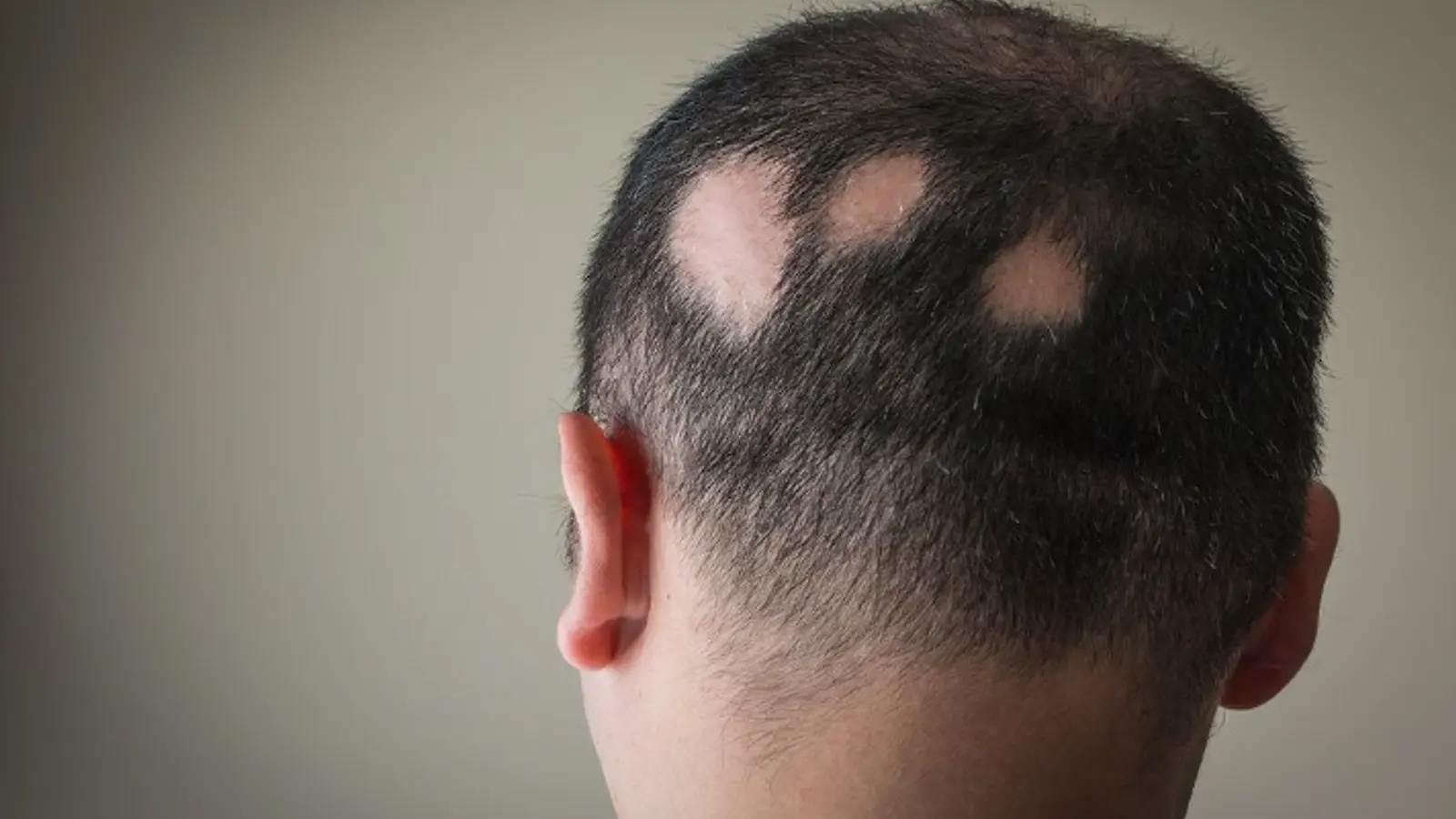
A round, smooth bald patch without scaling or redness fits alopecia areata, but several look-alike conditions are common in children specifically. Scalp ringworm (tinea capitis) occurs mainly in children and usually comes with scaling, itching and sometimes unevenly broken hairs. Trichotillomania, or hair pulling, looks different: the edge of the patch is not smooth and hairs of different lengths are seen. In babies, friction hair loss at the back of the head is also common; it comes from lying down and has nothing to do with an autoimmune condition10. An accurate diagnosis needs a clinical examination, and sometimes a magnified examination of the scalp.
The most common mix-up in practice is between alopecia areata and scalp ringworm, because both can start as a small area of hair loss. The practical difference: in ringworm there is almost always some change in the skin itself, such as scaling, redness, itching or hairs breaking close to the skin, whereas in alopecia areata the skin stays smooth and clean10. When in doubt, a short examination by a doctor, and sometimes a fungal culture, gives a clear answer.
Does a child with alopecia areata need blood tests?
No blood test diagnoses alopecia areata, but thyroid function is sometimes checked, because thyroid disease is more common in people with the condition. A review of studies in children and adolescents found that the disease is often accompanied by other conditions: atopic diseases (such as eczema and asthma), vitiligo, thyroid disease and emotional difficulties11. A meta-analysis of 50 studies found that thyroid dysfunction and thyroid antibodies are more common in people with alopecia areata, and the researchers recommend screening for them12.
In practice there is no need for a battery of tests "just in case," but tell the doctor about eczema, asthma, white patches on the skin or autoimmune disease in the family, and the doctor will decide which tests fit the picture1012. Small pits or roughness in the nails are also worth showing at the examination13.
Will the hair grow back?
Often, yes. According to the American Academy of Dermatology, many people, and children in particular, regrow their hair without treatment, especially when there are one or two patches that have been present for less than a year; children under 10 tend to regrow hair even without intervention3. However, when the disease starts at a young age or the hair loss is extensive, the chance of recovery is lower and repeated episodes are possible23.
A long-term follow-up study of patients diagnosed in childhood found that the course in children can be harder in the long run than in adults, and that the severity of the disease at the first visit is the most important predictor of how it will develop14. In that follow-up, 18 of 39 children had alopecia totalis or universalis by the end, although this trend was not statistically significant14. In practice: a small first episode is an encouraging sign, but no one can promise in advance how the disease will progress. More: does alopecia areata go away?
How is alopecia areata treated in children?
Treatment depends on age and the extent of hair loss. According to the American Academy of Dermatology, with a few patches it is reasonable to wait, because the hair often grows back on its own. In children up to age 10, a strong steroid cream and minoxidil are used, while injections into the patch are reserved mainly for adults because of the pain3. Minoxidil is a good option for children because it has few side effects3.
The current German guideline does not recommend steroid injections in children at all and suggests considering them only in teenagers with moderate to severe disease4. Mayo Clinic Press notes specifically that under age 10 a cream is preferred to injections5. Contact immunotherapy (DPCP) is possible in children only as an individual trial, not as routine treatment, and the German guideline states explicitly that PRP should not be offered to children and adolescents4.
| Age group | What is usually considered | What is less usual |
|---|---|---|
| Young children (up to 10) | Watchful waiting, steroid cream | Injections, DPCP, PRP45 |
| Older children and teenagers | Cream; sometimes injections for moderate to severe disease | PRP; DPCP only as an individual trial4 |
| From 12, severe disease | JAK inhibitors (ritlecitinib in Israel's health basket) | - |
How strong is the evidence in children? Weaker than parents expect. A systematic review of all studies on treating alopecia areata under 18 found 122 publications covering 1,032 children, but only two randomized controlled trials; most of the rest were case series and case reports. It concluded that steroid creams are the preferred first-line treatment in children, because they have the strongest evidence, followed by contact immunotherapy15. The table is a general guide only; the final decision depends on the individual child, the family's preferences and the treating doctor's judgment. All options are compared on the page alopecia areata treatment, and injections are covered in steroid injections for alopecia areata.
Systemic steroids, methotrexate and the new tablets: from what age?
In children and adolescents with mild or moderate alopecia areata, the German guideline recommends against systemic steroids and methotrexate. In severe or very severe disease they can be considered, but this is off-label use. If systemic steroids are chosen, the guideline prefers intermittent high-dose "pulse" courses over continuous use. Methotrexate can harm a fetus, so a girl taking it needs effective contraception during treatment and for six months afterward4. These are not first-line treatments, and the evidence for them in children is limited15.
JAK inhibitors. Ritlecitinib is approved for severe alopecia areata from age 12 according to the US label26, and in Israel it has been in the health basket from age 12 since 2024627; in 2025 its basket indication was extended to adults7. Baricitinib is approved for severe alopecia areata from age 12 in the United States (label revised in September 2026)28 and in the European Union (European Commission decision, April 2026)29, but in Israel's health basket it is funded for adults only616. A real-world study of both drugs in children and adolescents, published in 2026, shows that they are used in clinical practice, mainly from age 1217. Below age 12 there is currently no approved drug from this group for alopecia areata. JAK inhibitors are prescribed by a specialist dermatologist. Full details, including side effects and eligibility: JAK inhibitors for alopecia areata.
Protecting your child's scalp
Skin without hair burns more easily in the sun, so outdoors a wide-brimmed hat or a wig helps, or sunscreen on the scalp. The American Academy of Dermatology recommends a broad-spectrum, water-resistant sunscreen with SPF 30 or higher, reapplied every two hours and after sweating or swimming18. For children who spend hours in the playground, at the beach or in the pool, a sunscreen in the school bag is a good habit. A few more practical tips from the same advice18:
- In winter: a bare scalp is more sensitive to cold, and a hat or scarf helps.
- When eyelashes or eyebrows fall out: they protect the eyes from sweat, dust and light. A hat, headband or glasses can help; tell the doctor too. See alopecia areata of the eyebrows and eyelashes.
- A wig or head covering: not a treatment, but a legitimate option if the child wants one. On wig reimbursement in Israel: rights and benefits in alopecia areata (Hebrew).
Talking with your child and the school, and emotional support
The recommended approach is honest and reassuring: explain that it is not contagious, that it is not their fault, and that doctors help many children in a similar situation. HeadsUp (Barosh Muram), the Israeli association that supports families living with alopecia areata, offers age-appropriate materials for this conversation, as well as tools for the school: a ready-made letter to the teacher, a classroom presentation and a short video suitable for kindergartens8. Talking with the teaching staff can prevent awkward questions and support the child among friends.
Even in young children, a visible bald patch can affect confidence and self-image, especially as they grow and become more aware of differences from their friends. An international survey of patients with severe disease, adults and children, found a significant impact on quality of life in most respondents and high rates of anxiety and depression21. A systematic review of studies in children and adolescents found recurring themes of lower self-esteem, emotional distress and social difficulties, with stress, coexisting mental health conditions and family difficulties linked to the disease at these ages22. Most of the studies were short-term and varied, so it is hard to know in advance who will cope easily and who will need more help. That is another reason to ask your child how they feel from time to time, even when everything seems fine.
When there are signs of distress, such as social withdrawal, a drop in functioning or anxiety about appearance, it is worth seeking professional support rather than waiting for it to pass. The German guideline explicitly recommends informing every patient and family about psychological support and support groups4. An Israeli study found an increased association between alopecia areata and anxiety and depression in the general population, and mental health care is included in Israel's health basket1920.
How is it done at Dr. Dana Buchbut's clinic?
At the clinic in Beit HaRofim, HaBarzel 11, Ramat HaHayal, Tel Aviv:
- Patients under 18 are seen with a parent's consent, and no referral is needed.
- The visit starts with a trichoscopy examination with a FotoFinder device: the patch and the surrounding hairs are examined under magnification to confirm the diagnosis and rule out scalp ringworm, which is common in children. The examination is painless, takes one to two hours, and it is recommended to wash the hair beforehand.
- Regrowth is followed at scheduled visits, and the plan is adapted to the child and the family.
- An invoice is provided for private insurance, and the consultation fee is offset against treatment if you go ahead.
It is worth booking an examination when a new patch appears, when scaling, redness or itching suggest a fungal infection, when the hair loss spreads quickly, or when the eyebrows or eyelashes change. Practical details: alopecia areata care in Tel Aviv.
Frequently asked questions
Does alopecia areata in children go away?
Often, yes. According to the American Academy of Dermatology, many children regrow their hair without treatment, especially with one or two patches present for less than a year. When the disease starts at a young age or the hair loss is extensive, the chance of recovery is lower and relapses are possible, so examination and follow-up are worthwhile.
How is alopecia areata treated in children?
It depends on age and extent. With a few patches it is reasonable to wait. In children up to 10, a strong steroid cream and minoxidil are used, and injections are reserved mainly for adults. For severe hair loss, JAK inhibitor tablets can be considered from age 12.
At what age can a child get alopecia areata?
At any age, including early childhood. The condition is actually more common in children than in adults, and a large share of cases start before age 20.
Is a bald spot on a baby's head alopecia areata?
Not necessarily. In babies, friction hair loss at the back of the head is common; it comes from lying down and is not related to an autoimmune disease. An accurate diagnosis requires an examination.
Is it contagious to other children at kindergarten or school?
No. Alopecia areata is an autoimmune condition, not an infection, and there is no risk of spreading it between children.
Is there a pill for children with alopecia areata?
From age 12 there are JAK inhibitors for severe disease. Ritlecitinib is approved from 12 and is in Israel's health basket from 12. Baricitinib is approved from 12 in the US and EU but is funded in Israel's basket for adults only. Below 12 there is currently no approved drug from this group.
Are JAK inhibitors safe for children?
They carry significant safety warnings that apply at all ages, and the British guideline notes that long-term safety in children and adolescents is not yet known. The decision to use them is made individually by a specialist dermatologist.
Will my child lose all their hair?
Not necessarily, and it cannot be predicted in advance. Most children with a small first episode regrow their hair, but the extent of the disease at the first visit is the most important factor for the long-term outlook.
Did this happen because of stress at home or at school?
No. Stress may act as a trigger, but it is not a proven cause, and it is certainly not the parents' fault or related to anything they did or did not do.
Does my child need sunscreen on the bald patch?
Yes. Skin without hair burns more easily. Outdoors, a wide-brimmed hat or a wig helps, or a water-resistant sunscreen with SPF 30 or higher, reapplied every two hours and after swimming.
Sources
- Lee HH, et al. Epidemiology of alopecia areata, ophiasis, totalis, and universalis: a systematic review and meta-analysis. J Am Acad Dermatol. 2020;82(3):675-682. doi:10.1016/j.jaad.2019.08.032. doi.org
- Jackow C, et al. Alopecia areata and cytomegalovirus infection in twins: genes versus environment? J Am Acad Dermatol. 1998;38(3):418-25. (PMID 9520023). pubmed.ncbi.nlm.nih.gov
- American Academy of Dermatology. Alopecia areata: diagnosis and treatment. www.aad.org
- Blume-Peytavi U, et al. S3 guideline diagnostics and therapy in alopecia areata, Part 2: therapy, psychosocial and cosmetic support. J Dtsch Dermatol Ges. 2026. PMC13435026. pmc.ncbi.nlm.nih.gov
- Mayo Clinic Press. How is alopecia areata treated?. mcpress.mayoclinic.org
- Israel Ministry of Health. Recommendations of the public committee for expanding the health basket for 2024 (Hebrew, PDF). a7.org
- Expansion of the health basket for 2025: Medical Technologies Division circular (Hebrew, Wikirefua). www.wikirefua.org.il
- HeadsUp (Barosh Muram) Israeli alopecia areata association. Alopecia areata in children (Hebrew). headsup.org.il
- Gilhar A, Etzioni A, Paus R. Alopecia areata. N Engl J Med. 2012;366(16):1515-25. doi:10.1056/NEJMra1103442. doi.org
- DermNet. Alopecia areata. dermnetnz.org
- Adhanom R, Ansbro B, Castelo-Soccio L. Epidemiology of pediatric alopecia areata. Pediatr Dermatol. 2025;42 Suppl 1:12-23. doi:10.1111/pde.15803. doi.org
- Lee S, et al. Screening of thyroid function and autoantibodies in patients with alopecia areata: a systematic review and meta-analysis. J Am Acad Dermatol. 2019;80(5):1410-1413. doi:10.1016/j.jaad.2018.10.066. doi.org
- Chelidze K, Lipner SR. Nail changes in alopecia areata: an update and review. Int J Dermatol. 2018;57(7):776-783. doi:10.1111/ijd.13866. doi.org
- Tosti A, Bellavista S, Iorizzo M. Alopecia areata: a long term follow-up study of 191 patients. J Am Acad Dermatol. 2006;55(3):438-41. doi:10.1016/j.jaad.2006.05.008 (PMID 16908349). doi.org
- Barton VR, Toussi A, Awasthi S, Kiuru M. Treatment of pediatric alopecia areata: a systematic review. J Am Acad Dermatol. 2022;86(6):1318-1334. doi:10.1016/j.jaad.2021.04.077. doi.org
- National Alopecia Areata Foundation (NAAF). FDA-approved JAK inhibitors. www.naaf.org
- Cecere D, et al. Long-term real-world effectiveness of ritlecitinib and baricitinib in children and adolescents with alopecia areata: 24-month retrospective study. Clin Exp Dermatol. 2026. doi:10.1093/ced/llag400. doi.org
- American Academy of Dermatology. Alopecia areata: self-care. www.aad.org
- Tzur Bitan D, Berzin D, Kridin K, Cohen A. The association between alopecia areata and anxiety, depression, schizophrenia, and bipolar disorder: a population-based study. Arch Dermatol Res. 2022;314(5):463-468. doi:10.1007/s00403-021-02247-6. doi.org
- HeadsUp (Barosh Muram). Rights of people with alopecia areata (Hebrew). headsup.org.il
- Bewley A, et al. Patient-reported burden of severe alopecia areata: first results from the Multinational Alopecia Areata Unmet Need Survey. Clin Cosmet Investig Dermatol. 2024;17:751-761. doi:10.2147/CCID.S445646. doi.org
- Tan IJ, Jafferany M. Psychosocial impact of alopecia areata in paediatric and adolescent populations: a systematic review. J Paediatr Child Health. 2024;60(12):778-782. doi:10.1111/jpc.16678. doi.org
- British Association of Dermatologists, Patient Hub. Alopecia areata. www.skinhealthinfo.org.uk
- American Academy of Dermatology. Alopecia areata: causes. www.aad.org
- Xu L, Liu KX, Senna MM. A practical approach to the diagnosis and management of hair loss in children and adolescents. Front Med (Lausanne). 2017;4:112. pmc.ncbi.nlm.nih.gov
- U.S. FDA. Ritlecitinib (Litfulo) prescribing information. DailyMed. dailymed.nlm.nih.gov
- HeadsUp (Barosh Muram). JAK inhibitor medications (Hebrew). headsup.org.il
- U.S. FDA. Baricitinib (Olumiant) prescribing information, revised 10/2026 (alopecia areata indication updated 09/2026). DailyMed. dailymed.nlm.nih.gov
- European Medicines Agency. CHMP post-authorisation summary of positive opinion for Olumiant (extension to adolescents 12 years and older with severe alopecia areata), 26 February 2026. www.ema.europa.eu
Related reading
Alopecia areata
Causes, outlook and treatments, including JAK inhibitors.
ReadAlopecia areata treatment
Which treatment fits which extent of hair loss.
ReadJAK inhibitors for alopecia areata
Baricitinib and ritlecitinib: ages, results and risks.
ReadDoes alopecia areata go away?
What is known about recovery, relapses and the outlook.
ReadAlopecia areata in Tel Aviv
Diagnosis, treatment and follow-up in Tel Aviv.
ReadCoping with alopecia areata (Hebrew)
Emotions, school and work.
ReadThe information on this page is general and for education only. It does not replace an examination, diagnosis or personal medical advice. Any decision about treatment is made only after an examination.