

In short
- JAK inhibitors are tablets that suppress the immune signal attacking the hair follicle1.
- Two are in Israel's health basket for severe alopecia areata: baricitinib for adults and ritlecitinib from age 1223.
- In the trials, about a third of adults with extensive hair loss reached hair on at least 80% of the scalp45.
- The whole drug class carries a serious safety warning: infections, blood clots, heart events and cancer67.
- When treatment stops, hair loss may return; this is long-term treatment6.
What are JAK inhibitors and how do they work?
JAK inhibitors block an internal cell signaling pathway called JAK-STAT, through which immune cells "call in" the attack on the hair follicle. The mechanism was identified in basic research: cytotoxic T cells and interferon-gamma signal through this pathway, and blocking it restored hair in animal models and in the first patients, the scientific basis for developing the drugs1.
Unlike local treatments such as a cream or an injection, JAK inhibitors are taken by mouth and act on the whole body. That is what lets them reach areas that are hard to treat locally, such as an extensive scalp area, eyebrows and eyelashes at the same time, but it is also why their side effects are systemic rather than only local. They are one step on the wider alopecia areata treatment ladder, intended for extensive hair loss.
Which drugs are approved for alopecia areata?
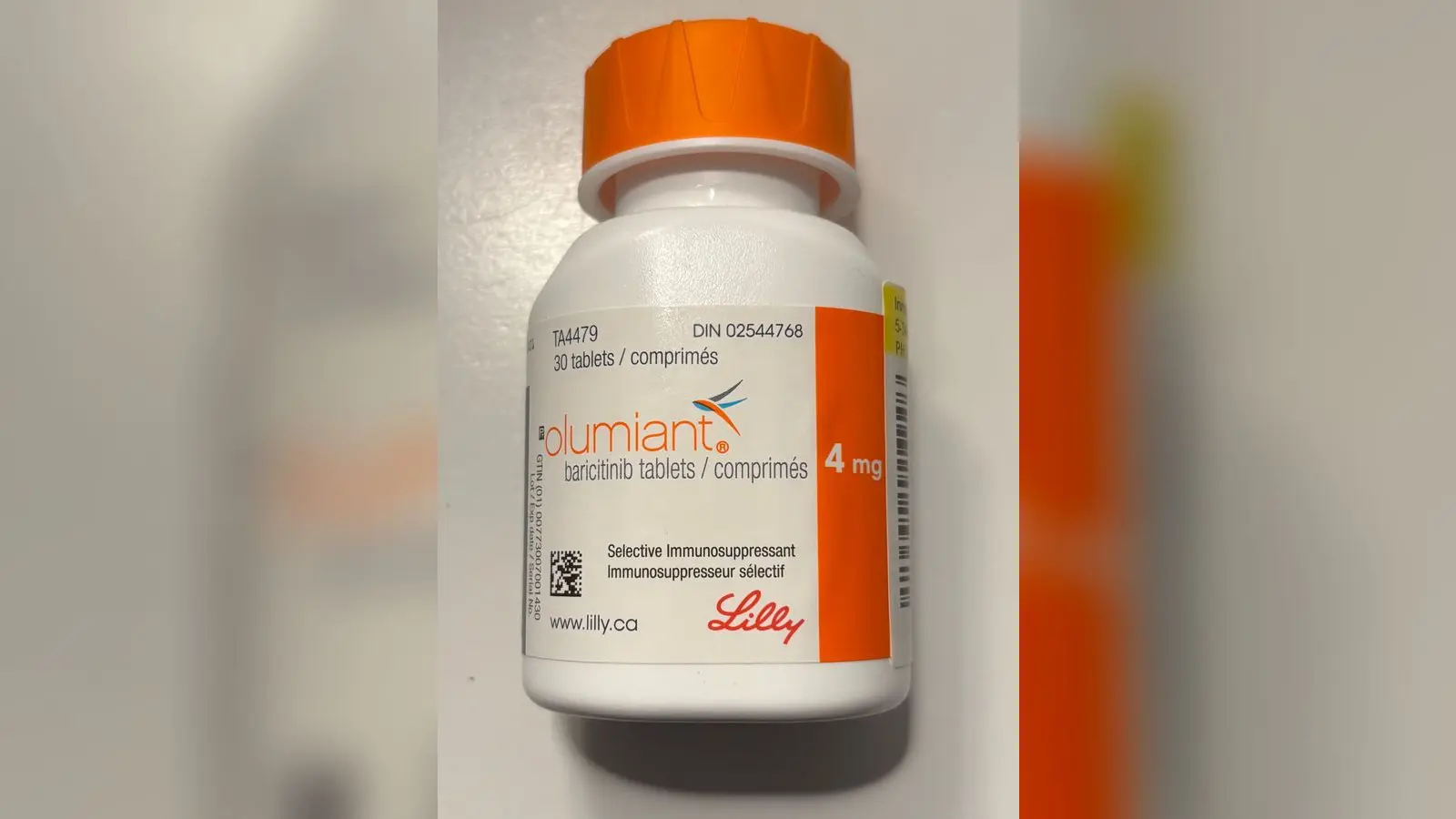
Several drugs in this class have been approved specifically for severe alopecia areata, and two of them are in Israel's health basket. Baricitinib was approved in Europe in May 2022 and in the US in June 2022 for adults with severe disease; ritlecitinib was approved in the US in June 2023 and in Europe in September 2023, from age 128. Baricitinib's indication was later extended to adolescents aged 12 and over: by the European Commission in April 2026 and in the US label in September 20262214. A third drug, deuruxolitinib, was approved in the US in 2024 and in the UK in 2026, but is not currently registered in Israel8. All three are small molecules taken as tablets, not biologics and not injections.
| Drug | Approved age | Status in Israel | Key trial |
|---|---|---|---|
| Baricitinib (Olumiant) | 12 and older (US and EU)1422 | In the basket for severe alopecia areata, adults only2 | BRAVE-AA1/24 |
| Ritlecitinib (Litfulo) | 12 and older15 | In the basket from age 12; extended to adults in 202523 | ALLEGRO-2b/35 |
| Deuruxolitinib (Leqselvi) | Adults | Not registered in Israel | THRIVE-AA19 |
Some other JAK inhibitors are not approved for alopecia areata but are used off-label in individual cases, for example tofacitinib, which is not registered for alopecia areata in Israel and is not in the basket10. Such use is an individual clinical decision by a doctor, not an approved standard treatment.
How well do JAK inhibitors work?
In the large trials, about a third of adults with extensive hair loss reached hair on at least 80% of the scalp (SALT 20 or less) after about six to nine months. In the baricitinib phase 3 trials, 38.8% and 35.9% reached this at week 36 on the 4 mg dose, compared with 6.2% and 3.3% on placebo4. In the ritlecitinib trial, the success rate at week 24 was 23% versus 2% on placebo, and improvement continued at least to week 485. Deuruxolitinib reached SALT 20 or less at week 24 in 29% and 32% in two trials, versus 1% on placebo9.
The drugs look similar in effectiveness across separate studies, but no trial has compared them head to head, so none can be called "better"611. Response varies between patients, so the plan is built after an individual assessment. People with complete scalp or body hair loss can read the Hebrew page on alopecia totalis and universalis (Hebrew).
Who responds better, and how long should you wait before deciding it is not working?
In an analysis of the baricitinib trials, response was better in people who still had some hair and in those whose current episode had lasted less than four years. In people who had lost almost all scalp hair, improvement kept building for up to a year, so the researchers recommend giving treatment at least a year before calling it a failure. This was a retrospective analysis of the two phase 3 trials, funded by the manufacturer12. Even in the group with near-total loss and long-standing disease some patients responded, so long disease duration does not rule out treatment, but the road may be longer. How regrowth looks along the way: Signs of regrowth in alopecia areata.
Who qualifies in Israel's health basket, and at what age?
The Israeli basket defines "severe disease" as loss of 50% or more of scalp hair, or 21% to 49% with clear involvement of the eyebrows or eyelashes. In 2024 the basket committee approved baricitinib for adults and ritlecitinib for children from age 12 with severe alopecia areata2. In the 2025 basket update, ritlecitinib was extended to adults as well3. The definition of severe is based on the SALT score, which measures the percentage of scalp without hair; SALT 50 means half the scalp is bald, and that is the main eligibility threshold3. SALT is explained on Types of alopecia areata.
The general medical definition of "extensive disease" used in trials and guidelines is not the same as the basket's precise administrative definition, which decides who gets public funding. Someone who does not meet the basket criteria can still receive treatment privately on a doctor's recommendation, but that is separate from basket eligibility. Other entitlements, such as wig reimbursement, are on the Hebrew rights page (Hebrew).
Below age 12 there is currently no approved drug from this class for alopecia areata. Teenagers aged 12 to 18 receive ritlecitinib in the basket; baricitinib is funded in the basket for adults only, even though in the US and the EU it is now approved from age 121422.
What are the side effects and warnings?
The whole JAK inhibitor class carries a serious (boxed) warning covering serious infections, blood clots, cardiovascular events, certain cancers and death. The warning applies to every drug in the class, not only those approved for alopecia6713. Beyond the serious risks, the trials saw more common effects such as acne, raised CK enzyme and raised cholesterol4. The current British guideline states explicitly that the long-term safety of these drugs in children, teenagers and adults with alopecia areata is still unknown, because they are relatively new6.
In practice, a conversation about JAK inhibitors has to cover not only the chance of regrowth but also an individual judgment about risk, especially for people with a history of recurrent infections, clotting problems, cardiovascular disease or cancer risk factors. That is why these are prescription drugs that need close medical follow-up, not something to start on your own.
Which tests are needed before and during treatment?
Before starting, the main checks are for latent infections and blood counts. The US-approved labels list the recommended baseline tests1415:
- Tuberculosis: testing for active or latent TB. Treatment is not started with active TB, and preventive treatment is considered first for latent TB.
- Viral hepatitis (B and C): screening according to accepted guidelines.
- Blood count: treatment is not started when lymphocytes, neutrophils or platelets are below a set threshold, or with significant anemia.
- Vaccinations: brought up to date before starting; live attenuated vaccines are avoided shortly before and during treatment.
During treatment, blood counts and signs of infection are monitored. For patients with diabetes, the ritlecitinib label suggests considering closer blood sugar monitoring15.
Can you get pregnant or breastfeed during treatment?
Human data are insufficient, and animal studies found harm to the fetus at high doses, so pregnancy should be planned in advance with the doctor. According to the US baricitinib label, the drug may harm the fetus based on animal studies, and there is not enough information from human pregnancies14. The ritlecitinib label describes similar animal findings and insufficient human data15. Both labels advise against breastfeeding during treatment1415. Anyone planning a pregnancy, or who becomes pregnant during treatment, should talk to the treating doctor as soon as possible.
What are JAK inhibitors used for besides alopecia areata?
JAK inhibitors are not a hair-specific drug; some were approved first for other inflammatory diseases. Baricitinib, for example, is approved in the US for rheumatoid arthritis14, and the 2026 Israeli health basket circular lists an indication for atopic dermatitis at ages 12 to 1816. There is also a JAK inhibitor cream approved in the US for atopic dermatitis and vitiligo17. So searches for "JAK inhibitors" also bring up other diseases with different indications, doses and warnings. For alopecia areata, the German guideline does not recommend JAK inhibitor creams18.
What happens when you stop?
In many patients, hair loss returns when the drug is stopped. That is why the current British guideline added specific recommendations on how to stop, how to handle a response that is too slow, and when to move to long-term maintenance6. In the part of the baricitinib trial that tested withdrawal, among responders who continued treatment about 90% kept their result after about three years, compared with only about 20% of those switched to placebo. This is one manufacturer-funded trial, and the researchers concluded that severe alopecia areata is a chronic disease requiring long-term maintenance treatment19. More on relapses: Does alopecia areata go away?
What about children under 12?
There is currently no JAK inhibitor approved or funded for alopecia areata below age 12. In the BRAVE-AA-PEDS trial in adolescents aged 12 to 18, 42% reached a good result at week 36 versus 2% on placebo20, and this trial underpinned baricitinib's later approval from age 12 in the EU and the US2214. A real-world study published in 2026 shows that both drugs are used in this age group in individual cases, mainly from age 1221. More for parents: Alopecia areata in children.
Who prescribes, and what is Dr. Buchbut's role?
In Israel, JAK inhibitors for alopecia areata are started on a prescription from a specialist in dermatology and venereology, according to the basket rules16. If you are wondering whether you are a suitable candidate, you can start with an examination that assesses the extent of hair loss and your general medical history, and be referred accordingly.
At Dr. Dana Buchbut's clinic in Beit HaRofim, HaBarzel 11, Ramat HaHayal, Tel Aviv:
- The examination includes trichoscopy with a FotoFinder device, which assesses the extent of hair loss and the state of the follicles. It takes one to two hours, and it is recommended to wash your hair beforehand.
- Regrowth is followed over time at the clinic.
- When JAK inhibitors are not the right tool, or until they are reached, other options can be considered, such as steroid injections into the patch.
- No referral is needed, and patients under 18 are seen with a parent's consent.
Comparing the routes in Tel Aviv: Alopecia areata in Tel Aviv. The full overview: Alopecia areata.
Frequently asked questions
Is there a new drug for alopecia areata?
Yes. In recent years JAK inhibitor tablets have been approved for severe alopecia areata: baricitinib, ritlecitinib and deuruxolitinib. In the large trials, about a third of patients with hair loss on half the scalp or more reached hair on at least 80% of the scalp. In Israel, baricitinib and ritlecitinib are in the health basket under defined criteria, prescribed by a specialist dermatologist.
Are JAK inhibitors in Israel's health basket?
Yes. Since 2024, two drugs from this class are in the basket for severe alopecia areata: baricitinib for adults, and ritlecitinib from age 12, which was extended to adults in 2025.
From what age can you take JAK inhibitors for alopecia areata?
Baricitinib is approved from age 12 in the US and the EU, but Israel's health basket funds it for adults only. Ritlecitinib is approved and funded from age 12. Below 12 there is currently no approved drug from this class for alopecia areata.
What is the difference between baricitinib and ritlecitinib?
Both are JAK inhibitors that work on a similar principle. In Israel's basket baricitinib is for adults and ritlecitinib from age 12, while in the US and EU both are approved from 12. No trial has compared them directly, and success rates in separate trials look similar in size.
How long until hair grows back on a JAK inhibitor?
In the trials, meaningful results were measured after 24 to 36 weeks, about six to nine months. It is a gradual process. With near-total hair loss, improvement can keep building for up to a year.
Does the hair stay after stopping treatment?
Not necessarily. In many patients hair loss returns when the drug is stopped, so this is long-term treatment rather than a one-off course.
Are JAK inhibitors dangerous?
They have risks you need to know. The US labels of baricitinib and ritlecitinib carry a boxed warning about serious infections, death, cancer, cardiovascular events and blood clots. In alopecia areata trials, common side effects were acne, headache and raised cholesterol and CPK. Tests are done before and during treatment, and the decision is individual.
Which tests are done before starting a JAK inhibitor?
According to the US labels: testing for active or latent tuberculosis, screening for hepatitis B and C, and a blood count. During treatment, blood counts and signs of infection are monitored, and vaccinations are updated before starting.
Is there a JAK cream for alopecia areata?
The current German guideline recommends against offering JAK inhibitor creams for alopecia areata. The approved and studied treatment is tablets.
What if I do not meet the basket criteria?
You can discuss other options with a dermatologist, including topical treatments, steroid injections or contact immunotherapy, or private treatment on a doctor's recommendation, which is separate from basket eligibility.
Sources
- Xing L, et al. Alopecia areata is driven by cytotoxic T lymphocytes and is reversed by JAK inhibition. Nat Med. 2014;20(9):1043-9. doi:10.1038/nm.3645. doi.org
- Recommendations of the public committee for expanding the Israeli health basket for 2024 (Hebrew, PDF). a7.org
- Expansion of the Israeli health basket for 2025: Medical Technologies Division circular (Hebrew, Wikirefua). www.wikirefua.org.il
- King B, et al. Two phase 3 trials of baricitinib for alopecia areata. N Engl J Med. 2022;386(18):1687-1699. doi:10.1056/NEJMoa2110343. doi.org
- King B, et al. Efficacy and safety of ritlecitinib in adults and adolescents with alopecia areata (ALLEGRO-2b/3). Lancet. 2023;401(10387):1518-1529. doi:10.1016/S0140-6736(23)00222-2. doi.org
- Harries MJ, et al. British Association of Dermatologists living guideline for managing people with alopecia areata 2025. Br J Dermatol. 2026;194(2):e56-e73. doi:10.1093/bjd/ljaf452. doi.org
- Mayo Clinic Press. How is alopecia areata treated?. mcpress.mayoclinic.org
- National Alopecia Areata Foundation (NAAF). FDA-approved JAK inhibitors. www.naaf.org
- King B, et al. Efficacy and safety of deuruxolitinib in adults with alopecia areata (THRIVE-AA1). J Am Acad Dermatol. 2024;91(5):880-888. doi:10.1016/j.jaad.2024.06.097. doi.org
- Heads Up Israel (Barosh Muram) association. JAK inhibitor drugs (Hebrew). headsup.org.il
- Rudnicka L, et al. European expert consensus statement on the systemic treatment of alopecia areata. J Eur Acad Dermatol Venereol. 2024;38(4):687-694. doi:10.1111/jdv.19768. doi.org
- King B, Senna M, Ohyama M, et al. How long to treat to achieve desired treatment outcomes with baricitinib 4 mg in severe alopecia areata: evidence-based approach. Dermatol Ther (Heidelb). 2026;16(6):2919-2929. PMC13237310. pmc.ncbi.nlm.nih.gov
- British Association of Dermatologists Patient Hub. Alopecia areata. www.skinhealthinfo.org.uk
- U.S. Food and Drug Administration. Baricitinib tablets: US prescribing information (severe alopecia areata in adults and pediatric patients 12 years and older, 09/2026). DailyMed. dailymed.nlm.nih.gov
- U.S. Food and Drug Administration. Ritlecitinib capsules: US prescribing information. DailyMed. dailymed.nlm.nih.gov
- Israel Ministry of Health. Director General circular 2/2026: expansion of the health basket for 2026 (Hebrew, PDF). www.gov.il
- U.S. Food and Drug Administration. Ruxolitinib cream: US prescribing information. DailyMed. dailymed.nlm.nih.gov
- Blume-Peytavi U, et al. S3 guideline diagnostics and therapy in alopecia areata, Part 2: therapy, psychosocial and cosmetic support. J Dtsch Dermatol Ges. 2026. PMC13435026. pmc.ncbi.nlm.nih.gov
- King B, Ko J, Kwon O, et al. Baricitinib withdrawal and retreatment in patients with severe alopecia areata: the BRAVE-AA1 randomized clinical trial. JAMA Dermatol. 2024;160(10):1075-1081. PMC11325239. pmc.ncbi.nlm.nih.gov
- Eli Lilly. Baricitinib delivered near-complete scalp hair regrowth in adolescents (BRAVE-AA-PEDS). investor.lilly.com. investor.lilly.com
- Cecere D, et al. Long-term real-world effectiveness of ritlecitinib and baricitinib in children and adolescents with alopecia areata: 24-month retrospective study. Clin Exp Dermatol. 2026. doi:10.1093/ced/llag400. doi.org
- European Medicines Agency. CHMP post-authorisation summary of positive opinion for Olumiant (baricitinib): severe alopecia areata in adults and adolescents 12 years and older. 2026. www.ema.europa.eu
Related reading
Alopecia areata treatment
All options, matched to the extent of hair loss.
ReadAlopecia areata
Causes, outlook and treatments, the full overview.
ReadAlopecia areata in Tel Aviv
Diagnosis, treatment and follow-up in Tel Aviv.
ReadAlopecia areata in children
Treatment options by age, including JAK inhibitors from 12.
ReadOlumiant (baricitinib) (Hebrew)
Who it is for, results and side effects.
ReadLitfulo (ritlecitinib) (Hebrew)
Who it is for, results and side effects.
ReadThe information on this page is general and for education only. It does not replace an examination, diagnosis or personal medical advice. Any decision about treatment is made only after an examination.