

In short
- The patchy form is the most common, and in most patients the hair loss stays patchy12.
- The ophiasis pattern, a band of hair loss at the back and sides of the head, is linked to a less favorable outlook134.
- Diffuse alopecia areata and alopecia areata "incognita" look like general thinning, so they are easily confused with other types of hair loss25.
- Totalis occurs in up to 5% of patients, and universalis in fewer than 1%1.
- A SALT score of 50 or higher is generally considered severe disease, and it is also the main threshold for JAK inhibitor coverage in Israel's national health basket79.
What types of alopecia areata are there?
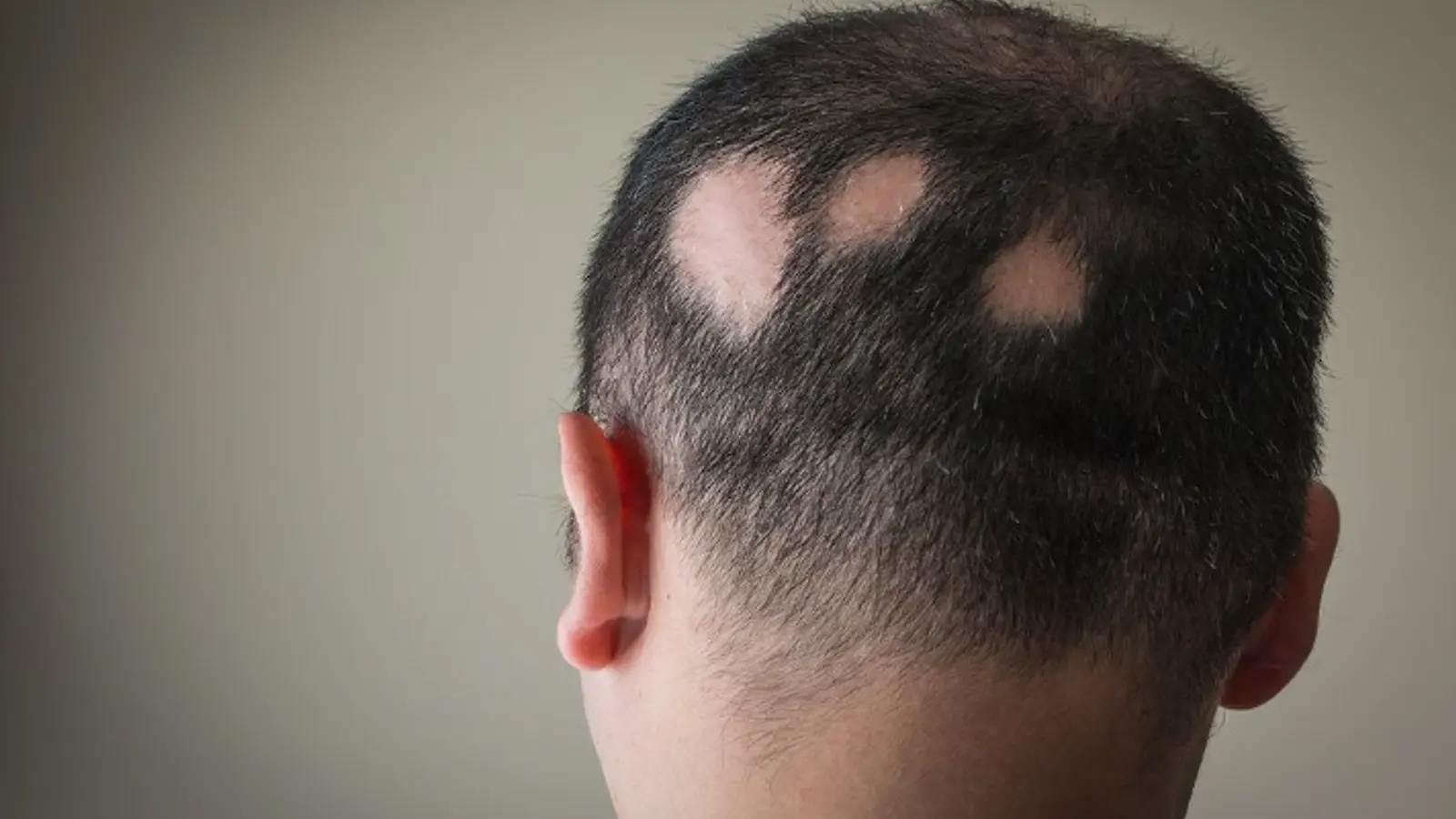
The types are defined by where the hair loss is and how extensive it is. These are the forms described in the medical sources, along with what is known about the outlook for each:
| Type | What it looks like | What is known about the outlook | Further reading |
|---|---|---|---|
| Patchy (one or more bald patches) | Smooth, round or oval bald patches about the size of a coin2 | The most common type. When hair loss is limited, hair grows back fully within a year in 4 out of 5 people, even without treatment14 | Round bald patch on the head (Hebrew) |
| Ophiasis | A band of hair loss along the hairline at the back and sides of the head12 | Considered a factor for a less favorable outlook13 | Does it go away? (Hebrew) |
| Sisaipho (inverse ophiasis) | Hair loss at the front of the head, the temples and the crown, which can look like male pattern baldness1 | The sources we read give no separate outlook data | Trichoscopy (Hebrew) |
| Diffuse / incognita | Sudden, scattered thinning across the whole scalp, without clear bald patches12 | In an Italian case series the course was good, with a response to topical steroids5 | Topical treatments (Hebrew) |
| Totalis | Loss of all scalp hair12 | Full recovery in about 1 in 10 or fewer34 | Totalis and universalis (Hebrew) |
| Universalis | Loss of all body hair, including eyebrows and eyelashes12 | As with totalis34 | Totalis and universalis (Hebrew) |
| Beard, eyebrows, eyelashes, nails | Bald patches in the beard or eyebrows, small pits in the nails14 | Nail changes are linked to more severe disease14 | Beard (Hebrew), Eyebrows and nails (Hebrew) |
The course of the disease is unpredictable: in most patients it stays patchy, but in about 5% to 10% it progresses to complete hair loss12.
See also: what causes alopecia areata
What is ophiasis, and why does it matter?
Ophiasis is a pattern in which hair falls out in a band along the edges of the scalp, at the back of the head and above the ears13.
The pattern matters because it appears on lists of factors linked to a less favorable outlook. DermNet lists it alongside young age at onset, extensive hair loss, disease lasting more than a year and nail changes1. The British guidance for primary care doctors also states that the outlook is less favorable with the ophiasis pattern3, and the British Association of Dermatologists' patient leaflet notes that hair loss along the back hairline lowers the chance of regrowth4. This is a statistic, not a verdict: mainly, it means it is worth not just waiting, and getting advice early.
See also: eyebrows, eyelashes and nails
What is sisaipho?
Sisaipho, also called inverse ophiasis (ophiasis inversus), is the mirror image of ophiasis, and the name itself is the word ophiasis spelled backward. Here the hair falls out at the front of the head, the temples and the crown, while the edges of the scalp are spared. According to DermNet, this pattern can look like hereditary male pattern baldness1.
Because of this resemblance, hair loss at the front of the head is not always male pattern baldness (Hebrew), and a doctor makes the distinction on examination. In the sources we read, we found no separate data on the outlook for sisaipho. More about the signs on the page Trichoscopy in alopecia areata (Hebrew).
What are diffuse alopecia areata and alopecia areata incognita?
These are two forms with no round bald patches, only scattered thinning. According to the American patient organization, the diffuse form causes sudden thinning across the whole scalp and is hard to diagnose because it resembles other types of hair loss2. DermNet describes both as the same picture, rapid and extensive hair loss1.
An Italian study followed, over 5 years, 107 patients with alopecia areata incognita and 25 with the diffuse form, all confirmed by biopsy5:
- Who gets it. Almost only women: 98% of the incognita group and all of the diffuse group, with an average age of about 40.
- Pace. According to the researchers, incognita develops quickly, within weeks, while the diffuse form can develop over a longer period.
- What it is confused with. Diffuse shedding (telogen effluvium) (Hebrew) and female pattern hair loss (Hebrew). In 95% of the incognita patients there was also female pattern hair loss.
- Diagnosis. According to the researchers, looking with the naked eye is not enough. The most common trichoscopy sign was empty yellow dots, and the examination helps choose where to take a biopsy.
- Course. After 8 months of a potent steroid cream, 52% of the incognita group and 60% of the diffuse group were in remission. The researchers describe a good course.
This is a single-center study without a control group, so the data are encouraging but not conclusive5.
What is the SALT score, and how do you read it?
SALT is a score that expresses what percentage of the scalp is bald, from 0 (no hair loss) to 100 (all scalp hair lost)17. A score of 30, for example, means that about a third of the scalp has no hair. How it is calculated from the four regions of the scalp is explained on the alopecia areata page.
Originally, the score was divided into grades S0 to S56:
| Grade | Percentage of scalp that is bald | Description on the new scale (IGA) |
|---|---|---|
| S0 | 0% | No hair loss |
| S1 | 1% to 24% | Limited up to 20%, moderate from 21% |
| S2 | 25% to 49% | Moderate |
| S3 | 50% to 74% | Severe |
| S4 | 75% to 99% | Severe up to 94%, very severe from 95% |
| S5 | 100% | Very severe (totalis) |
Body hair is graded separately: B0 no hair loss, B1 partial hair loss and B2 complete hair loss6. The new descriptive scale divides hair loss into "limited" (1% to 20%), "moderate" (21% to 49%), "severe" (50% to 94%) and "very severe" (95% to 100%)6.
The grade at the start is linked to the outlook. In a study that followed 191 patients for 15 to 22 years, 68% of those with grade S1 were disease-free at the end of follow-up, compared with 32% at grade S2 and 7% to 9% at grades S3, S4 and totalis8. More on the page Does alopecia areata go away? (Hebrew).
Why is SALT alone not enough, and what is the new severity scale?
Because SALT measures only the scalp. It does not take into account the eyebrows, eyelashes, body hair or the emotional impact7. Interestingly, DermNet notes that patients and dermatologists consider even a score of 40 to be severe disease1.
That is why experts developed a severity scale for clinical use (the Alopecia Areata Scale). It starts from the extent of scalp hair loss and moves the grade up one level if any of the following is present67:
- Noticeable hair loss in the eyebrows or eyelashes.
- A negative effect on emotional and social functioning.
- At least six months of treatment without a response.
- A diffuse positive pull test, meaning hairs come out easily in several places, a sign of a less favorable outlook.
According to the American patient organization, someone with 30% scalp hair loss who also has eyebrow loss would be considered to have severe disease on this scale7.
How does SALT relate to JAK inhibitor coverage in Israel?
In Israel's national health basket, severe alopecia areata is defined as one of two situations: loss of 50% or more of the scalp area (SALT 50), or loss of 21% to 49% of scalp hair with clear involvement of the eyebrows or eyelashes9. Baricitinib (Olumiant) is covered for adults, and ritlecitinib (Litfulo) for adults and children from age 12. Treatment is started with a prescription from a specialist dermatologist9.
In other words, the Israeli definition is similar to the American severity scale: eyebrows and eyelashes can move moderate disease into the severe category. That is why it is important for the medical records to document the eyebrows and eyelashes too, not just the scalp. About the medications, their effectiveness and risks, see JAK inhibitors for alopecia areata (Hebrew), and about other entitlements, see Rights and entitlements in alopecia areata (Hebrew).
How is it done at Dr. Dana Buchbut's clinic?
At the clinic in Beit HaRofim, HaBarzel 11, Ramat HaHayal, Tel Aviv:
- Dr. Dana Buchbut has practiced hair medicine since 2010.
- Diagnosis begins with a trichoscopy examination using a FotoFinder device and an assessment of the extent of hair loss. The examination takes one to two hours, and it is recommended to wash your hair beforehand.
- The examination also checks the eyebrows, eyelashes, beard and nails.
- The diagnosis and the type of hair loss are determined by a doctor on examination. A personal plan is built from there.
- When hair loss is extensive and JAK inhibitors are being considered, they are prescribed by a specialist dermatologist.
- No referral is needed, and patients under 18 are seen with a parent's consent.
More on the page Trichoscopy in alopecia areata (Hebrew).
Frequently asked questions
How many types of alopecia areata are there?
The main forms are patchy, ophiasis, sisaipho, diffuse, totalis and universalis. The patchy form, with one or more round bald patches, is the most common. The condition can also affect the beard, eyebrows, eyelashes and nails.
What is ophiasis?
Ophiasis is a pattern of alopecia areata in which a band of hair falls out along the edges of the scalp, at the back of the head and above the ears. It is considered a factor for a less favorable outlook, so it is worth getting checked early rather than just waiting.
What is diffuse alopecia areata?
It is a form with no round bald patches, only sudden, scattered thinning across the whole scalp. It resembles diffuse shedding and hereditary hair loss, so diagnosis relies on trichoscopy and sometimes a biopsy.
What is alopecia areata incognita?
It is a hidden form of alopecia areata that appears mainly in young women as rapid thinning without bald patches. In an Italian study of 107 patients the course was good, and many reached remission with a potent steroid cream.
What is the SALT score?
SALT is the percentage of the scalp that has no hair, from 0 to 100. A score of 50 means half the scalp is bald, which is the accepted threshold for severe disease. The score does not include eyebrows, eyelashes or body hair, so these are documented separately.
At what SALT score are JAK inhibitors covered in Israel's health basket?
In Israel's national health basket, coverage is for severe alopecia areata: SALT 50 or higher, or 21% to 49% with clear involvement of the eyebrows or eyelashes. Baricitinib is for adults, and ritlecitinib for adults and children from age 12, prescribed by a specialist dermatologist.
Can patchy alopecia areata turn into totalis?
It is possible but not common. In most patients the hair loss stays patchy, and according to DermNet about 5% to 10% progress to complete loss of scalp or body hair.
Does alopecia areata also affect the nails?
Yes. According to DermNet, nail changes occur in 10% to 40% of patients, mainly small pits, and they are linked to more severe disease. More details on the page about eyebrows, eyelashes and nails.
Sources
- DermNet. Alopecia areata.. dermnetnz.org
- National Alopecia Areata Foundation (NAAF). Types of alopecia areata.. www.naaf.org
- Primary Care Dermatology Society (PCDS). Alopecia areata: clinical guidance.. www.pcds.org.uk
- British Association of Dermatologists, Patient Hub. Alopecia areata.. www.skinhealthinfo.org.uk
- Alessandrini A, et al. Alopecia Areata Incognita and Diffuse Alopecia Areata: Clinical, Trichoscopic, Histopathological, and Therapeutic Features of a 5-Year Study. Dermatol Pract Concept. 2019;9(4):272-277. (PMID 31723460). pmc.ncbi.nlm.nih.gov
- King BA, et al. Defining Severity in Alopecia Areata: Current Perspectives and a Multidimensional Framework. Dermatol Ther (Heidelb). 2022;12(4):825-834. (PMID 35357658). pmc.ncbi.nlm.nih.gov
- National Alopecia Areata Foundation (NAAF). Determining alopecia areata severity.. www.naaf.org
- Tosti A, Bellavista S, Iorizzo M. Alopecia areata: a long term follow-up study of 191 patients. J Am Acad Dermatol. 2006;55(3):438-441. (PMID 16908349). pubmed.ncbi.nlm.nih.gov
- Expansion of the national health basket for 2025: circular of the Medical Technologies Division (WikiRefua). (Hebrew). www.wikirefua.org.il
Related reading
Alopecia areata
Causes, outlook and treatments, including JAK inhibitors.
ReadAlopecia areata regrowth
Signs of regrowth, white hair and how long it takes.
ReadTrichoscopy (scalp analysis)
What the magnified scalp examination shows.
ReadAlopecia areata in Tel Aviv
Diagnosis, treatment and follow-up in Tel Aviv.
ReadAlopecia totalis and universalis (Hebrew)
When all the hair falls out: outlook and treatments.
ReadDoes alopecia areata go away? (Hebrew)
What determines the outlook and when hair grows back.
ReadThe information on this page is general and for education only. It does not replace an examination, diagnosis or personal medical advice. Any decision about treatment is made only after an examination.