

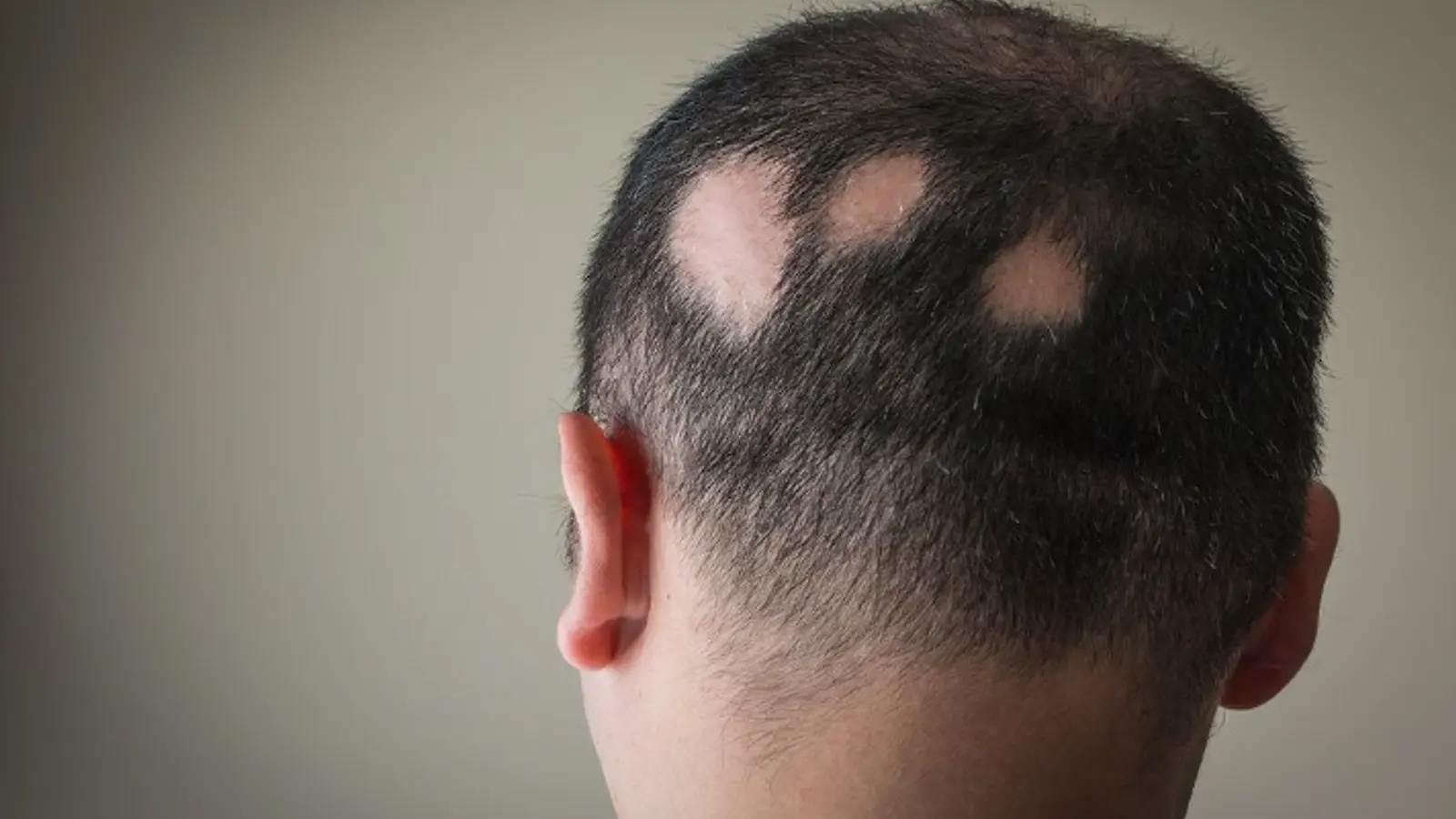
In short
- Alopecia areata is an autoimmune disease: the immune system attacks the hair follicles, but the follicles are not destroyed12.
- It has a strong hereditary component, and about 20% of people with alopecia areata have a relative with the condition13.
- It is more common in people with atopic conditions and other autoimmune diseases, such as thyroid disease and vitiligo456.
- Stress is not the cause; at most it may raise the risk in someone who is already predisposed4.
- Vitamin D and diet have been studied without proof that they cause the disease, and alopecia areata is not contagious783.
What causes alopecia areata?
Alopecia areata develops when immune cells mistakenly attack hair follicles in their growth phase, in people with a genetic tendency. Normally, a growing hair follicle sits in a kind of "protected zone" that the immune system leaves alone. In alopecia areata this protection breaks down, T cells gather around the follicle, and the hair falls out1. The follicle itself is not destroyed, which is why the hair can grow back2. A general overview of the condition, how it looks and the outlook is on the main alopecia areata page.
Put simply, there is no single cause. It is a combination of inherited susceptibility and other factors, some of which are still not understood1. The American Academy of Dermatology stresses that people with risk factors will not necessarily develop it, and that people with no known risk factor can still get it4.
Is alopecia areata hereditary?
Yes, it has a strong hereditary component, but it is not passed "directly" from parent to child. According to DermNet, at least 16 regions of the genome have been linked to the risk of the disease, most of them involved in the immune system. The inheritance pattern is complex, and environmental factors also play a role1. About 20% of people with alopecia areata have a relative with the condition39, and when it starts at a young age there is often a family member who has it as well4.
Twin studies support the genetic component: identical twins are much more likely to both be affected than non-identical twins10. Even so, most children and siblings of someone with alopecia areata will never develop it3.
Which conditions are linked to alopecia areata?
Alopecia areata is more common in people with allergic (atopic) conditions and with other autoimmune diseases. This does not mean one condition causes the other; they share an immune background. How other autoimmune diseases relate to hair loss is covered on the page Autoimmune diseases and hair loss (Hebrew).
| Condition | What is known |
|---|---|
| Eczema (atopic dermatitis) | In a meta-analysis, about 11% of people with alopecia areata also had eczema, and the link ran in both directions5 |
| Asthma and hay fever | Raise the risk of alopecia areata4 |
| Thyroid disease | More common in people with alopecia areata6; see Hair loss and the thyroid (Hebrew) |
| Vitiligo and psoriasis | Autoimmune conditions linked to a higher risk41 |
| Down syndrome | A recognized risk factor1 |
Atopy also matters for the outlook: in people who also have atopy or another autoimmune disease, the outlook tends to be less favorable1. Because of the link with thyroid disease, the doctor may suggest blood tests depending on the overall picture.
Can stress cause alopecia areata?
Emotional stress is not the cause of alopecia areata, but a crisis or intense stress may raise the risk in someone who is predisposed. This is how the American Academy of Dermatology puts it: some people remember a major stress or crisis before the bald patch appeared, and although these are not the cause of the disease, they may increase the risk4. In a French survey cited by DermNet, 65% of respondents, most of them women with alopecia totalis (Hebrew), attributed the onset or worsening of their disease to stress1. A survey like this describes how people feel; it does not prove cause and effect.
A few things worth knowing about stress and hair loss:
- It is not your fault. Even if the episode began after a hard time, you did not "cause" it, and there was no way to prevent it.
- The link also runs the other way. Alopecia areata itself causes distress, and an Israeli population study found that anxiety and depression are more common in people with the condition11. Emotional support is a legitimate part of care.
- Stress causes a different kind of hair loss too. After severe stress, illness or childbirth, diffuse shedding from the whole scalp can appear. This is called telogen effluvium (Hebrew), and unlike alopecia areata it does not create a round bald patch. The different causes of a bald spot are compared on the page A round bald patch on the scalp (Hebrew).
Is vitamin D deficiency linked to alopecia areata?
Vitamin D deficiency is more common in people with alopecia areata, but it has not been shown to cause the disease. In a 2018 meta-analysis, blood vitamin D levels were lower in people with alopecia areata than in controls, and the odds of deficiency were roughly four times higher7. Studies like this show an association, not causation: the deficiency may contribute to the disease, or it may stem from other factors. If a deficiency is found it is treated as it would be in anyone else, but a vitamin D supplement should not be seen as a treatment for alopecia areata.
Can COVID-19, other infections, smoking or medications trigger it?
Probably yes, in people who are predisposed, but the absolute risk is low. In a nationwide Korean study of more than 259,000 people who had COVID-19, compared with a similar group who had not, the rate of alopecia areata after infection was about 1.8 times higher, yet still under half a percent per year12. After COVID-19 vaccination only isolated cases have been reported, about half of them in people who had the disease before, and a systematic review concluded that it is a rare event13. This fits the overall picture: the disease comes from a combination of genetic and immune susceptibility, and an infection is at most a possible trigger.
Smoking and some medications can also raise the risk. The American Academy of Dermatology mentions two such factors: heavy, long-term smoking and a specific cancer immunotherapy drug. According to the Academy, the risk rises in people who smoked more than five cigarettes a day for ten years or more. In addition, one to two percent of patients receiving nivolumab, a drug used to treat cancer, develop alopecia areata4. If you are on such a treatment and notice a bald patch, tell your oncologist and do not stop treatment on your own.
Do diet or gluten cause alopecia areata?
There is no proof that any particular diet causes or cures alopecia areata. A 2025 review gathered 14 papers on diet in alopecia areata, most of them case reports and small series. Most dealt with a gluten-free diet in people who also have celiac disease. In this small group of 32 patients, hair grew back in some of them8. Without a control group, though, it is hard to know how much of that was due to the diet, because in alopecia areata hair often grows back on its own3.
The practical takeaway: people with celiac disease need a gluten-free diet anyway. People without celiac disease do not need to avoid gluten because of alopecia areata. A balanced diet matters for general health and for hair, but it does not replace treatment. More on what has and has not been tested: Diet and alopecia areata (Hebrew).
What do the causes mean for treatment and outlook, and what does not cause it?
Because the hair loss is driven by the immune system, most treatments for alopecia areata act on the immune system rather than on the hair itself. Steroid creams and steroid injections calm the inflammation around the follicle. The newer tablets, the JAK inhibitors, block a signaling pathway that the attacking immune cells use2. Older treatments such as contact immunotherapy also target the immune response. The options are compared on the page Alopecia areata treatment.
Some background factors are also linked to the outlook. According to DermNet, the outlook tends to be less favorable when the disease starts at a young age, when hair loss is extensive or lasts more than a year, when there are nail changes or a band of hair loss along the back and sides of the scalp (ophiasis), and when there is a family history, atopy or another autoimmune disease1. These are group statistics, not a personal forecast. For many people, especially with a first, small episode, hair grows back even without treatment3. More on this: Does alopecia areata go away? Nail pitting and loss of brows and lashes are covered on Alopecia areata of the eyebrows and eyelashes.
Alopecia areata is not contagious and is not caused by something you did. It is an immune condition, not an infection13. When a bald patch comes with scaling, redness or broken hairs, that points to a different diagnosis, such as a fungal scalp infection, which is another reason to get examined1.
When to get checked, and how is it done at Dr. Dana Buchbut's clinic?
It is worth getting examined when a new bald patch appears, when it spreads or when more patches appear, and especially when it is a child (see Alopecia areata in children). The examination confirms the diagnosis and rules out look-alike conditions, and depending on the overall picture, blood tests such as thyroid tests may be considered16.
At the clinic in Beit HaRofim, HaBarzel 11, Ramat HaHayal, Tel Aviv:
- The examination starts with trichoscopy, a magnified look at the scalp and hairs using a FotoFinder device, to confirm the diagnosis and rule out other causes of hair loss.
- The trichoscopy examination takes one to two hours, and it is recommended to wash your hair beforehand.
- No referral is needed, and patients under 18 are seen with a parent's consent.
- You receive an invoice for the consultation for private insurance, and the consultation fee is offset against treatment if you go ahead with it.
For English-speaking patients and visitors, practical details are on the page Alopecia areata in Tel Aviv.
Frequently asked questions
What is the cause of alopecia areata?
Alopecia areata is an autoimmune disease: immune cells attack hair follicles in their growth phase and the hair falls out. It develops in people with a genetic tendency, and usually there is no single cause you can point to.
Is alopecia areata hereditary?
It has a strong hereditary component. About 20% of people with alopecia areata have a relative with the condition, and at least 16 regions of the genome have been linked to the risk. Still, most relatives of someone with alopecia areata never develop it.
Can a bald patch be caused by stress?
Many people describe a stressful time before the patch appeared, but stress is not the cause of alopecia areata. The American Academy of Dermatology writes that a crisis or intense stress is not the cause but may raise the risk. It is not your fault.
Is alopecia areata contagious?
No. It is an immune condition, not an infection. You cannot catch it from another person or pass it on to others.
Does vitamin D deficiency cause alopecia areata?
A meta-analysis found that vitamin D deficiency is more common in people with alopecia areata, but studies like this do not prove that the deficiency causes the disease. If a deficiency is found, it is treated as it would be in anyone else.
Can COVID-19 or another infection cause alopecia areata?
An infection can probably act as a trigger in someone who is predisposed. In a nationwide Korean study the risk after COVID-19 was about 1.8 times higher, but still under half a percent per year. After COVID-19 vaccination only isolated cases have been reported.
Does diet affect alopecia areata?
There is no proof that any diet causes or cures alopecia areata. Most of the information concerns a gluten-free diet in people who also have celiac disease, and it comes from case reports and small series. People without celiac disease do not need to avoid gluten because of alopecia areata.
Which conditions are linked to alopecia areata?
Alopecia areata is more common in people with asthma, hay fever and eczema (atopic dermatitis), and with autoimmune conditions such as thyroid disease, vitiligo and psoriasis. It is also more common in Down syndrome.
Could the episode have been prevented?
No. There is no known way to prevent alopecia areata. People with no known risk factor can develop it, and most people with risk factors never do.
Sources
- DermNet. Alopecia areata. dermnetnz.org
- Ungar B, Renert-Yuval Y, et al. Alopecia areata. Nat Rev Dis Primers. 2025;11(1):77. doi:10.1038/s41572-025-00664-9. doi.org
- Clalit Health Services. Alopecia areata (in Hebrew). www.clalit.co.il
- American Academy of Dermatology. Alopecia areata: causes. www.aad.org
- Sun R, Kong D. Bilateral association between atopic dermatitis and alopecia areata: a systematic review and meta-analysis. Dermatitis. 2024;35(3):208-218. doi:10.1089/derm.2023.0114. doi.org
- Lee S, et al. Screening of thyroid function and autoantibodies in patients with alopecia areata: a systematic review and meta-analysis. J Am Acad Dermatol. 2019;80(5):1410-1413. doi:10.1016/j.jaad.2018.10.066. doi.org
- Lee S, Kim BJ, Lee CH, Lee WS. Increased prevalence of vitamin D deficiency in patients with alopecia areata: a systematic review and meta-analysis. J Eur Acad Dermatol Venereol. 2018;32(7):1214-1221. doi:10.1111/jdv.14987. doi.org
- Bestavros S, Huang RS, McMullen EP, Metko D, Sibbald C, Donovan J. Dietary measures as an adjunctive therapy in alopecia areata: a scoping review. Clin Exp Dermatol. 2025;50(6):1253-1255. doi:10.1093/ced/llaf047. doi.org
- National Alopecia Areata Foundation (NAAF). Alopecia areata. www.naaf.org
- Jackow C, et al. Alopecia areata and cytomegalovirus infection in twins: genes versus environment? J Am Acad Dermatol. 1998;38(3):418-25. (PMID 9520023). pubmed.ncbi.nlm.nih.gov
- Tzur Bitan D, Berzin D, Kridin K, Cohen A. The association between alopecia areata and anxiety, depression, schizophrenia, and bipolar disorder: a population-based study. Arch Dermatol Res. 2022;314(5):463-468. doi:10.1007/s00403-021-02247-6. doi.org
- Kim JS, Lee GJ, Jeong CY, et al. Risk of alopecia areata after COVID-19. JAMA Dermatol. 2024;160(2):232-235. doi:10.1001/jamadermatol.2023.5559. doi.org
- Zhu Y, Ouyang X, Zhang D, et al. Alopecia areata following COVID-19 vaccine: a systematic review. Eur J Med Res. 2024;29(1):356. doi:10.1186/s40001-024-01956-8. doi.org
Related reading
Alopecia areata
What it is, the outlook and the main treatments.
ReadAlopecia areata treatment
What works, by how much hair has been lost.
ReadDoes alopecia areata go away?
Recovery, relapses and what predicts the outlook.
ReadTypes of alopecia areata
Patchy, ophiasis, diffuse, totalis and the SALT score.
ReadAlopecia areata in Tel Aviv
Diagnosis, treatment and follow-up in Tel Aviv.
ReadHair loss from stress (Hebrew)
Round bald patches, telogen effluvium and the role of stress.
ReadThe information on this page is general and for education only. It does not replace an examination, diagnosis or personal medical advice. Any decision about treatment is made only after an examination.