

In short
- Alopecia areata often goes away and the hair grows back. According to Clalit Health Services, the disease resolves within a year in about 50% of patients1.
- The timing cannot be predicted: sometimes recovery only comes after more than a year, and no one can forecast it1.
- The most important factor for the outlook is the extent of hair loss: after 15 to 22 years of follow-up, 68% of patients with the mildest grade were disease-free, compared with 7% to 9% in the severe grades2.
- The disease can come back, and some people go through several cycles of hair loss and regrowth34.
- Even when the outlook is less favorable there are treatments, and an accurate diagnosis is the starting point for choosing between watching and treating.
Does alopecia areata go away on its own?
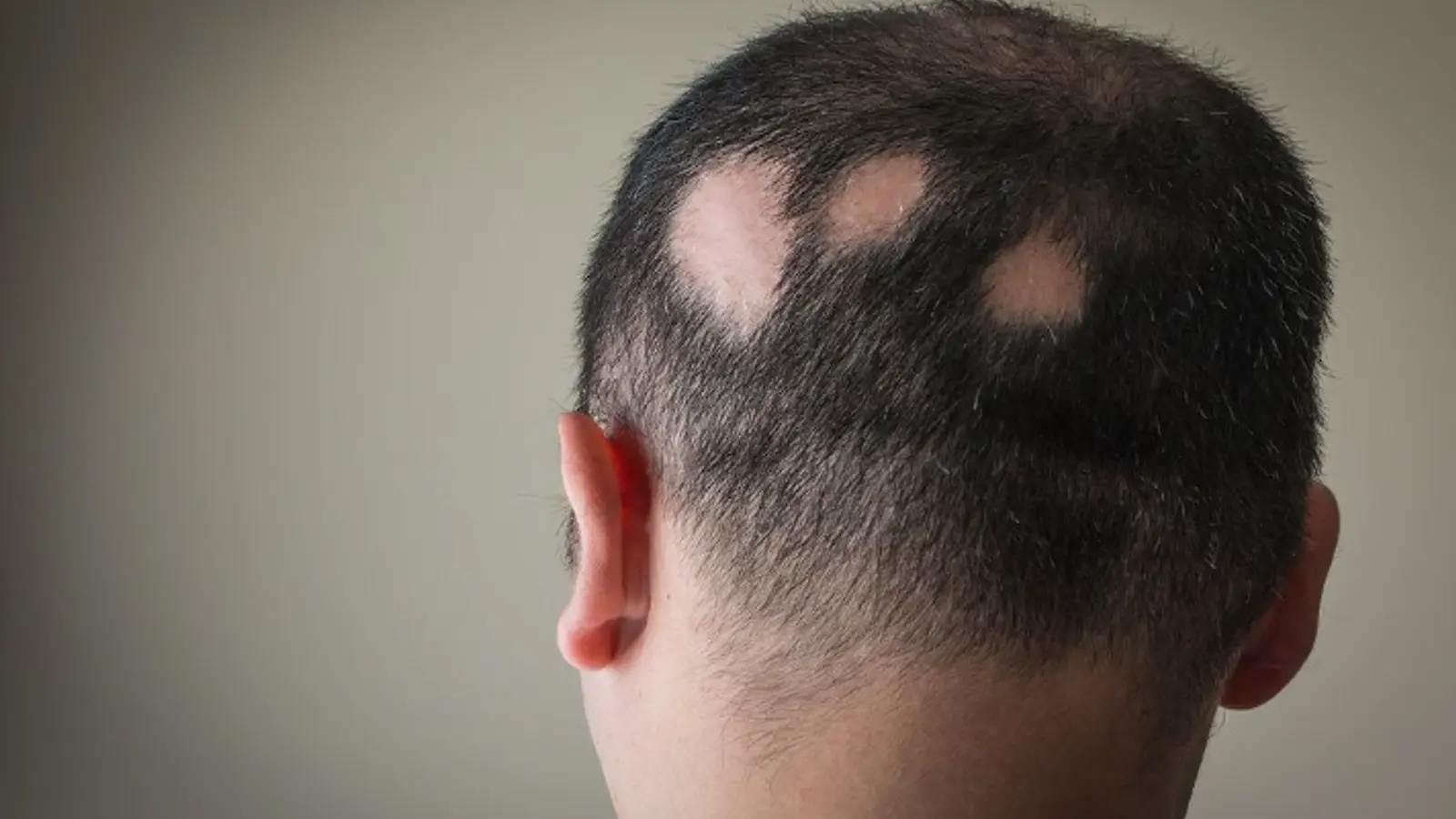
A round bald patch that appears out of nowhere makes everyone ask "will this go away?" The honest answer is that it depends. In many people the hair grows back; in others the disease persists or returns in episodes. For a large share of patients it does resolve, especially when the hair loss is limited. According to the British Association of Dermatologists, when hair loss is limited at the start, the hair grows back fully within a year in 4 out of 5 people, even without treatment. For those who lose more than half of their hair, or all of it at some point, the chance of full recovery is about 1 in 1011. Further episodes are possible even after regrowth, so follow-up is worthwhile.
According to Clalit Health Services, the disease resolves within a year in about 50% of patients, and in most people the hair regrows spontaneously in the bald area1. A population-based study from the US, which followed 292 residents diagnosed in one county over 15 years, found that spontaneous remission is expected in most patients, and that about 7% may develop severe, long-lasting disease5. DermNet also describes spontaneous regrowth as common in some reports, but notes that the disease is unpredictable and there may be several cycles of loss and regrowth3. The condition itself is explained on the main alopecia areata page.
How long does it take for the hair to grow back?
There is no single timeline, and no one can know in advance. Clalit notes that sometimes the hair only returns after more than a year, and that this uncertainty about recovery is frustrating for many patients1. When the hair does start to grow, it first appears fine and light-colored, so progress looks slow in the first weeks. How long each treatment takes to show improvement is covered on the page Alopecia areata treatment, and what early regrowth looks like is described on Signs of hair regrowth in alopecia areata.
What does regrowth look like, and how do you spot active disease?
Fine, light hairs inside the bald patch are usually a good sign, while "exclamation mark" hairs at its edges indicate that the disease is still active. According to DermNet, exclamation mark hairs are broken hairs with a thick upper part and a thin lower part, the result of the follicle suddenly stopping growth, while regrowing hair may lack pigment and come in white or blond3. In a pull test, hairs that come out easily at the edge of the patch fit with a patch that is spreading6. The difference between these states is identified more reliably with a magnified examination, see trichoscopy.
What decides whether the disease goes away?
Mainly the extent of hair loss at the start. In a study that followed 191 patients seen at a hair clinic, after 15 to 22 years the following were disease-free: 41 of 60 patients with the mildest grade (68%), 22 of 68 with grade S2 (32%), and only one of 11 with grade S3, one of 14 with grade S4 and one of 11 with alopecia totalis2. The researchers also found that among patients with severe hair loss, those who responded to contact immunotherapy had a better outlook than those who did not.
Other factors linked to a less favorable outlook: young age at onset, disease lasting more than a year, nail changes, the ophiasis pattern, a family history, and an associated autoimmune disease or atopy37. Having one or two of these does not necessarily put you in a bad position; it means it is worth following closely rather than simply waiting. The picture in children is different and has its own page: Alopecia areata in children. The different patterns are explained on Types of alopecia areata.
Why do the numbers differ from study to study?
Because each study looks at a different population. In the community study (292 county residents), 21 patients, about 7%, developed complete scalp or body hair loss at some point5. In the clinic study, 69 of 191 (about 36%) had such hair loss at the end of follow-up2. People who go to a specialist clinic may have more severe disease, and the second study relied on a telephone interview. DermNet gives a risk of about 5% to 10% of progressing to complete hair loss3. In short: most patients in the community study were mild, and more severe cases may be concentrated in clinics.
There is one more point worth knowing. A 2025 systematic review and meta-analysis that looked at the placebo groups of 15 clinical trials found that only about 8% of those patients reached at least a 30% improvement in SALT (a score of scalp hair coverage), and 1.6% reached a 90% improvement. The researchers note that earlier estimates of 34% to 50% spontaneous recovery per year, based on observational studies, probably included milder patients, for example with single patches or short-lived disease8. According to the researchers, the gap comes from different populations and definitions, so it makes sense to look at your own situation: the extent of hair loss, how long it has lasted and any history of episodes.
Can it come back after the hair has regrown?
Yes, and it is important to know this in advance. DermNet describes that patients may go through several phases of loss and regrowth, and that hair loss can return after treatment is stopped3. In a clinic follow-up study of 400 patients over 52 weeks, about 32% had a relapse, at a median of 28 weeks, and the risk was higher in those with previous episodes4. In a small retrospective series of 65 adults treated with JAK inhibitors (baricitinib or ritlecitinib), all four baricitinib responders who stopped the drug lost their hair again, on average after about 15 weeks9. Treatment planning and follow-up are discussed on the page JAK inhibitors for alopecia areata.
A relapse does not mean something was done wrong. This is an autoimmune disease, and the immune system can flare up again. Alopecia areata is not a scarring condition, so regrowth is possible even after a relapse, although the outlook is less favorable with extensive hair loss. If you have a history of episodes, a follow-up plan can be set up in advance. See also Recurrent alopecia areata (Hebrew).
Should you wait or start treatment?
With one or two patches that have been present for less than a year, waiting is a legitimate option. The American Academy of Dermatology notes that a "watch and wait" approach can suit this situation, that many people, especially children, regrow hair without treatment, and that a topical medication can be added if regrowth is not satisfactory10. When the hair loss is extensive, progressing or long-lasting, treatment is usually considered. The options by extent of hair loss are set out on Alopecia areata treatment, and on the pages about steroid injections and JAK inhibitors. In any case, treatment can speed up regrowth but does not prevent future episodes.
What is checked first, and when should you see a doctor?
First, make sure it really is alopecia areata, and only then estimate the outlook. A round bald patch can also be a fungal scalp infection, hair pulling (trichotillomania) or scarring hair loss, and each has a different course. The assessment includes a talk about the history, a magnified examination of the scalp and an estimate of how much hair has been lost, and the outlook and the choice between watching and treating follow from that. How the causes of a round bald spot are told apart is covered on A round bald patch on the scalp (Hebrew); the underlying causes are on What causes alopecia areata?
It is worth getting examined when a new bald patch appears, when the hair loss spreads, or when a patch does not improve after a few months. Other reasons to get checked: a red, itchy or scaly scalp, loss of eyebrows or eyelashes (see eyebrows and eyelashes), and nail changes. In children it is worth coming early, because the patch may be a fungal infection.
How is it done at Dr. Dana Buchbut's clinic?
At the clinic in Beit HaRofim, HaBarzel 11, Ramat HaHayal, Tel Aviv:
- The visit starts by working out the cause of the bald patch and how much hair has been lost, because these determine what you can expect.
- The examination includes a talk about your history and a trichoscopy examination of the scalp using a FotoFinder device. Trichoscopy takes one to two hours, and it is recommended to wash your hair beforehand.
- Based on this, a personal plan is made, either follow-up alone or treatment, with follow-up visits that compare the same areas over time.
- No referral is needed, and patients under 18 are seen with a parent's consent.
- You receive an invoice for the consultation for private insurance.
Practical details for English-speaking patients are on the page Alopecia areata in Tel Aviv.
Frequently asked questions
Does alopecia areata go away on its own?
In many people, yes. According to the British Association of Dermatologists, when hair loss is limited at the start, the hair grows back fully within a year in 4 out of 5 people, even without treatment. For those who lose more than half of their hair, or all of it at some point, the chance of full recovery is about 1 in 10. According to Clalit, the disease resolves within a year in about half of patients. Relapses are possible, so follow-up is worthwhile.
How long does it take for the hair to grow back?
There is no single timeline. Clalit notes that sometimes regrowth only comes after more than a year, and no one can know when it will happen. New hair first appears as fine, light hairs, so progress looks slow at first.
Will the hair that grows back be white?
Sometimes. According to DermNet, regrowing hair may lack pigment at first and come in white or blond. The color usually returns gradually.
Can alopecia areata come back after the hair has regrown?
Yes, there can be several cycles of loss and regrowth. In a study of 400 patients followed for one year, about 32% had a relapse, and the risk was higher in those with previous episodes. A new episode does not mean treatment failed, because this is a disease driven by the immune system.
What decides whether alopecia areata goes away?
Mainly the extent of hair loss. Factors linked to a less favorable outlook are young age at onset, extensive hair loss, disease lasting more than a year, nail changes, the ophiasis pattern (hair loss along the lower edges of the scalp), a family history and an associated autoimmune disease or atopy.
Should I wait or start treatment?
With one or two patches present for less than a year, the American Academy of Dermatology notes that follow-up alone is an option. With extensive or progressing hair loss, early treatment is usually considered. The decision depends on the individual case and an accurate diagnosis.
Do some people end up losing all their hair?
A minority. According to DermNet, the risk of progressing to complete scalp hair loss (totalis) or body hair loss (universalis) is about 5% to 10%. A clinic follow-up study found a higher rate, so it matters which population each number comes from.
Does treatment shorten the disease?
Treatments help speed up regrowth and, in extensive disease, bring the hair back, but no treatment prevents the disease from returning. In a small series, all four baricitinib responders who stopped the drug lost their hair again, so treatment and follow-up are planned together.
What is checked first?
First, making sure it really is alopecia areata, because round bald patches can also come from a fungal infection, hair pulling or scarring hair loss. Once the diagnosis is clear and the extent of hair loss is measured, the outlook can be estimated and the choice made between follow-up and treatment.
Sources
- Clalit Health Services. Alopecia areata (in Hebrew). www.clalit.co.il
- Tosti A, Bellavista S, Iorizzo M. Alopecia areata: a long term follow-up study of 191 patients. J Am Acad Dermatol. 2006;55(3):438-441. doi:10.1016/j.jaad.2006.05.008. doi.org
- DermNet. Alopecia areata. dermnetnz.org
- Wenjie Y, Yue W, Mengjiao W, Yumei Z, Xi H. Longitudinal clinical course, treatment outcomes, and relapse patterns in alopecia areata: a prospective cohort study. Front Med (Lausanne). 2025;12:1695618. doi:10.3389/fmed.2025.1695618. doi.org
- Safavi KH, Muller SA, Suman VJ, Moshell AN, Melton LJ 3rd. Incidence of alopecia areata in Olmsted County, Minnesota, 1975 through 1989. Mayo Clin Proc. 1995;70(7):628-633. doi:10.4065/70.7.628. doi.org
- Dhurat R, Saraogi P. Hair evaluation methods: merits and demerits. Int J Trichology. 2009;1(2):108-119. doi:10.4103/0974-7753.58553. doi.org
- Spano F, Donovan JC. Alopecia areata: part 1: pathogenesis, diagnosis, and prognosis. Can Fam Physician. 2015;61(9):751-755. (PMC4569104). pmc.ncbi.nlm.nih.gov
- Jastrząb-Miśkiewicz B, Szepietowski JC, Saceda Corralo D, Krajewski PK. Is spontaneous regrowth in alopecia areata possible: a systematic review and meta-analysis of placebo-controlled studies. Acta Derm Venereol. 2025;105:adv44153. doi:10.2340/actadv.v105.44153. doi.org
- Hayashi R, Takamura S, Fukuda T. Real-world outcomes of baricitinib and ritlecitinib in refractory alopecia areata: response predictors and relapse after discontinuation or dose reduction. J Dermatol. 2026;53:746-757. doi:10.1111/1346-8138.70241. doi.org
- American Academy of Dermatology. Alopecia areata: diagnosis and treatment. www.aad.org
- British Association of Dermatologists. Alopecia areata: patient information (skinhealthinfo.org.uk). www.skinhealthinfo.org.uk
Related reading
Alopecia areata
What it is, the outlook and the main treatments.
ReadSigns of regrowth
White hairs, tiny hairs and how long regrowth takes.
ReadAlopecia areata treatment
What works, by how much hair has been lost.
ReadWhat causes alopecia areata?
Genes, the immune system, stress and other triggers.
ReadAlopecia areata in Tel Aviv
Diagnosis, treatment and follow-up in Tel Aviv.
ReadRecurrent alopecia areata (Hebrew)
How common relapses are and what to do.
ReadThe information on this page is general and for education only. It does not replace an examination, diagnosis or personal medical advice. Any decision about treatment is made only after an examination.