

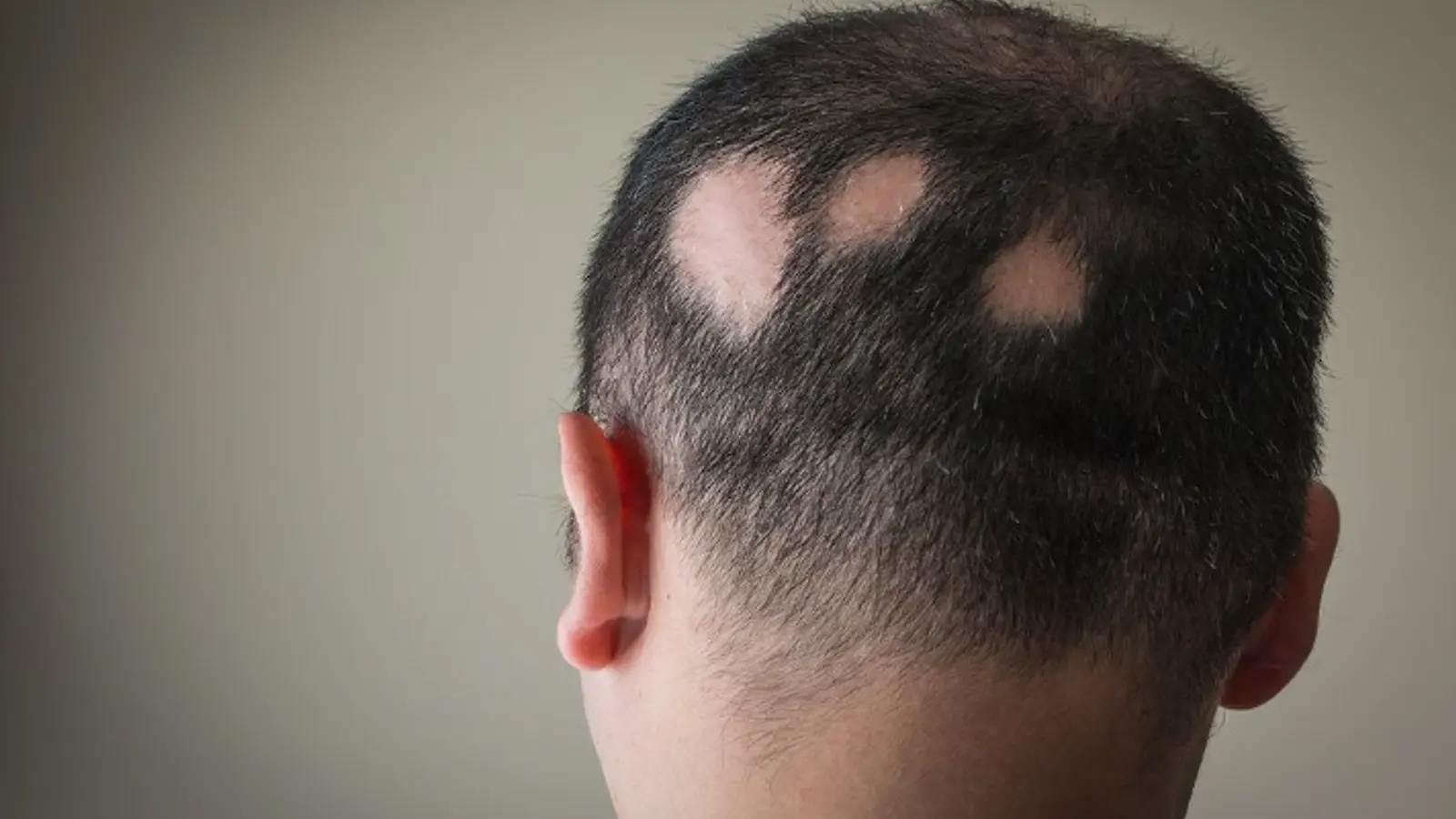
In short
- Steroid injections into the bald patch are the standard first-line treatment for adults with limited alopecia areata1.
- The injections are usually repeated every 4 to 6 weeks2.
- In a study of 127 patients, more than 80% regrew at least half of their hair within 12 weeks3.
- The most common side effect is a small dent in the skin (atrophy), which usually fades2.
- In children a steroid cream is preferred; in teenagers injections can be considered4.
Do steroid injections work for alopecia areata?
For most adults with a few bald patches, yes. The American Academy of Dermatology describes injections as the most effective treatment when there are only a few patches: in a study of 127 patients, more than 80% regrew at least half of their hair within 12 weeks3. The British Association of Dermatologists also describes injections as the most effective approach for small patches, and they are stopped once the hair has grown back10.
Injections are a local treatment. They aim to calm the immune attack around the hair follicle only in the area being treated, so their effect on the rest of the body is limited compared with tablets. The trade-off is that they require repeated clinic visits, unlike treatments you can apply at home. A comparison of all the options is on the page alopecia areata treatment, and an overview of the condition is on the main alopecia areata page. Steroid injections are also used for other scalp conditions, such as lichen planopilaris, where the goal is different: steroid injections for the scalp (Hebrew).
Who are injections suitable for?
Mainly adults with limited to moderate patches, not young children and not very extensive disease. The British guideline recommends injections as the usual first treatment for adults in this situation1. The German guideline adds that they can be considered in teenagers with moderate to severe disease, but not in children4.
When the hair loss is very extensive, for example when more than half of the scalp is involved, injections become impractical because the area to cover each time is too large. The German guideline does not recommend injections for very extensive disease, while allowing them to be considered in adults with severe disease4. In that situation doctors usually move to other approaches, such as contact immunotherapy or, in severe disease, JAK inhibitors14.
What happens during a treatment session?
It is a short clinic visit. Triamcinolone is injected into the skin as several tiny injections spread across the patch, a small amount at each point, rather than as one large injection4. A lower concentration is used for the eyebrows and beard. Mild pain or a small spot of bleeding may occur and usually settles on its own5. The timing of the next session depends on how the regrowth is progressing.
In the scalp, the German guideline recommends triamcinolone acetonide at 2.5 to 10 mg/ml, about 0.1 ml per square centimeter, injected into the skin itself, and limits the area treated at each session to no more than 100 square centimeters4. In the eyebrows and beard the skin is thinner and local side effects are more noticeable, so the guideline recommends the lower concentration, 2.5 mg/ml, and only by doctors experienced in injecting these areas4. The exact concentration depends on the area, the skin thickness and the response to previous treatment.
How often, and how many sessions?
Injections are usually repeated every 4 to 6 weeks, according to Mayo Clinic Press and other sources2. There is no fixed number of sessions: the doctor follows the regrowth and decides whether to continue, change the interval or switch to another treatment.
How long should injections be continued? The current German guideline sets two limits. If there is no response, injections should not be continued for more than three months. If there is a response, they can be continued, on an individual basis, for up to one year4.
How soon will I see results?
In the American study of 127 patients mentioned above, more than 80% regrew at least half of the hair in the treated area within 12 weeks. This figure describes a group, not any individual patient3. The response varies between people and also depends on the extent of hair loss and other prognostic factors, such as how long the disease has been present and the age at onset67.
At first it can be hard to tell "nothing yet" from "something is starting," because the first hairs to grow back may be fine, short and light, sometimes completely white, before they thicken and regain their usual color6. This is an expected stage, not a problem. More on what early regrowth looks like: signs of regrowth in alopecia areata.
Side effects: what to expect
The most common side effect is a small dent in the skin at the injection site (local atrophy), which usually fades over time. Lightening of the skin in the treated area can also occur2. If skin changes do not fade, tell your doctor.
DermNet divides the side effects of triamcinolone injected into the skin into two groups5:
- Immediate, usually short-lived: pain, minor bleeding or bruising, and rarely infection, an allergic reaction to the preservative, or an abscess.
- Delayed: a dent in the skin a few weeks after the injection (the most common effect), lighter or darker patches, and small visible blood vessels at the injection site. Some of these changes resolve, but some may persist.
Does the steroid affect the whole body? According to DermNet, systemic side effects are not expected with injections into a local lesion, because the dose is very small, and a generalized allergic reaction is very rare5. Large doses, such as injections into muscle, are a different matter, which is why guidelines limit the amount and the area treated per session4.
Does it hurt, and what about children?
There is some discomfort during the injection, which is one reason a gentler approach is preferred in children. The current German guideline does not recommend steroid injections in children at all and suggests a topical treatment instead; in teenagers, injections can be considered only for moderate to severe disease42. The American Academy of Dermatology also presents injections as an adult treatment because of the pain, and prefers a steroid cream and minoxidil for children3. More for parents: alopecia areata in children.
Needle-free injectors. Pressure (jet) injectors that deliver the drug into the skin without a needle do exist, but the evidence is limited and they do not remove the steroid's side effects. A 2023 systematic review included 37 studies of such devices in dermatology, including alopecia areata. The studies reported good efficacy and safety for triamcinolone injection without serious side effects, but according to the authors the methodological quality of most studies was low, and some of the researchers had worked with a device manufacturer8. Even without a needle the drug still enters the skin: one case report described a dent in the skin where the jet injector was used, with hair regrowth around it9. Not every clinic has such a device, so if fear of needles is a barrier, ask your doctor what options exist.
What if there is no improvement, and can injections be combined?
If there is no response after three months of treatment, the German guideline recommends stopping injections and considering another option; the same three-month limit applies to steroid creams4. Next steps, such as contact immunotherapy or JAK inhibitors for more extensive disease, are covered on the treatment page. Keep in mind that in alopecia areata hair can also grow back on its own, and that the disease can return after a successful treatment, so the decision to continue, stop or switch is reviewed at every visit67. See also does alopecia areata go away?
Combining injections with a steroid cream or with minoxidil is common and is tailored to the individual. Minoxidil does not act on the immune process itself but encourages growth, so it can be used alongside injections rather than instead of them4.
Injections versus steroid cream. The main difference is how much drug reaches the target. An injection delivers the steroid directly into the skin around the affected follicles, so its effectiveness in limited disease is considered relatively high. A cream is absorbed through the surface and reaches a lower concentration, but it is painless and better suited to children and to large areas14.
Injections in the beard and eyebrows. Steroid injections are also used in other areas affected by alopecia areata, such as the eyebrows and beard, not only the scalp. There is, however, less dedicated research on treating the beard alone than on the scalp6. On the face, thinning of the skin and other side effects are more visible than under scalp hair, so extra care and the lower concentration are needed4. Dedicated pages: alopecia areata in the beard and alopecia areata of the eyebrows and eyelashes.
How is it done at Dr. Dana Buchbut's clinic?
At the clinic in Beit HaRofim, HaBarzel 11, Ramat HaHayal, Tel Aviv:
- Injections follow a trichoscopy examination with a FotoFinder device, which assesses the extent of the patches and the state of the follicles. The examination takes one to two hours, and it is recommended to wash your hair beforehand.
- The concentration, the interval between sessions and any combination with other treatments are decided individually, and regrowth is followed at scheduled visits.
- The consultation takes from 15 minutes to two hours. An invoice is provided for private insurance, and the consultation fee is offset against treatment if you go ahead.
- No referral is needed, and patients under 18 are seen with a parent's consent.
It is worth being examined before starting injections, and again if side effects do not fade, if there is no improvement after a few months, or if the hair loss spreads. Practical details for visitors are on the page alopecia areata care in Tel Aviv.
Frequently asked questions
Do steroid injections work for alopecia areata?
For most adults with a few bald patches, yes. According to the American Academy of Dermatology, in a study of 127 patients more than 80% regrew at least half of their hair within 12 weeks. Injections are usually given every 4 to 6 weeks.
Do the injections hurt?
There is some discomfort during the injection itself, because it goes directly into the skin of the scalp. How much it hurts varies between people and depends on the area treated.
How many injections will I need?
It is an ongoing process, not a one-off treatment. Injections are usually repeated every 4 to 6 weeks, and the total number of sessions depends on how each patient responds.
When does hair start to grow after injections?
In a study of 127 patients, more than 80% regrew at least half of the hair in the treated area within 12 weeks. Regrowth is gradual, and the first hairs may be fine and white before they darken.
Is the small dent in the skin after an injection permanent?
Usually not. It is the most common side effect and it usually fades over time, but it can sometimes persist. Tell your doctor about a dent that does not improve.
Can children have steroid injections for alopecia areata?
The current German guideline does not recommend steroid injections in children and prefers a steroid cream. In teenagers, injections can be considered for moderate to severe disease.
Can steroid injections be used for eyebrows or a beard?
Yes. Injections are also used in the eyebrows and beard when they are affected, with a lower concentration (2.5 mg/ml) because the skin is thinner and side effects are more visible.
Does the steroid from the injection go into the whole body?
The injection is local, into the bald patch, and is not comparable to a steroid tablet or infusion that acts on the whole body. According to DermNet, systemic side effects are not expected because the dose is very small.
How long should injections be continued?
According to the current German guideline, if there is no response they should not be continued for more than three months. If there is a response, they can be continued on an individual basis for up to one year.
Is there a needle-free option?
Needle-free pressure injectors exist. A 2023 systematic review found positive reports on efficacy and safety, but most studies were of low quality. A dent in the skin can still occur, and not every clinic has such a device.
Sources
- Harries MJ, et al. British Association of Dermatologists living guideline for managing people with alopecia areata 2025. Br J Dermatol. 2026;194(2):e56-e73. doi:10.1093/bjd/ljaf452. doi.org
- Mayo Clinic Press. How is alopecia areata treated?. mcpress.mayoclinic.org
- American Academy of Dermatology. Alopecia areata: diagnosis and treatment. www.aad.org
- Blume-Peytavi U, et al. S3 guideline diagnostics and therapy in alopecia areata, Part 2: therapy, psychosocial and cosmetic support. J Dtsch Dermatol Ges. 2026. PMC13435026. pmc.ncbi.nlm.nih.gov
- Lin CY. Intralesional steroid injection. DermNet. dermnetnz.org
- DermNet. Alopecia areata. dermnetnz.org
- Tosti A, Bellavista S, Iorizzo M. Alopecia areata: a long term follow-up study of 191 patients. J Am Acad Dermatol. 2006;55(3):438-41. doi:10.1016/j.jaad.2006.05.008. doi.org
- Bekkers VZ, Bik L, van Huijstee JC, Wolkerstorfer A, Prens EP, van Doorn MBA. Efficacy and safety of needle-free jet injector-assisted intralesional treatments in dermatology: a systematic review. Drug Deliv Transl Res. 2023. doi:10.1007/s13346-023-01295-x. doi.org
- Kaliyadan F, Alkhateeb A, Swaroop K. Localized atrophy with surrounding hair growth in a case of alopecia areata treated with intralesional steroids, using a needle-less injector. Indian J Dermatol Venereol Leprol. 2018. doi:10.4103/ijdvl.IJDVL_297_17. doi.org
- British Association of Dermatologists, Patient Hub. Alopecia areata. www.skinhealthinfo.org.uk
Related reading
Alopecia areata
Causes, outlook and treatments, including JAK inhibitors.
ReadAlopecia areata treatment
Which treatment fits which extent of hair loss.
ReadJAK inhibitors for alopecia areata
Baricitinib and ritlecitinib: who they are for, results and risks.
ReadSigns of regrowth
White hairs, tiny hairs and how long regrowth takes.
ReadAlopecia areata in Tel Aviv
Diagnosis, treatment and follow-up in Tel Aviv.
ReadCreams and topical treatments (Hebrew)
Steroid creams, minoxidil and other topical options.
ReadThe information on this page is general and for education only. It does not replace an examination, diagnosis or personal medical advice. Any decision about treatment is made only after an examination.