

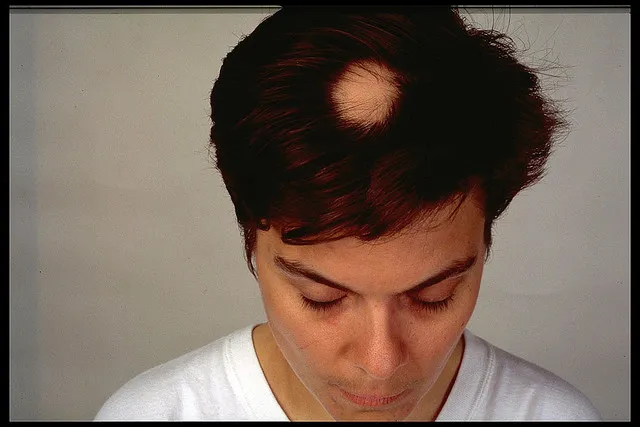
In short
- Regrowing hair usually appears first in the center of the patch, as fine white hairs that darken over time32.
- Under magnification, upright regrowing hairs and coiled (pigtail) hairs are linked to regrowth, while black dots and "exclamation mark" hairs are linked to active disease89.
- Without treatment, hair can grow back within months and, rarely, only after years3. With steroid injections, when they work, regrowth is usually seen within 3 months11.
- With JAK inhibitors, some patients respond by week 12 and some only after six months or more12.
- A new patch can appear while the old one fills in, and relapses are common12.
What does hair look like when it starts growing back in a bald patch?
Usually not like the hair that fell out. According to the British Association of Dermatologists' leaflet, regrowth usually starts in the center of the patch, with fine white hairs that later darken to the usual color3. The American Academy of Dermatology writes that hair may grow back white or blond and finer than before, that this is usually temporary, and that with time, and sometimes with the right treatment, the natural color and texture often return2. The US National Institute of Arthritis and Musculoskeletal and Skin Diseases (NIAMS) also describes hair that at first looks white or gray and may regain its color1.
The explanation, according to DermNet: the first hairs to grow back may lack pigment, so they are white or light-colored4. In other words, white "fuzz" inside a bald patch is usually a good sign, not a new disease. There is a separate page on the chance that hair will grow back and what determines it: Does alopecia areata go away? (Hebrew).
Why is there white hair in the patch, and will it stay white?
White hair inside an alopecia areata patch has more than one explanation. A large retrospective study from China, published in 2026 and including 5,155 patients, found disease-related white hair in 16% of them, and in 44.4% of patients aged 55 and over. The researchers described three mechanisms5:
- Growth of white vellus hairs. This is what is usually seen at the start of regrowth.
- Dark hairs that lose their color. A dark hair can turn white in place.
- Gray hairs that remain. In people who already have gray hair, the gray hairs can stay in the patch while the dark hairs fall out.
The study observed both loss and return of color. Of 432 patients with white hair who were followed over time, 81.7% recovered after treatment5. Still, the color does not always return: there are reports of an area where the hair stayed white after alopecia areata, and researchers believe this is more common than reported6. There is no way to know in advance who this will happen to.
Which signs under magnification point to regrowth, and which to active disease?
With the naked eye you mostly see "hair or no hair." A trichoscopy examination shows the shape of the hairs, which helps estimate where the patch is heading. In a trial in which 65 patients with bald patches were examined under magnification two months after starting treatment and classified after six months, these differences were found9:
| Sign under magnification | What it looks like | What it usually means | At two months: responders vs. non-responders |
|---|---|---|---|
| Upright regrowing hairs | A pointed tip that thickens toward the root, thicker than vellus hairs8 | Regrowth | 100% vs. 55% |
| Short coiled hairs (pigtail) | Short, regularly coiled hairs with a pointed tip8 | Regrowth | 33% vs. 8% |
| Black dots | A dark hair broken off at skin level8 | Active disease | 11% vs. 50% |
| "Exclamation mark" hairs | Short hairs, 1-2 mm long, thick at the tip and thin at the base8 | Active disease | 19% vs. 61% |
| Broken hairs | Broken hairs inside the patch | Active disease | 22% vs. 68% |
| Tapered hairs | Longer "exclamation mark" hairs, over 2 mm8 | Active disease | 0% vs. 29% |
Note the first row: new upright hairs were also found in more than half of those who did not respond in the end. In other words, a few new hairs do not yet guarantee that the patch will fill in. The researchers built a score from these signs, and the more regrowth signs and the fewer activity signs, the higher the chance of regrowth9. A systematic review points out that no single sign is diagnostic on its own, and that several signs are relied on together7. All the signs of the disease, and how it differs from hair pulling and fungal infection, are covered on the page Trichoscopy in alopecia areata (Hebrew).
How can you tell that regrowth is "real"?
The key sign is that the hairs thicken and gain color, not just that they appear. In a Polish study of 35 patients with alopecia totalis or universalis, the scalp was examined under magnification 6 weeks after starting treatment, and the response was determined after 4 months. Pigmented vellus hairs were found in 94% of responders compared with 11% of non-responders, and pigmented upright hairs in 100% compared with 28%. Coiled hairs did not distinguish between the groups in this study10.
In practice, look for three things over several weeks: the hairs get longer, thicker and darker. White vellus hairs that stay the same for months, or a patch whose edges keep spreading, are a reason for another examination.
How long does it take for hair to grow back after alopecia, with and without treatment?
There is no single timeline, but there are ranges worth knowing:
| Situation | What is known about timing |
|---|---|
| Without treatment | Hair can grow back over months, and rarely over years. When hair loss is limited, hair grows back fully within a year in 4 out of 5 people3. According to the American Academy of Dermatology, hair may grow back on its own within about a year2 |
| Steroid injections into the patch | When they work, regrowth is usually seen within 3 months of the first injection, and they are repeated every 4 to 6 weeks11 |
| Baricitinib (JAK inhibitor), hair loss of 50% or more | At the 4 mg dose: 33% reached at least 30% improvement by week 12, another 28% between weeks 12 and 36, and another 8% between weeks 36 and 52. In 31% there was no such improvement within a year12 |
| Ritlecitinib (JAK inhibitor) | After 24 weeks, about a quarter of patients reached at least 80% scalp coverage, and after a year more than 40%4 |
In an analysis of the baricitinib trials, early responders reached the full result faster, and an early response was more common when the initial hair loss was less complete. A response at all was more common when the hair loss had lasted less than 4 years12. In other words, no improvement in the first months of a JAK inhibitor does not necessarily mean it will not work. JAK inhibitors are prescribed by a specialist dermatologist. Details on each treatment: steroid injections (Hebrew), JAK inhibitors (Hebrew) and treatment of alopecia areata (Hebrew).
See also: Does alopecia areata go away? · JAK inhibitors for alopecia areata · steroid injections for alopecia areata
Why does a new patch appear while the old one is filling in?
Because the disease is not active across the whole scalp at the same time. NIAMS describes that hair sometimes grows back in the first patch while new patches form, and that it is hard to predict what will happen after a patch appears1. According to the American Academy of Dermatology, unpredictable patchy hair loss is a common feature of the disease, and the time between episodes varies2. That is why it is worth tracking each patch separately: one can be in a regrowth phase and another in an active phase.
Can hair fall out again after it has grown back?
Yes. The American Academy of Dermatology writes that many people have a relapse within a year of regrowth, and that most relapses occur within 5 years. Some people never have another episode2. According to the British Association of Dermatologists, most people will have further episodes of alopecia areata, and there is a risk of new patches in the future3. DermNet adds that hair loss may return when treatment is stopped4.
A relapse does not erase what the previous treatment achieved, but it is a reason to get checked again and decide anew. On relapses and the factors linked to them, see Does alopecia areata go away? (Hebrew).
When should treatment be reassessed, and how can you track progress at home?
It is worth coming back for an examination when a patch keeps spreading, when new patches appear, or when there is no regrowth within the time a treatment should show results. For example, with steroid injections, regrowth is usually seen within 3 months when the treatment works11. The decision to continue, adjust or switch treatment is made with the treating doctor.
Photos help you notice slow changes that are hard to remember. Photograph the same area, in the same place and the same lighting, every few weeks. A detailed guide is on the page How to photograph your hair for tracking (Hebrew).
How is it done at Dr. Dana Buchbut's clinic?
At the clinic in Beit HaRofim, HaBarzel 11, Ramat HaHayal, Tel Aviv:
- Dr. Dana Buchbut has practiced hair medicine since 2010.
- Follow-up is done with a trichoscopy examination using a FotoFinder device. The examination takes one to two hours, and it is recommended to wash your hair beforehand.
- At follow-up visits, the same areas are examined under magnification to see whether the new hairs are thickening and gaining color.
- The diagnosis and the decision on continuing treatment are made by a doctor on examination.
- No referral is needed, and patients under 18 are seen with a parent's consent.
More about the condition on the main alopecia areata page.
Frequently asked questions
What are the first signs that hair is growing back in alopecia areata?
Usually small, fine, white or light-colored hairs that appear in the center of the bald patch. Over time they get longer, thicker and darker. Under magnification, new upright regrowing hairs can also be seen.
Why does hair grow back white in the patch?
The first hairs to grow back after alopecia areata may lack pigment. According to the American Academy of Dermatology this is usually temporary, and the natural color often returns. In some people the hair in the area stays white.
Is white hair in an alopecia areata patch a good or bad sign?
White vellus hairs inside a bald patch are usually a sign that regrowth is starting. What matters is that they thicken and darken over the following weeks. In older adults with gray hair, gray hairs can also simply remain in the patch while the dark hairs fall out.
How long does it take for hair to grow back after alopecia?
Without treatment it can take months, and rarely years. When hair loss is limited, hair grows back fully within a year in 4 out of 5 people. With steroid injections, when they work, regrowth is usually seen within 3 months.
There are tiny hairs in the patch. Does that mean the alopecia is going away?
It is an encouraging sign, but not a guarantee. In a study of 65 patients, new upright hairs were also found in more than half of those who did not respond to treatment in the end. It is important to see the hairs thicken and darken, and the edges of the patch not spread.
Why does a new patch appear when the old one is already filling in?
In alopecia areata the disease acts in patches, not across the whole scalp at once. So one patch can fill in while another is starting. This does not mean regrowth in the first patch will stop.
My hair grew back. Can it fall out again?
Yes. According to the American Academy of Dermatology, many people have a relapse within a year, and most relapses occur within 5 years. Some people never have another episode.
How long do JAK inhibitors take to regrow hair?
It varies. In the baricitinib trials at the 4 mg dose, a third of patients improved by at least 30% by week 12, and others only after week 12 or even after week 36. The medications are prescribed by a specialist dermatologist.
Sources
- National Institute of Arthritis and Musculoskeletal and Skin Diseases (NIAMS). Alopecia Areata: overview.. www.niams.nih.gov
- American Academy of Dermatology. Hair loss types: Alopecia areata overview.. www.aad.org
- British Association of Dermatologists. Alopecia areata: patient information leaflet (skinhealthinfo.org.uk).. www.skinhealthinfo.org.uk
- DermNet. Alopecia areata.. dermnetnz.org
- Zhang X, et al. Alopecia areata-associated white hair growth can occur independent of follicular cycling. Br J Dermatol. 2026. doi:10.1093/bjd/ljag303 (PMID 43006142). doi.org
- Jalalat SZ, Kelsoe JR, Cohen PR. Alopecia areata with white hair regrowth: case report and review of poliosis. Dermatol Online J. 2014. doi:10.5070/d3209023902 (PMID 25244170). pubmed.ncbi.nlm.nih.gov
- Waśkiel A, Rakowska A, Sikora M, Olszewska M, Rudnicka L. Trichoscopy of alopecia areata: An update. J Dermatol. 2018;45(6):692-700. (PMID 29569271). pubmed.ncbi.nlm.nih.gov
- Sibbald C. Alopecia Areata: An Updated Review for 2023. J Cutan Med Surg. 2023;27(3):241-259. (PMID 37340563). pmc.ncbi.nlm.nih.gov
- Waśkiel-Burnat A, et al. Alopecia areata predictive score: A new trichoscopy-based tool to predict treatment outcome in patients with patchy alopecia areata. J Cosmet Dermatol. 2020;19(3):746-751. (PMID 31301100). pubmed.ncbi.nlm.nih.gov
- Waśkiel-Burnat A, Rakowska A, Sikora M, Olszewska M, Rudnicka L. Pigmented vellus and upright regrowing hairs as the only predictive trichoscopic markers of hair regrowth in alopecia totalis and universalis. Dermatol Rev. 2019;106(2):150-158. doi:10.5114/dr.2019.83937. termedia.pl
- American Academy of Dermatology. Alopecia areata: diagnosis and treatment.. www.aad.org
- King B, et al. When to expect scalp hair regrowth during treatment of severe alopecia areata with baricitinib: insights from trajectories analyses of patients enrolled in two phase III trials. Br J Dermatol. 2023;189(6):666-673. (PMID 37708254). doi.org
Related reading
Alopecia areata
Causes, outlook and treatments, including JAK inhibitors.
ReadTypes of alopecia areata
Patchy, ophiasis, diffuse, totalis and the SALT score.
ReadTrichoscopy (scalp analysis)
What the magnified scalp examination shows.
ReadAlopecia areata in Tel Aviv
Diagnosis, treatment and follow-up in Tel Aviv.
ReadDoes alopecia areata go away? (Hebrew)
What is known about recovery, relapses and the outlook.
ReadSteroid injections for alopecia areata (Hebrew)
How it is done, how often and side effects.
ReadThe information on this page is general and for education only. It does not replace an examination, diagnosis or personal medical advice. Any decision about treatment is made only after an examination.