

In short
- What it is: local freezing of the keloid with liquid nitrogen, which has a temperature of minus 196 degrees Celsius2.
- Who it suits: mainly small keloids, and keloids that are relatively new and red13.
- Combining with injections: freezing before a steroid (Kenalog) injection softens the tissue, which makes the injection easier. In a small controlled study the combination worked better than either treatment alone14.
- The main risk: a light patch on the skin, which can be permanent, mainly in darker skin15.
- How many treatments: usually a series. The American Academy of Dermatology notes that the best results are seen after three or more treatments1.
- Who performs it: Dr. Dana Buchbut, physician (M.D.), performs the treatment herself.
What is keloid cryotherapy and how does it work?
Freezing that damages the excess tissue of the scar. Cryotherapy uses liquid nitrogen, the most common and most effective agent for in-office freezing. The cold forms ice crystals inside the cells and damages the small blood vessels that feed the tissue2. In a keloid, where cells keep producing excess collagen even after the wound has closed, this damage may slow the growth and lead to gradual softening and flattening of the scar67.
The American Academy of Dermatology (AAD) describes freezing as a treatment that can reduce the hardness and size of a keloid, and notes that it works best on small keloids1. In the British Association of Dermatologists' guidance, freezing is listed as an option on its own or combined with other treatments5.
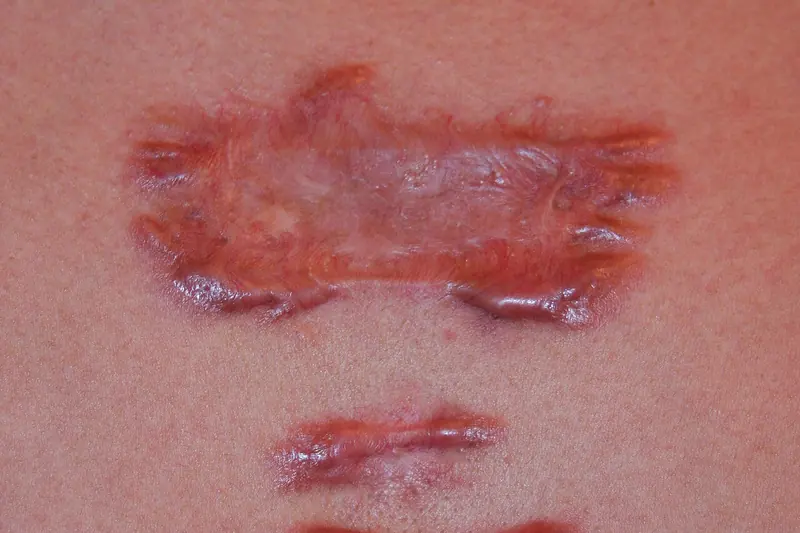
What types of freezing are there?
From the outside, or from the inside. There are two main approaches:
- Contact or spray freezing: the nitrogen is sprayed onto the surface of the keloid, or applied through a probe that touches it, for a few seconds. This is the common method. It mainly freezes the upper layers, so a thick keloid sometimes needs several treatments28.
- Freezing from the inside (intralesional): a special needle is inserted along the keloid, and the nitrogen flows through it and freezes the tissue from within. At the clinic, Dr. Dana Buchbut performs both methods herself: external freezing and intralesional needle freezing, depending on the type and location of the keloid. One of the early studies of this method was done in Israel, at Carmel Medical Center in Haifa. In that study, in a small number of patients, a reduction in scar volume was measured after a single treatment, with no permanent color change over a year and a half of follow-up8.
The AAD describes freezing that works "from the inside out" and spares the skin beneath the keloid1. In any case, the method, the freezing time and the number of cycles are set according to the keloid's size, thickness and location.
Why is freezing combined with a Kenalog injection?
Because the keloid softens after freezing, so the injection goes in and spreads better. A keloid is hard, dense tissue, and it is sometimes difficult to inject into it. After brief freezing the tissue swells and softens. The AAD recommends freezing before or after steroid injections, and notes that it may shrink the keloid and improve the effect of the injections1.
In a controlled study from Singapore, patients with several keloids received different treatments on different keloids: freezing alone, a steroid injection alone, or both. The combination reduced keloid thickness more than either treatment alone, and itching decreased with the combination and with the injection alone4. The study was small, so it shows a direction rather than final proof.
A 2026 meta-analysis that included 13 studies found that combining freezing and steroids led to more good responses than other treatments, but no significant difference was found in the average improvement of the scar. The researchers wrote that the combination is a reasonable alternative to first-line treatments, and that recommendations should be cautious and tailored to each patient9. On the injections themselves, see Kenalog injections for keloids.
Who is freezing suitable for, and who less so?
It mainly suits a small, new keloid, and is less suitable for darker skin. In a UK study comparing freezing with steroid injections in keloids after acne, freezing worked better in early, red keloids that still have many blood vessels3.
| Situation | What is important to know |
|---|---|
| Small keloid | Freezing works best on small keloids1 |
| New, red keloid | In a comparative study it responded to freezing better than an older keloid3 |
| Darker skin | Risk of a light patch that can be permanent. Sometimes it is better to skip freezing12 |
| Sensitivity to cold | Freezing is not done in Raynaud's syndrome, cold urticaria or cryoglobulinemia2 |
| After keloid excision | Freezing can be used as an add-on treatment, usually about two weeks after the stitches are removed1 |
For a very large keloid, freezing alone is usually not enough, and it is combined with other treatments7. On ear keloids, see ear keloid.
What is the treatment like, and how many treatments are needed?
A few minutes at the clinic, and a series of treatments a few weeks apart. The area is cleaned, and the keloid is frozen for a few seconds, sometimes in two freeze-thaw cycles. You feel intense cold and a brief stinging or pain. When combined with an injection, it is usually given at the end of the same visit, after the tissue has softened.
In the controlled study described above, treatments were given at least three times, four weeks apart4. The AAD notes that patients who have three or more freezing treatments usually get the best results1. The actual number of treatments is set according to the response at each visit.
Side effects of keloid cryotherapy
Most are temporary. The most important is a change in color.
- Pain and burning during freezing and in the hours afterward.
- Swelling and a blister: common in the first few days. The blister dries into a scab and usually heals within one to two weeks2.
- A light patch (hypopigmentation): can be permanent, mainly in darker skin15.
- A dark patch, temporary, around the area.
- Slow healing or infection: uncommon. Spreading redness, fever or pus are a reason to get in touch.
During healing, keep the area clean, do not pick the scab, and protect the skin from the sun.
How is it done at Dr. Dana Buchbut's clinic?
The keloid and the skin are examined, and together you decide whether freezing is suitable. Dr. Dana Buchbut, physician (M.D.), assesses the keloid's size, thickness and location, asks about previous treatments and how it responded to them, and explains the risk of a color change, especially in darker skin. Liquid nitrogen freezing is done on its own for a small keloid, or before a steroid injection in the same visit. When the keloid is resistant, 5-FU and Kenalog can also be combined. Dr. Dana Buchbut performs the treatment herself, at the clinic in Ramat HaHayal, Tel Aviv, and the response and the surrounding skin are checked at every visit. After the series, follow-up is scheduled, because a keloid can come back. General information on the page keloid scar.
Frequently asked questions
What is keloid cryotherapy?
It is local freezing of the keloid tissue with liquid nitrogen. Freezing damages the scar's cells and blood vessels, and over time the keloid may soften and flatten.
Does keloid freezing hurt?
You feel intense cold and a brief stinging or pain during freezing, and sometimes burning in the hours afterward. The freezing itself lasts seconds.
How many freezing treatments does a keloid need?
Usually a series of several treatments, a few weeks apart. The American Academy of Dermatology notes that the best results are seen after three or more treatments.
Why freeze before a Kenalog injection?
Because after freezing the tissue softens and swells, which makes the injection easier. In a small controlled study the combination reduced keloid thickness more than either treatment alone.
Does freezing leave a white patch?
It is possible. A light patch is the important side effect of freezing, and it can be permanent, mainly in darker skin. That is why it is discussed before treatment.
Can a keloid come back after freezing?
Yes. Keloids tend to come back even after successful treatment, so follow-up continues after the series, sometimes with silicone or pressure.
Can an ear keloid be frozen?
Yes, freezing is also used for ear keloids, alone or together with injections. When the keloid is large, it is sometimes combined with excision and add-on treatment.
Keloid scar
What a keloid is, why it comes back and which treatments exist.
Read moreKenalog injections for keloids
How the injections work, how many are needed and what the side effects are.
Read more5-FU and Kenalog for keloids
When 5-FU is added to the injection and who it suits.
Read moreEar keloid
Keloid after a piercing: what to do and how to prevent recurrence.
Read moreKeloids on the chest and shoulders
Why keloids in these areas are especially stubborn.
Read moreWart freezing with liquid nitrogen
How in-office freezing works and what recovery is like.
Read moreThe information on this page is general educational information only and is not a substitute for an examination, diagnosis or personal medical advice. A decision about treatment is made only after an examination.